
Net for a Rectangular Prism by Daryl Cox
Loading the math board and drawing, please wait…
In collections
Surface Area Discovery
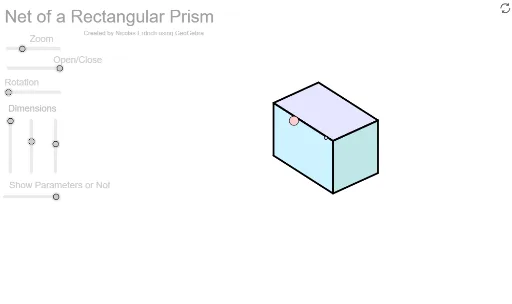
This example demonstrates the net of a rectangular prism and its properties, involving core math concepts like solid geometry, polygon construction, and vector operations. It utilizes GeoGebra commands such as Sequence, Element, Polygon, and Segment, along with objects like z, R_z, a, echelle, P, β, sinβ, cosβ, R_y, α, sinα, cosα, R_x, I, u, v, w, Mat, cube, cube', alpha, texte1, texte2, AE, droite, listepoints, A, E, C_1, D, poly1, a_1, b, c_1, d, B, F, G, H, poly2. Suitable for high school students to understand spatial geometry and geometric constructions, or for educational demonstrations.
GeoGebra Commands & Parameters
Sequence((Mat * Element[cube, k]), k, 1, 8) → cube'Element(Element[AE, 3], 1) → droiteSequence(I + (Element[cube', k, 1, 1], Element[cube', k, 2, 1]), k, 1, 8) → listepointsElement(listepoints, 2) → AElement(listepoints, 1) → EElement(listepoints, 4) → C_1Element(listepoints, 3) → DPolygon(A, E, C_1, D) → poly1, a_1, b, c_1, dElement(listepoints, 6) → BElement(listepoints, 7) → FElement(listepoints, 8) → GElement(listepoints, 5) → HPolygon(B, F, G, H) → poly2, e, f, g, hElement(listepoints, 3) → CPolygon(F, C, A, B) → poly3, f_1, i, a_2, b_1Element(AB, 3, 1) → avantPolygon(C_1, G, H, E) → poly4, c_2, g_1, h_1, e_1Element(AC, 3, 1) → dessusPolygon(F, C, C_1, G) → poly5, f_2, c_3, c_4, g_2Polygon(A, B, H, E) → poly6, a_3, b_2, h_2, e_2Segment(E, A) → cSegment(A, C) → jSegment(A, B) → kSegment(C, C_1) → lSegment(C_1, E) → mSegment(A, B) → pSegment(B, H) → qSegment(H, E) → rSegment(H, G) → sSegment(B, F) → tSegment(G, C_1) → d_1Segment(F, G) → i_1Segment(F, C) → j_1Polygon(A, B, F', D') → poly7, a_4, b_3, f', d'Polygon(E, A, D'', C') → poly8, e_3, a_5, d'', c'Polygon(B, F'', G', H) → poly9, b_4, f'', g', h_3Polygon(H, G'', C''', E) → poly10, h_4, g'', c''', e_4Polygon(A_2, B_2, G'', C''') → poly11, a_6, b_5, g''_1, c'''_1
AI Drawing Prompt Reference
Draw the net of a rectangular prism, consisting of six connected rectangular faces arranged in a cross shape, with labeled edge lengths and angles to demonstrate its 3D structure. Start by sketching the base rectangular prism, then unfold it into a flat net by sequentially connecting the vertices to form each face, and finally label the key points, edges, and angle measures for clarity.
The prompt above was compiled from the original drawing commands and is for reference only.