
3-D Pyramids GeoGebra Demo
Loading the math board and drawing, please wait…
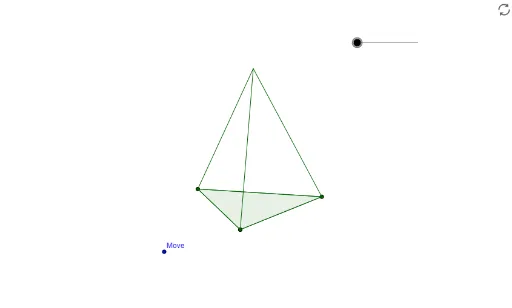
This example dynamically demonstrates the construction and properties of 3-D pyramids using GeoGebra. It involves core math concepts like solid geometry, vectors, polygon construction, and parametric equations. Key GeoGebra commands/objects used include Vector, Sequence, Conic, and Polygon. Suitable for high school students and math enthusiasts to understand spatial geometry and geometric constructions.
GeoGebra Commands & Parameters
Vector(B, E) → uVector(B, C) → vVector(B, D) → wSequence(F - ((sin(i) * w) + (cos(i) * u)), i, 0, α, α / h) → list1Sequence(Segment[Element[list1, i], I], i, 0, h) → list2Conic(Element[list1, 1], Element[list1, 10], Element[list1, 3], Element[list1, 15], Element[list1, 5]) → kSequence(Segment[Element[list1, i], Element[list1, i + 1]], i, 0, h) → list3Polygon(list1) → poly1
AI Drawing Prompt Reference
Create a dynamic demonstration of a 3D pyramid to show its construction and properties. Start by creating three vectors for the pyramid's lateral edges, then use sine and cosine functions combined with vectors to generate a series of points. Draw the pyramid's sides and base using these points, and finally connect them to form the pyramid's outline. The process involves vectors and parametric equations, suitable for understanding spatial geometry and geometric constructions.
The prompt above was compiled from the original drawing commands and is for reference only.