
Net and Surface Area of a Cylinder by Math Team - EnergyTech
Loading the math board and drawing, please wait…
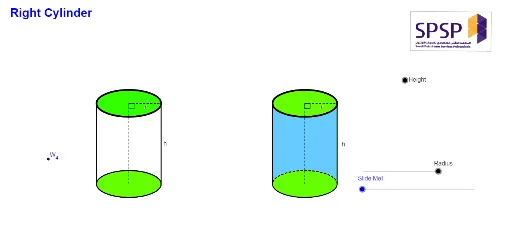
This GeoGebra example dynamically demonstrates the net (unfolded surface) of a cylinder and its surface area calculation. The core mathematical concept is the surface area formula of a cylinder in solid geometry, including the lateral area (2πrh) and the two base areas (2πr²), visualized through an interactive net. Construction highlights: commands such as Point, Circle, Intersect, Ellipse, Vector, Translate, Polygon, Arc, Segment, Angle, Line, Midpoint, If, Conic, OrthogonalLine, Center, Rotate, Mirror, and CircleArc are used to build the cylinder's base circles, side rectangle, and auxiliary construction lines. Suitable for middle and high school geometry classes, this resource helps students intuitively grasp how the surface area formula is derived and explore how changing radius and height affects the total surface area.
GeoGebra Commands & Parameters
Point(xAxis) → ACircle(A, r) → cIntersect(c, xAxis) → B, CEllipse(E, D, C) → eIntersect(xAxis, yAxis) → FVector(F, G) → uTranslate(B, Vector[(u * h)]) → B'_1Translate(C, Vector[(u * h)]) → C'_1Translate(A, Vector[(u * h)]) → A'Translate(e, Vector[(u * h)]) → e'_1Polygon(B'_1, B, C, C'_1) → poly1, b', b, c_1, c'Arc(e'_1, C'_1, B'_1) → fArc(e, B, C) → gArc(e, C, B) → kArc(e'_1, C'_1, B'_1) → p_5Arc(e'_1, B'_1, C'_1) → qArc(e, B, C) → sSegment(A', A) → h_6Segment(A', C'_1) → pAngle(A, A', C'_1) → αLine(A, A') → jIntersect(e'_1, j) → H, IIntersect(k, j) → J,Circle(I, r) → tIntersect(t, j, 2) → KCircle(K, I) → d_1Circle(J, r) → e_1Intersect(e_1, j, 1) → LCircle(L, J) → f_1Intersect(f_1, j, 2) → MIntersect(d_1, j, 2) → NIntersect(s, j) → O,Vector(H, N) → vVector(O, M) → wTranslate(H, Vector[(v * n)]) → H'_1Translate(D, Vector[(u * h)]) → D'Translate(E, Vector[(u * h)]) → E'Line(B, B'_1) → lLine(C, C'_1) → mIntersect(d_1, l, 1) → PIntersect(d_1, m, 1) → QVector(B'_1, P) → zVector(C'_1, Q) → u_1Translate(B'_1, Vector[(z * n)]) → B''Translate(C'_1, Vector[(u_1 * n)]) → C''Midpoint(B'_1, A') → RMidpoint(B, A) → SLine(R, S) → a_1Intersect(q, a_1) → T,Intersect(d_1, a_1, 1) → UVector(T, U) → v_1Translate(T, Vector[(v_1 * n)]) → T'Intersect(f_1, l, 1) → VIntersect(f_1, m, 1) → WIntersect(f_1, a_1, 2) → ZIntersect(s, a_1) → A_1,Vector(B, V) → w_1Vector(A_1, Z) → z_1Vector(C, W) → b_1Translate(B, Vector[(w_1 * (n - 1))]) → B'Translate(A_1, Vector[(z_1 * (n - 1))]) → C_1Translate(O, Vector[(w * (n - 1))]) → O'Translate(C, Vector[(b_1 * (n - 1))]) → C'If(n ≟ 0.02, B'_1, If[n < 1, B'', P]) → B_1If(n ≟ 0.02, T, If[n < 1, T', U]) → D_1If(n ≟ 0.02, H, If[n < 1, H'_1, N]) → E_1If(n ≟ 0.02, C'_1, If[n < 1, C'', Q]) → F_1Conic(B_1, D_1, E_1, F_1, I) → g_1Conic(I, B_1, D_1, E_1, F_1) → h_1If(n < 1, B, If[n < 2, B', V]) → G_1If(n < 1, A_1, If[n < 2, C_1, Z]) → H_1If(n < 1, O, If[n < 2, O', M]) → I_1If(n < 1, C, If[n < 2, C', W]) → J_1Conic(G_1, H_1, I_1, J_1, J) → k_1Vector(H, O) → i_1Translate(H, Vector[(i_1 * (n - 2))]) → H'If(n < 2, H, If[n < 3, H', O]) → K_1Segment(H, K_1) → j_1Arc(e, B, C) → q_1Intersect(g, k_1) → M_1, N_1, R_1, S_1Arc(k_1, M_1, N_1) → r_1Arc(k_1, N_1, M_1) → p_1Arc(e, C, B) → s_1OrthogonalLine(I, j) → l_1OrthogonalLine(J, l) → m_1Circle(I, w_2) → t_1Intersect(t_1, l_1, 1) → L_1Intersect(t_1, l_1, 2) → O_1OrthogonalLine(O_1, l_1) → n_1OrthogonalLine(L_1, m_1) → a_2Intersect(m_1, n_1) → P_1Intersect(m_1, a_2) → Q_1Circle(H, r) → c_2Intersect(c_2, j, 2) → T_1Circle(T_1, H) → d_2OrthogonalLine(H, j) → b_2Intersect(d_2, l_1, 1) → U_1OrthogonalLine(T_1, j) → e_2Intersect(d_2, e_2, 1) → V_1Angle(U_1, T_1, V_1) → βCircle(L_1, r) → f_2Intersect(f_2, l_1, 2) → W_1Vector(I, W_1) → u_2Translate(d_2, Vector[(u_2 * (n - 3))]) → g_2Center(g_2) → Z_1Intersect(g_2, b_2) → A_2, B_3Rotate(A_2, w_3, Z_1) → B_2If(n < 3, H, If[n < 4, B_2, L_1]) → C_2Mirror(C_2, j) → D_2Mirror(E_2, j) → F_2Midpoint(I, L_1) → G_2Intersect(m, l_1) → H_2Midpoint(H_2, C'_1) → I_2Vector(H_2, G_2) → v_2OrthogonalLine(C'_1, m) → i_2Polygon(D_2, F_2, E_2, C_2) → poly2, d_3, f_3, e_3, c_3Vector(C'_1, W_1) → z_2Translate(C'_1, Vector[(z_2 * (n - 3))]) → J_2If(n < 3, C'_1, If[n < 4, J_2, W_1]) → K_2Mirror(K_2, j) → L_2Conic(D_2, L_2, I, K_2, C_2) → h_2Arc(h_2, B_2, D_2) → k_2Arc(h_2, B_2, D_2) → p_2Conic(F_2, N_2, J, M_2, E_2) → q_2Intersect(q_2, k_1) → O_2, P_2, Q_2, R_2Center(h_2) → S_2Center(q_2) → T_2OrthogonalLine(T_2, j) → j_2OrthogonalLine(S_2, j) → m_2Intersect(h_2, m_2) → U_2, V_2Intersect(q_2, j_2) → W_2, Z_2Polygon(U_2, D_2, F_2, W_2) → poly3, u_3, d_4, f_4, w_5Polygon(V_2, C_2, E_2, Z_2) → poly4, v_3, c_4, e_4, z_3Intersect(q_2, d_3, 2) → A_3Intersect(q_2, e_3, 2) → C_3Polygon(F_2, A_3, C_3, E_2) → poly5, f_5, a_3, c_5, e_5Arc(q_2, C_3, A_3) → s_2Arc(q_2, E_2, F_2) → t_2Arc(q_2, E_2, F_2) → g_3Segment(A_3, C_3) → l_2Intersect(k_1, l_2) → D_3, E_3Segment(E_3, A_3) → n_2Segment(D_3, C_3) → b_3Segment(F_2, E_2) → h_3Arc(k_1, D_3, E_3) → k_3Segment(E_3, D_3) → i_3Segment(D_2, C_2) → j_3Segment(L_2, K_2) → l_3Arc(q_2, W_2, F_2) → p_3Arc(q_2, E_2, Z_2) → q_3Arc(q_2, E_2, Z_2) → r_3Arc(q_2, W_2, F_2) → s_3Intersect(k_1, d_3) → F_3, J_3Intersect(k_1, e_3) → G_3, K_3Arc(k_1, G_3, F_3) → t_3Arc(k_1, F_3, R_2) → g_4Arc(k_1, O_2, G_3) → h_4Segment(F_2, E_2) → r_2Intersect(k_1, r_2) → H_3, I_3Segment(F_2, I_3) → m_3Segment(E_2, H_3) → n_3Arc(q_2, E_2, F_2) → k_4Arc(k_1, H_3, I_3) → p_4Segment(I_3, H_3) → a_4Segment(F_2, E_2) → b_4Segment(E_2, Z_2) → i_4Segment(D_2, F_2) → j_4Segment(C_2, E_2) → l_4Arc(k_1, N_1, M_1) → q_4Arc(k_1, N_1, M_1) → r_4Midpoint(j_4) → L_3Translate(e, Vector[(u * h)]) → e'Arc(k_1, M_1, N_1) → s_4Arc(k_1, R_2, N_1) → t_4Arc(k_1, R_2, O_2) → d_5Arc(k_1, P_2, Q_2) → g_5Center(h_1) → M_3Segment(M_3, F_1) → aMidpoint(c_1) → N_3Point(xAxis) → O_3Circle(O_3, r) → h_5Intersect(h_5, xAxis) → P_3, Q_3Ellipse(R_3, S_3, Q_3) → k_5OrthogonalLine(S_3, i_2) → iOrthogonalLine(Q_3, i_2) → m_4OrthogonalLine(P_3, i_2) → n_4OrthogonalLine(R_3, i_2) → a_5Intersect(i_2, a_5) → T_3Intersect(n_4, i_2) → U_3Intersect(i, i_2) → V_3Intersect(m_4, i_2) → W_3Ellipse(T_3, V_3, W_3) → q_5Polygon(U_3, W_3, Q_3, P_3) → poly6, u_4, w_6, q_6, p_6Ellipse(T_3, V_3, W_3) → r_5Arc(k_5, Q_3, P_3) → s_5Arc(k_5, P_3, Q_3) → t_5Center(q_5) → Z_3Segment(O_3, Z_3) → b_5Segment(Z_3, W_3) → i_5Angle(W_3, Z_3, O_3) → γIntersect(k_1, f_4) → A_4,Intersect(k_1, e_4) → B_4,Intersect(g_3, k_1) → C_4, D_4, E_4, F_4Polygon(Z_2, C_4, B_4) → poly7, b_6, z_4, c_6Polygon(F_4, A_4, W_2) → poly8, w_7, f_6, a_6Arc(q_2, W_2, F_4) → d_6Arc(q_2, C_4, Z_2) → e_6Arc(q_2, W_2, F_4) → g_6Arc(q_2, C_4, Z_2) → k_6Arc(k_1, G_3, J_3) → r_6Intersect(k_1, b) → G_4, H_4Segment(E_3, D_3) → m_5Segment(H_3, I_3) → n_5Point(c_3) → J_4Point(k_2) → K_4Point(c_3) → N_4Vector(M_4, N_4) → u_5Segment(D_2, C_2) → i_6Intersect(h_1, i_6) → O_4, V_4If(4 < n ≤ 5, Dilate[O_4, 5 - n, C_2]) → P_4Vector(O_4, P_4) → v_5Translate(h_1, v_5) → s_6Translate(E_1, v_5) → Q_4Center(s_6) → R_4Segment(O_4, P_4) → l_6Segment(O_4, P_4) → m_6If(4 < n ≤ 5, Rotate[Q_4, (((-(n - 4)) * 180))°, R_4]) → S_4CircleArc(R_4, P_4, S_4) → t_6Mirror(O_4, j_6) → T_4Mirror(P_4, j_6) → U_4Segment(T_4, U_4) → n_6Mirror(t_6, j_6) → c_7Segment(D_2, C_2) → a_7Segment(D_2, C_2) → j_5