
N-Gon Exterior Angles
Loading the math board and drawing, please wait…
In collections
Chapter 12: The Place of Parallels
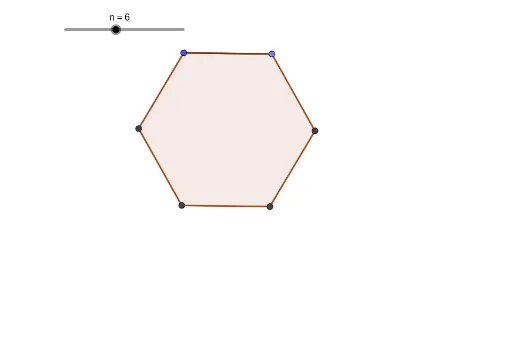
This example demonstrates how to construct a polygon and calculate its exterior angles. It involves core math concepts like polygons, exterior angles, angles, and geometric construction. The construction uses commands such as Point, Segment, Polygon, Ray in GeoGebra. Suitable for high school mathematics teaching to understand the properties and calculation of exterior angles of polygons.
GeoGebra Commands & Parameters
Point(Circle[A, d]) → BSegment(A, B) → fPolygon(B, A, n) → poly1, g, c, C, D, E, F, G, H, I, J, h, i, j, k, l, m, p, qRay(E, D) → sRay(D, C) → tRay(C, A) → aRay(A, B) → bRay(B, J) → eRay(J, I) → f_1Ray(I, H) → g_1Ray(H, G) → h_1Ray(G, F) → i_1Ray(F, E) → j_1Ray(B, I) → rRay(B, H) → k_1Ray(B, G) → l_1Ray(B, F) → m_1Ray(B, E) → n_1Ray(B, D) → p_1Ray(B, C) → q_1
AI Drawing Prompt Reference
Draw a regular polygon with vertices evenly spaced on a circle. Connect consecutive vertices to form a closed shape. From each vertex, extend rays along the direction of the adjacent side's extension, pointing outward, to represent exterior angles. Additionally, from one chosen vertex, draw rays to all other vertices, creating internal diagonals. The figure illustrates exterior angles of a polygon, with rays emanating from vertices outward, forming angles with the sides.
The prompt above was compiled from the original drawing commands and is for reference only.