
Geometric and Probabilistic Connections: Exploring Triangle, Functions, and Prob
Loading the math board and drawing, please wait…
In collections
Chapter 12: The Place of Parallels
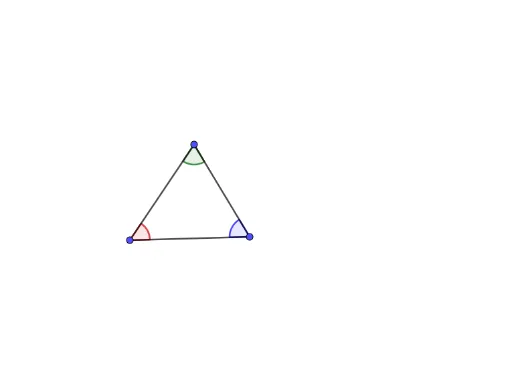
This example demonstrates the intersection of geometry and probability by exploring the relationship between triangles, functions, and probability. Key mathematical concepts include geometric construction, function graphing, probability distribution, and conditional probability. Construction involves using GeoGebra commands such as Segment, Angle, Line, Point to create triangles, function graphs, and probability models. Suitable for high school students or college students to learn cross-disciplinary applications of geometry, functions, and probability, as well as hands-on geometric construction and probability analysis skills.
GeoGebra Commands & Parameters
Segment(A, B) → fSegment(B, C) → gSegment(C, A) → hAngle(C, B, A) → αAngle(B, A, C) → βAngle(A, C, B) → γLine(B, C) → iLine(A, i) → jPoint(j) → DPoint(j) → EAngle(D, A, B) → δAngle(C, A, E) → εAngle(F, C, A) → ζPoint(i) → GAngle(G, C, F) → η
AI Drawing Prompt Reference
Draw a triangle with its three interior angles labeled. Construct a line parallel to one side of the triangle, and place two points on this parallel line. Connect each of these points to a vertex of the triangle, creating two new angles. Then, from another vertex, draw a perpendicular to the opposite side, marking the foot on that side, and form an additional angle involving this foot and another point. Show the triangle, the parallel line, the perpendicular, and all the angle markers clearly.
The prompt above was compiled from the original drawing commands and is for reference only.