
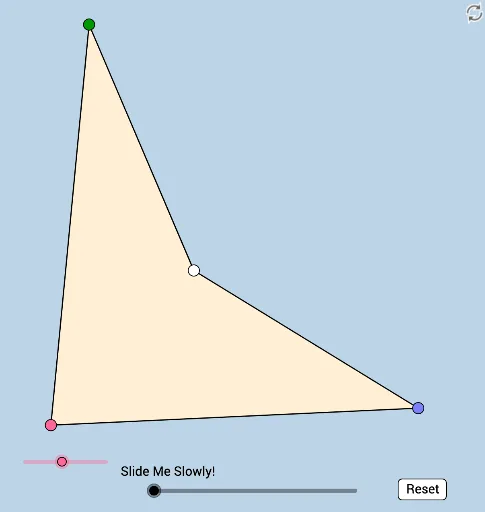
Mysterious Relationship of Angle Bisectors in Any Concave Quadrilateral
Loading the math board and drawing, please wait…
This example demonstrates the dynamic relationship of angle bisectors within any concave quadrilateral. Key mathematical concepts include angle bisectors and polygons. Constructed using GeoGebra commands such as Rotate, Angle, Ray, etc., it is suitable for high school geometry education.
GeoGebra Commands & Parameters
Rotate(A, (a * π / 180), B) → A'Angle(A, B, A') → αRotate(A, α / 2, B) → A'_2Ray(B, A'_2) → rRay(B, A') → gPoint(g) → CSegment(B, C) → hPolygon(B, A, C) → poly1, c, b, a_1PointIn(poly1) → DSegment(C, D) → iSegment(D, A) → jAngle(B, C, D) → βRotate(B, β / 2, C) → B'Ray(C, B') → lAngle(D, A, B) → γRotate(D, γ / 2, A) → D'Ray(A, D') → nIntersect(n, l) → JSegment(C, J) → g_1Segment(J, A) → h_1Segment(A, B) → fMin({f, i, h, j, g_1, h_1}) → dCircle(B, (0.2 * d)) → pIntersect(p, r, 1) → NCircle(B, (2 * Distance[B, N])) → r_1Intersect(r_1, r) → O,Angle(A, D, C) → δCircle(D, (0.2 * d)) → qCircle(C, (0.2 * d)) → eCircle(A, (0.2 * d)) → kIntersect(e, h, 1) → EIntersect(q, j, 1) → FIntersect(k, j, 1) → GIntersect(p, f, 1) → HAngle(B, C, B') → εRotate(A, δ / 2, D) → A'_1Angle(A, D, A'_1) → ζAngle(D, A, D') → ηAngle(A, B, A'_2) → θRay(D, A'_1) → mIntersect(k, n) → K,Intersect(q, m, 1) → LIntersect(e, l) → M,Dilate(A, If[0 < o ≤ 1, 1 - o, 0], J) → A'_3Segment(A, A'_3) → sPolygon(B, A, D, C) → poly2, b_1, a_2, d_1, c_1CircleSector(A, G, K) → tDilate(C, If[1 < o ≤ 2, 2 - o, 0], J) → C'Segment(C, C') → f_1CircleSector(C, E, M) → e_1Rotate(t, If[2 < o ≤ 3, ((o - 2) * η), η], A) → t'Rotate(e_1, If[3 < o ≤ 4, ((o - 3) * ε), ε], C) → k_1Dilate(B, If[4 < o ≤ 5, 5 - o, 0], O) → B'_1Segment(B, B'_1) → i_1Dilate(D, If[5 < o ≤ 6, 6 - o, 0], L) → D'_1Segment(D, D'_1) → j_1CircleSector(B, H, N) → p_1CircleSector(D, F, L) → q_1Ray(D, L) → l_1Rotate(p_1, If[6 < o ≤ 7, ((o - 6) * θ), θ], B) → s_1Rotate(q_1, If[7 < o ≤ 8, ((o - 7) * ζ), ζ], D) → t_1Line(J, i_1) → m_1Circle(J, 3) → c_2Intersect(c_2, m_1, 2) → PAngle(A, J, P) → κDilate(B, If[8 < o ≤ 9, 9 - o, 0], J) → B'_2Vector(B, B'_2) → uTranslate(s_1, u) → d_2Rotate(d_2, If[9 < o ≤ 10, ((-(o - 9)) * κ), (-κ)], J) → e_2Midpoint(J, C) → QDilate(D, If[10 < o ≤ 11, 11 - o, 0], Q) → D'_2Vector(D, D'_2) → vTranslate(t_1, v) → f_2Dilate(Q, If[11 < o ≤ 12, 12 - o, 0], J) → Q'Rotate(A, θ, J) → A'_4Rotate(A'_3, θ, J) → RSegment(A'_4, R) → s'Line(Q', s') → n_1Vector(Q, Q') → wTranslate(f_2, w) → g_2Line(J, l_1) → h_2Circle(J, 3) → k_2Intersect(k_2, h_2) → S, TAngle(A'_4, J, T) → ρRotate(g_2, If[11 < o ≤ 12, ((-(o - 11)) * ρ), (-ρ)], Q') → p_2