
Multiplying and Dividing Complex Numbers: Geometric Visualization
Loading the math board and drawing, please wait…
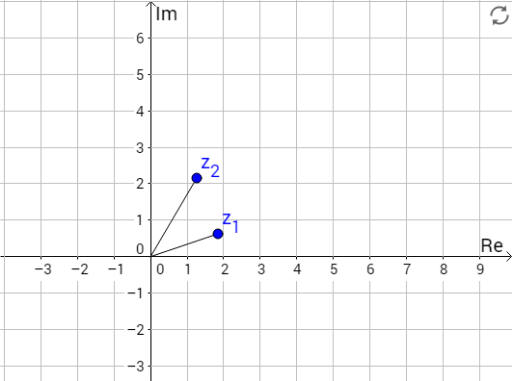
This GeoGebra example dynamically illustrates the geometric meaning of multiplication and division of complex numbers, showing how the modulus and argument change when two complex numbers are multiplied or divided. Core mathematical concepts include polar representation of complex numbers, modulus and argument, multiplication (moduli multiply, arguments add), division (moduli divide, arguments subtract), and vector operations on the complex plane. Construction highlights: uses the Intersect command to create intersection points, Segment command to draw segments, and defines complex objects z_1, z_2, z_3, z_4 with auxiliary objects α, β, text1, text2 to label angles and values, points A, f, g, h, i to build geometric relationships, and sliders or dynamic interactions to show results. Suitable for high school and above to grasp the geometric essence of complex arithmetic, and useful for university introductory complex analysis or classroom demonstrations.
GeoGebra Commands & Parameters
Intersect(xAxis, yAxis) → ASegment(A, z_1) → fSegment(A, z_2) → gSegment(A, z_3) → hSegment(A, z_4) → i
AI Drawing Prompt Reference
Draw a complex plane with an origin point. From the origin, draw four line segments to four distinct complex points, representing two complex numbers, their product, and their quotient. Use different colors or line styles for each segment. Label each point with its modulus and argument. The figure should clearly illustrate that multiplication multiplies moduli and adds arguments, while division divides moduli and subtracts arguments. Include angle arcs or text labels for clarity, suitable for classroom demonstration.
The prompt above was compiled from the original drawing commands and is for reference only.