
Multi-step Geometric Construction Combining Pythagorean Theorem, Fractions, Divi
Loading the math board and drawing, please wait…
In collections
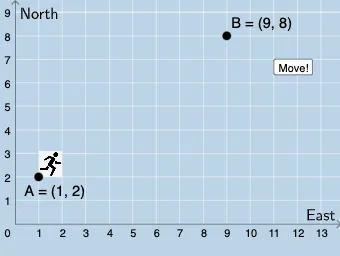
Distance in the Coordinate Plane: Exploration
This GeoGebra example demonstrates a complex geometric construction that integrates the Pythagorean theorem, fraction operations, division, and the binomial distribution concept, presented in multiple steps with interactive buttons. The core mathematical concepts include the Pythagorean theorem (relationship among sides of a right triangle), fraction and division arithmetic, the binomial probability model, and geometric transformations such as dilation, rotation, and translation. Construction highlights: based on the summary, the commands used include Dilate, Vector, Line, Point, Angle, Rotate, Translate, and Polygon. Key objects include points B, A, C, D, F, G, H, I, J, K, vectors u, v, w, angles α, β, γ, images pic1, pic2, pic3, and buttons button1, button2, button3 for interactive control. This is suitable for middle and high school students learning geometric transformations, applications of the Pythagorean theorem, and introductory probability and statistics, as well as for teachers to demonstrate the integration of multiple concepts in a visual and interactive way.
GeoGebra Commands & Parameters
Dilate(A, If[0 < a ≤ 1, 1 - a, 0], D) → A'Vector(A, A') → uDilate(D, If[1 < a ≤ 2, 2 - a, 0], B) → D'Vector(D, D') → vLine(A, B) → fPoint(f) → FAngle(D, A, F) → αPoint(eq1) → GAngle(G, A, F) → βRotate(H, If[0 ≤ b ≤ 1, (b * β), β], B) → H'Dilate(B, If[1 < b ≤ 2, 2 - b, 0], A) → E'Vector(B, E') → wTranslate(H', w) → H''Angle(B, D, A) → γPolygon(A, D, B) → t1, b_1, a_1, d
AI Drawing Prompt Reference
Construct a plane figure centered on a triangle framework using key points A, B, D and auxiliary points F and G. Draw the line through A and B to define the reference point F on it. Establish angle relations by marking angle α determined by D–A–F, angle β determined by G–A–F, and angle γ determined by B–D–A. Perform geometric transformations in steps: scale A toward D using parameter a to get A′, take the vector from A to A′ as a direction, then scale D relative to B using a to get D′ and take the vector from D to D′. Use angle β to rotate around B producing H′, scale B relative to A using parameter b to get E′ and form vector w from B to E′, then translate H′ by vector w to obtain H″. Conclude by forming a polygon whose vertices include A, D, and B, reflecting the constructed relations.
The prompt above was compiled from the original drawing commands and is for reference only.