
Morley's Trisector Theorem Demonstration
Loading the math board and drawing, please wait…
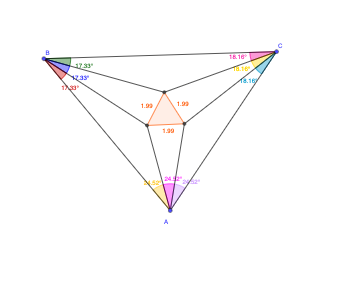
This example demonstrates Morley's Trisector Theorem, which states that the intersection points of the angle trisectors of any triangle form an equilateral triangle. The core mathematical concepts involved include angles, triangles, geometric construction, rotation, and intersection points. The construction utilizes GeoGebra commands/objects such as Segment, Angle, AngularBisector, Intersect, Rotate, Ray, and Polygon. It is suitable for high school and above students to understand the proof process and construction methods of classic geometric theorems.
GeoGebra Commands & Parameters
Segment(A, B) → fSegment(B, C) → gSegment(C, A) → hAngle(B, A, C) → aAngle(B, C, A) → bAngle(A, B, C) → cAngularBisector(h, f) → i, jAngularBisector(g, h) → k, lAngularBisector(g, f) → m, nAngularBisector(B, C, A) → pIntersect(p, f) → DRotate(D, b1, C) → D'Rotate(D, (-b1), C) → D'_{1}Ray(C, D'_{1}) → qRay(C, D') → rAngularBisector(C, B, A) → sIntersect(s, h) → ERotate(E, c1, B) → E'Rotate(E, (-c1), B) → E'_{1}Ray(B, E'_{1}) → tRay(B, E') → dIntersect(q, d) → FAngularBisector(B, A, C) → eIntersect(e, g) → GRotate(G, a1, A) → G'Rotate(G, (-a1), A) → G'_{1}Ray(A, G') → f_1Ray(A, G'_{1}) → g_1Intersect(g_1, r) → HIntersect(t, f_1) → IPolygon(F, I, H) → t1, h_1, f_2, i_1Segment(B, F) → j_1Segment(B, I) → k_1Segment(C, F) → l_1Segment(H, C) → m_1Segment(I, A) → n_1Segment(A, H) → p_1Angle(C, B, F) → αAngle(F, B, I) → βAngle(I, B, A) → γAngle(B, C, F) → δAngle(F, C, H) → εAngle(H, C, A) → ζAngle(B, A, I) → ηAngle(I, A, H) → θAngle(H, A, C) → ι
AI Drawing Prompt Reference
Draw a triangle ABC, then trisect each angle and connect the intersection points of the trisectors to form a new triangle DEF. Next, rotate these intersection points and connect the new intersection points GHI to form an equilateral triangle.
The prompt above was compiled from the original drawing commands and is for reference only.