
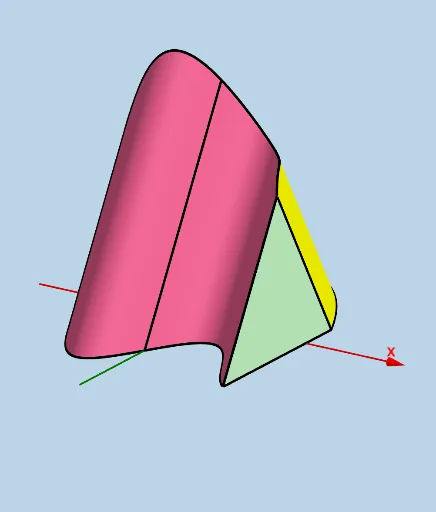
Modifiable Solid with Equilateral Triangle Cross Sections Parallel to yAxis
Loading the math board and drawing, please wait…
This example demonstrates a solid with equilateral triangle cross sections parallel to the yAxis, where the side length is the difference between the upper and lower functions. Key mathematical concepts include properties of equilateral triangles, function graphs, and integration. Constructed using GeoGebra commands such as Segment, Polygon, and CurveCartesian. Suitable for calculus courses focusing on solid geometry and integration.
GeoGebra Commands & Parameters
Segment(H, I) → s_1Midpoint(s_1) → ESegment(J, K) → q_1Midpoint(q_1) → FIntersect(upper, h, (0, 10)) → BIntersect(lower, h, (0, -6)) → CSegment(C, B) → qIntersect(upper, q, (0, 10)) → GMidpoint(C, G) → TLine(B, D) → iSphere(B, d) → eSegment(C, B) → pPolygon(C, G, U) → q1, f_1, g_1, n_1Polygon(K, J, W) → q2, l, m, nPolygon(Q, P, V) → q3, r, s, tTextfield(upper) → InputBox1Textfield(lower) → InputBox2Textfield(a) → InputBox3Textfield(b) → InputBox4Segment(K, W) → fSegment(W, J) → gSegment(Q, V) → jSegment(V, P) → kCurveCartesian(t, (0.5 * (upper(t) + lower(t))), ((sqrt(3) * 1 / 2) * (upper(t) - lower(t))), t, a, b) → cSurface(u, ((1 - v) * lower(u)) + ((0.5 * v) * (lower(u) + upper(u))), (sqrt(3) / 2 * (v * (upper(u) - lower(u)))), u, a, b, v, 0, 1) → oSurface(u, (v * upper(u)) + (((1 - v) * 0.5) * (lower(u) + upper(u))), (((sqrt(3) * 0.5) * (1 - v)) * (upper(u) - lower(u))), u, a, b, v, 0, 1) → uSegment(C, U) → i_1Segment(U, G) → j_1Segment(C, G) → k_1
AI Drawing Prompt Reference
Draw a modifiable solid with equilateral triangle cross sections parallel to the y-axis. The side length of the equilateral triangle is the difference between the upper and lower functions. First, plot the graphs of the upper and lower functions, then select two points on the y-axis as the base of the equilateral triangle, construct the apex of the triangle, and finally use these points to form the equilateral triangle cross sections, and integrate these sections to form the solid.
The prompt above was compiled from the original drawing commands and is for reference only.