
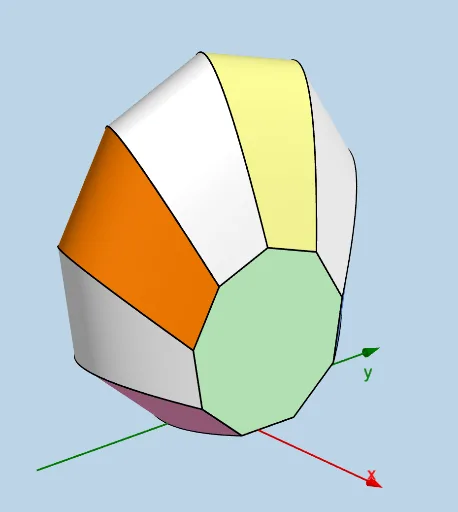
Modifiable Solid: Regular Nonagon Cross Sections Parallel to yAxis
Loading the math board and drawing, please wait…
This example demonstrates a modifiable solid where cross sections parallel to the yAxis are regular nonagons. Core mathematical concepts include solid geometry, coordinate geometry, and calculus. Construction highlights the use of GeoGebra commands and objects such as Intersect, Segment, Midpoint, Line, Sphere, Textfield, Rotate, Polygon, CurveCartesian, and Surface. Suitable for high school and above students to explore complex geometric solids and their cross-sectional properties.
GeoGebra Commands & Parameters
Intersect(lower, h, (-10, -3)) → CIntersect(upper, h, (-10, 13.333333333333332)) → BSegment(C, B) → qIntersect(upper, q, (-10, 13.333333333333332)) → GMidpoint(C, G) → TLine(T, T + (1, 0, 0)) → l_1Segment(H, I) → s_1Midpoint(s_1) → ELine(E, E + (1, 0, 0)) → r_1Segment(J, K) → q_1Midpoint(q_1) → FLine(F, F + (1, 0, 0)) → cLine(B, D) → iSphere(B, d) → eSegment(C, B) → pTextfield(upper) → InputBox1Textfield(lower) → InputBox2Textfield(a) → InputBox3Textfield(b) → InputBox4Segment(C, G) → k_1Rotate(J, (2 * pi / 5), Z, c) → J'Rotate(J', (2 * pi / 5), Z, c) → J''Rotate(J'', (2 * pi / 5), Z, c) → J'''Rotate(H, (2 * pi / 5), A_1, r_1) → H'Rotate(H', (2 * pi / 5), A_1, r_1) → H''Rotate(H'', (2 * pi / 5), A_1, r_1) → H'''Rotate(G, (2 * pi / 5), B_1, l_1) → G'Rotate(G', (2 * pi / 5), B_1, l_1) → G''Rotate(G'', (2 * pi / 5), B_1, l_1) → G'''Segment(C, G) → fLine(C_1, C_1 + (1, 0, 0)) → gRotate(G, (2 * pi / 9), C_1, g) → G'_1Rotate(G'_1, (2 * pi / 9), C_1, g) → D_1Rotate(D_1, (2 * pi / 9), C_1, g) → E_1Rotate(E_1, (2 * pi / 9), C_1, g) → F_1Rotate(F_1, (2 * pi / 9), C_1, g) → G_1Rotate(G_1, (2 * pi / 9), C_1, g) → H_1Rotate(H_1, (2 * pi / 9), C_1, g) → I_1Polygon(C, G, G'_1, D_1, E_1, F_1, G_1, H_1, I_1) → poly1, c_1, g_1, g'_1, d_1, e_1, f_1, g_2, h_2, i_1Segment(G, G'_1) → jSegment(G'_1, D_1) → kSegment(D_1, E_1) → lSegment(E_1, F_1) → mSegment(F_1, G_1) → nSegment(G_1, H_1) → rSegment(H_1, I_1) → sSegment(I_1, C) → tRotate(J, (2 * pi / 9), J_1, Line[J_1, J_1 + (1, 0, 0)]) → J'_1Rotate(J'_1, (2 * pi / 9), J_1, Line[J_1, J_1 + (1, 0, 0)]) → K_1Rotate(K_1, (2 * pi / 9), J_1, Line[J_1, J_1 + (1, 0, 0)]) → L_1Rotate(L_1, (2 * pi / 9), J_1, Line[J_1, J_1 + (1, 0, 0)]) → M_1Rotate(M_1, (2 * pi / 9), J_1, Line[J_1, J_1 + (1, 0, 0)]) → N_1Rotate(N_1, (2 * pi / 9), J_1, Line[J_1, J_1 + (1, 0, 0)]) → O_1Rotate(O_1, (2 * pi / 9), J_1, Line[J_1, J_1 + (1, 0, 0)]) → P_1Polygon(K, J, J'_1, K_1, L_1, M_1, N_1, O_1, P_1) → poly2, k_2, j_1, j'_1, k_3, l_2, m_1, n_1, o_1, p_1Segment(J, J'_1) → a_1Segment(J'_1, K_1) → b_1Segment(K_1, L_1) → f_2Segment(L_1, M_1) → i_2Segment(M_1, N_1) → j_2Segment(N_1, O_1) → m_2Segment(O_1, P_1) → n_2Segment(P_1, K) → p_2Rotate(H, (2 * pi / 9), Q_1, Line[Q_1, Q_1 + (1, 0, 0)]) → H'_1Rotate(H'_1, (2 * pi / 9), Q_1, Line[Q_1, Q_1 + (1, 0, 0)]) → R_1Rotate(R_1, (2 * pi / 9), Q_1, Line[Q_1, Q_1 + (1, 0, 0)]) → S_1Rotate(S_1, (2 * pi / 9), Q_1, Line[Q_1, Q_1 + (1, 0, 0)]) → T_1Rotate(T_1, (2 * pi / 9), Q_1, Line[Q_1, Q_1 + (1, 0, 0)]) → U_1Rotate(U_1, (2 * pi / 9), Q_1, Line[Q_1, Q_1 + (1, 0, 0)]) → V_1Rotate(V_1, (2 * pi / 9), Q_1, Line[Q_1, Q_1 + (1, 0, 0)]) → W_1Polygon(H, H'_1, R_1, S_1, T_1, U_1, V_1, W_1, I) → poly3, h_3, h'_1, r_2, s_2, t_2, u_1, v_1, w_1, i_3Segment(I, W_1) → q_2Segment(W_1, V_1) → a_2Segment(V_1, U_1) → b_2Segment(U_1, T_1) → c_2Segment(T_1, S_1) → d_2Segment(S_1, R_1) → e_2Segment(R_1, H'_1) → f_3Segment(H'_1, H) → g_3CurveCartesian(t, lower(t) - ((upper(t) - lower(t)) * cos((2 * pi / 9))), ((upper(t) - lower(t)) * sin((2 * pi / 9))), t, a, b) → oCurveCartesian(t, upper(t) + ((upper(t) - lower(t)) * cos((2 * pi / 9))), ((upper(t) - lower(t)) * sin((2 * pi / 9))), t, a, b) → uCurveCartesian(t, lower(t) - ((upper(t) - lower(t)) * (cos((2 * pi / 9)) + cos((4 * pi / 9)))), ((upper(t) - lower(t)) * (sin((2 * pi / 9)) + sin((4 * pi / 9)))), t, a, b) → vCurveCartesian(t, upper(t) + ((upper(t) - lower(t)) * (cos((2 * pi / 9)) + cos((4 * pi / 9)))), ((upper(t) - lower(t)) * (sin((2 * pi / 9)) + sin((4 * pi / 9)))), t, a, b) → wCurveCartesian(t, lower(t) - ((upper(t) - lower(t)) * (cos((2 * pi / 9)) + cos((4 * pi / 9)) - 0.5)), ((upper(t) - lower(t)) * (sin((2 * pi / 9)) + sin((4 * pi / 9)) + sqrt(3) / 2)), t, a, b) → o_2CurveCartesian(t, upper(t) + ((upper(t) - lower(t)) * (cos((2 * pi / 9)) + cos((4 * pi / 9)) - 0.5)), ((upper(t) - lower(t)) * (sin((2 * pi / 9)) + sin((4 * pi / 9)) + sqrt(3) / 2)), t, a, b) → u_2CurveCartesian(t, (0.5 * (upper(t) + lower(t))), ((0.5 * (upper(t) - lower(t))) * (tan((7 * pi / 18)) + 1 / cos((7 * pi / 18)))), t, a, b) → v_2Surface(u, lower(u) - ((v * (upper(u) - lower(u))) * cos((2 * pi / 9))), ((v * (upper(u) - lower(u))) * sin((2 * pi / 9))), u, a, b, v, 0, 1) → w_2Surface(u, upper(u) + ((v * (upper(u) - lower(u))) * cos((2 * pi / 9))), ((v * (upper(u) - lower(u))) * sin((2 * pi / 9))), u, a, b, v, 0, 1) → a_3Surface(u, lower(u) - ((upper(u) - lower(u)) * cos((2 * pi / 9))) - (((upper(u) - lower(u)) * cos((4 * pi / 9))) * v), ((upper(u) - lower(u)) * sin((2 * pi / 9))) + (((upper(u) - lower(u)) * sin((4 * pi / 9))) * v), u, a, b, v, 0, 1) → b_3Surface(u, upper(u) + ((upper(u) - lower(u)) * cos((2 * pi / 9))) + (((upper(u) - lower(u)) * cos((4 * pi / 9))) * v), ((upper(u) - lower(u)) * sin((2 * pi / 9))) + (((upper(u) - lower(u)) * sin((4 * pi / 9))) * v), u, a, b, v, 0, 1) → c_3Surface(u, lower(u) - ((upper(u) - lower(u)) * (cos((2 * pi / 9)) + cos((4 * pi / 9)))) + ((0.5 * (upper(u) - lower(u))) * v), ((upper(u) - lower(u)) * (sin((2 * pi / 9)) + sin((4 * pi / 9)) + (sqrt(3) / 2 * v))), u, a, b, v, 0, 1) → d_3Surface(u, upper(u) + ((upper(u) - lower(u)) * (cos((2 * pi / 9)) + cos((4 * pi / 9)) - (0.5 * v))), ((upper(u) - lower(u)) * (sin((2 * pi / 9)) + sin((4 * pi / 9)) + (sqrt(3) / 2 * v))), u, a, b, v, 0, 1) → e_3Surface(u, lower(u) - ((upper(u) - lower(u)) * (cos((2 * pi / 9)) + cos((4 * pi / 9)) - 0.5 - (cos(pi / 9) * v))), ((upper(u) - lower(u)) * (sin((2 * pi / 9)) + sin((4 * pi / 9)) + sqrt(3) / 2 + (v * sin(pi / 9)))), u, a, b, v, 0, 1) → l_3Surface(u, upper(u) + ((upper(u) - lower(u)) * (cos((2 * pi / 9)) + cos((4 * pi / 9)) - 0.5 - (cos(pi / 9) * v))), ((upper(u) - lower(u)) * (sin((2 * pi / 9)) + sin((4 * pi / 9)) + sqrt(3) / 2 + (v * sin(pi / 9)))), u, a, b, v, 0, 1) → j_3