
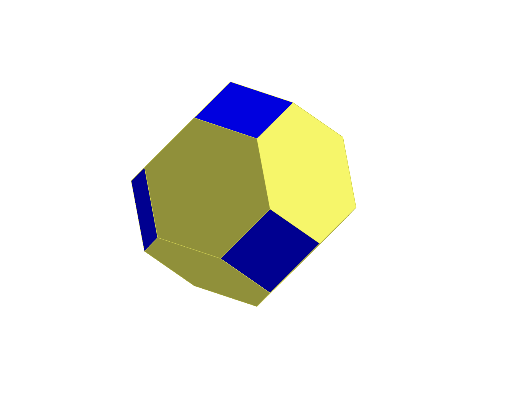
Truncated Octahedron
Loading the math board and drawing, please wait…
In collections
Archimedean Solids
This example demonstrates the geometric construction and properties of a truncated octahedron. Key math concepts include polygons, solid geometry, and coordinate geometry. Construction highlights involve commands/objects like Point, Distance, Segment, Sphere, Intersect, Polygon, and Rotate in GeoGebra. Suitable for high school and above learning solid geometry and geometric constructions.
GeoGebra Commands & Parameters
Point(zAxis) → APoint(zAxis) → BPoint(xAxis) → CPoint(yAxis) → DPoint(yAxis) → EPoint(xAxis) → FDistance(A, E) → aSegment(A, E) → fSegment(A, C) → gSphere(A, a / 3) → bIntersect(f, b, 2) → GIntersect(g, b, 2) → HSegment(A, D) → hSegment(A, F) → iIntersect(h, b) → J, IIntersect(i, b) → L, KIntersect(g, b) → M,Intersect(f, b) → N,Polygon(N, M, J, L) → q1, n, m, j, lRotate(q1, 90°, yAxis) → q1'Rotate(q1, 180°, yAxis) → q1'_{1}Rotate(q1, 270°, yAxis) → q1'_{2}Rotate(q1'_{2}, 90°, zAxis) → q2Rotate(q1'_{2}, 180°, zAxis) → q3Rotate(q1'_{2}, 270°, zAxis) → q4Segment(E, C) → kSphere(C, a / 3) → cIntersect(g, c) → O,Intersect(k, c) → P,Rotate(O, -90°, zAxis) → O'Sphere(E, a / 3) → dIntersect(k, d) → Q,Polygon(N, O', Q, P, O, M) → poly1, n_1, o', q, p, o, m_1Rotate(poly1, 90°, zAxis) → poly1'Rotate(poly1, 180°, zAxis) → poly1'_{1}Rotate(poly1, 270°, zAxis) → poly1'_{2}Rotate(poly1', -90°, xAxis) → poly1''Rotate(poly1'', 90°, zAxis) → poly1'''Rotate(poly1'', 180°, zAxis) → poly1'''_{1}Rotate(poly1'', 270°, zAxis) → poly1'''_{2}
AI Drawing Prompt Reference
Create a truncated octahedron in 3D. Start by placing reference points along the coordinate axes, then define key distances from one vertex to two direction points. Construct two spheres centered at that vertex using fractions of the chosen distance, and find intersection points between the spheres and the lines/segments determined by those reference directions. Use the resulting points to form one quadrilateral polygon face. Generate the remaining faces by rotating this polygon around the y-axis to create symmetric copies, then further rotate the set around the z-axis and also around the x-axis to complete the corresponding facets. Use additional sphere–segment intersection points to form and include the remaining polygon faces so the full solid is assembled.
The prompt above was compiled from the original drawing commands and is for reference only.