
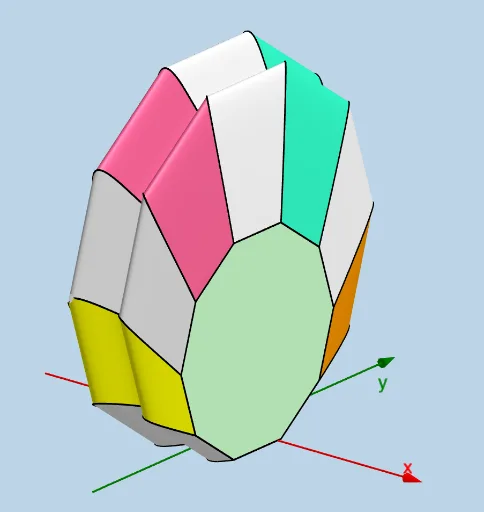
Modifiable Solid: Regular Decagon Cross Sections Parallel to yAxis
Loading the math board and drawing, please wait…
This example demonstrates a modifiable solid where cross-sections parallel to the yAxis are regular decagons. Core math concepts include solid geometry, coordinate geometry, and calculus concepts like integration and functions. Construction highlights GeoGebra commands such as Intersect, Segment, Midpoint, Line, Sphere, Rotate, Polygon, CurveCartesian, and Surface. Suitable for high school students and above, particularly those learning calculus and geometric transformations.
GeoGebra Commands & Parameters
Intersect(lower, h, (-10, -11.367936667331891)) → CIntersect(upper, h, (-10, 1)) → BSegment(C, B) → qIntersect(upper, q, (-10, 1)) → GMidpoint(C, G) → TLine(T, T + (1, 0, 0)) → l_1Segment(H, I) → s_1Midpoint(s_1) → ELine(E, E + (1, 0, 0)) → r_1Segment(J, K) → q_1Midpoint(q_1) → FLine(F, F + (1, 0, 0)) → cLine(B, D) → iSphere(B, d) → eSegment(C, B) → pTextfield(upper) → InputBox1Textfield(lower) → InputBox2Textfield(a) → InputBox3Textfield(b) → InputBox4Segment(C, G) → k_1Rotate(J, (2 * pi / 5), Z, c) → J'Rotate(J', (2 * pi / 5), Z, c) → J''Rotate(J'', (2 * pi / 5), Z, c) → J'''Rotate(H, (2 * pi / 5), A_1, r_1) → H'Rotate(H', (2 * pi / 5), A_1, r_1) → H''Rotate(H'', (2 * pi / 5), A_1, r_1) → H'''Rotate(G, (2 * pi / 5), B_1, l_1) → G'Rotate(G', (2 * pi / 5), B_1, l_1) → G''Rotate(G'', (2 * pi / 5), B_1, l_1) → G'''Segment(C, G) → fLine(C_1, C_1 + (1, 0, 0)) → gRotate(G, (2 * pi / 9), C_1, g) → G'_1Rotate(G'_1, (2 * pi / 9), C_1, g) → D_1Rotate(D_1, (2 * pi / 9), C_1, g) → E_1Rotate(E_1, (2 * pi / 9), C_1, g) → F_1Rotate(F_1, (2 * pi / 9), C_1, g) → G_1Rotate(G_1, (2 * pi / 9), C_1, g) → H_1Rotate(H_1, (2 * pi / 9), C_1, g) → I_1Rotate(J, (2 * pi / 9), J_1, Line[J_1, J_1 + (1, 0, 0)]) → J'_1Rotate(J'_1, (2 * pi / 9), J_1, Line[J_1, J_1 + (1, 0, 0)]) → K_1Rotate(K_1, (2 * pi / 9), J_1, Line[J_1, J_1 + (1, 0, 0)]) → L_1Rotate(L_1, (2 * pi / 9), J_1, Line[J_1, J_1 + (1, 0, 0)]) → M_1Rotate(M_1, (2 * pi / 9), J_1, Line[J_1, J_1 + (1, 0, 0)]) → N_1Rotate(N_1, (2 * pi / 9), J_1, Line[J_1, J_1 + (1, 0, 0)]) → O_1Rotate(O_1, (2 * pi / 9), J_1, Line[J_1, J_1 + (1, 0, 0)]) → P_1Rotate(H, (2 * pi / 9), Q_1, Line[Q_1, Q_1 + (1, 0, 0)]) → H'_1Rotate(H'_1, (2 * pi / 9), Q_1, Line[Q_1, Q_1 + (1, 0, 0)]) → R_1Rotate(R_1, (2 * pi / 9), Q_1, Line[Q_1, Q_1 + (1, 0, 0)]) → S_1Rotate(S_1, (2 * pi / 9), Q_1, Line[Q_1, Q_1 + (1, 0, 0)]) → T_1Rotate(T_1, (2 * pi / 9), Q_1, Line[Q_1, Q_1 + (1, 0, 0)]) → U_1Rotate(U_1, (2 * pi / 9), Q_1, Line[Q_1, Q_1 + (1, 0, 0)]) → V_1Rotate(V_1, (2 * pi / 9), Q_1, Line[Q_1, Q_1 + (1, 0, 0)]) → W_1Line(Z_1, Z_1 + (1, 0, 0)) → jRotate(J, pi / 5, Z_1, j) → J'_2Rotate(J'_2, pi / 5, Z_1, j) → A_2Rotate(A_2, pi / 5, Z_1, j) → B_2Rotate(B_2, pi / 5, Z_1, j) → C_2Rotate(C_2, pi / 5, Z_1, j) → D_2Rotate(D_2, pi / 5, Z_1, j) → E_2Rotate(E_2, pi / 5, Z_1, j) → F_2Rotate(F_2, pi / 5, Z_1, j) → G_2Polygon(K, J, J'_2, A_2, B_2, C_2, D_2, E_2, F_2, G_2) → poly2, k, g_3, j_1, j'_2, a_2, b_2, c_2, d_2, e_2, f_2Rotate(G, pi / 5, H_2, Line[H_2, H_2 + (1, 0, 0)]) → G'_2Rotate(G'_2, pi / 5, H_2, Line[H_2, H_2 + (1, 0, 0)]) → I_2Rotate(I_2, pi / 5, H_2, Line[H_2, H_2 + (1, 0, 0)]) → J_2Rotate(J_2, pi / 5, H_2, Line[H_2, H_2 + (1, 0, 0)]) → K_2Rotate(K_2, pi / 5, H_2, Line[H_2, H_2 + (1, 0, 0)]) → L_2Rotate(L_2, pi / 5, H_2, Line[H_2, H_2 + (1, 0, 0)]) → M_2Rotate(M_2, pi / 5, H_2, Line[H_2, H_2 + (1, 0, 0)]) → N_2Rotate(N_2, pi / 5, H_2, Line[H_2, H_2 + (1, 0, 0)]) → O_2Polygon(C, O_2, N_2, M_2, L_2, K_2, J_2, I_2, G'_2, G) → poly3, c_4, g_4, o_2, n_2, m_2, l_2, k_2, j_2, i_2, g'_2Segment(C, O_2) → lSegment(O_2, N_2) → mSegment(N_2, M_2) → nSegment(M_2, L_2) → rSegment(L_2, K_2) → sSegment(K_2, J_2) → tSegment(J_2, I_2) → m_1Segment(I_2, G'_2) → n_1Segment(G'_2, G) → p_1Segment(J, J'_2) → a_1Segment(J'_2, A_2) → b_1Segment(A_2, B_2) → p_2Segment(B_2, C_2) → q_2Segment(C_2, D_2) → r_2Segment(D_2, E_2) → s_2Segment(E_2, F_2) → t_2Segment(F_2, G_2) → f_3Segment(G_2, K) → h_3Rotate(H, pi / 5, P_2, Line[P_2, P_2 + (1, 0, 0)]) → H'_2Rotate(H'_2, pi / 5, P_2, Line[P_2, P_2 + (1, 0, 0)]) → Q_2Rotate(Q_2, pi / 5, P_2, Line[P_2, P_2 + (1, 0, 0)]) → R_2Rotate(R_2, pi / 5, P_2, Line[P_2, P_2 + (1, 0, 0)]) → S_2Rotate(S_2, pi / 5, P_2, Line[P_2, P_2 + (1, 0, 0)]) → T_2Rotate(T_2, pi / 5, P_2, Line[P_2, P_2 + (1, 0, 0)]) → U_2Rotate(U_2, pi / 5, P_2, Line[P_2, P_2 + (1, 0, 0)]) → V_2Rotate(V_2, pi / 5, P_2, Line[P_2, P_2 + (1, 0, 0)]) → W_2Polygon(I, H, H'_2, Q_2, R_2, S_2, T_2, U_2, V_2, W_2) → poly4, i_3, w_1, h_4, h'_2, q_3, r_3, s_3, t_3, u_2, v_2Segment(H, H'_2) → k_3Segment(H'_2, Q_2) → m_3Segment(Q_2, R_2) → n_3Segment(R_2, S_2) → p_3Segment(S_2, T_2) → f_4Segment(T_2, U_2) → i_4Segment(U_2, V_2) → j_4Segment(V_2, W_2) → k_4Segment(W_2, I) → l_4CurveCartesian(t, lower(t) - ((upper(t) - lower(t)) * cos(pi / 5)), ((upper(t) - lower(t)) * sin(pi / 5)), t, a, b) → oCurveCartesian(t, upper(t) + ((upper(t) - lower(t)) * cos(pi / 5)), ((upper(t) - lower(t)) * sin(pi / 5)), t, a, b) → uCurveCartesian(t, lower(t) - ((upper(t) - lower(t)) * (cos(pi / 5) + cos((2 * pi / 5)))), ((upper(t) - lower(t)) * (sin(pi / 5) + sin((2 * pi / 5)))), t, a, b) → vCurveCartesian(t, upper(t) + ((upper(t) - lower(t)) * (cos(pi / 5) + cos((2 * pi / 5)))), ((upper(t) - lower(t)) * (sin(pi / 5) + sin((2 * pi / 5)))), t, a, b) → wCurveCartesian(t, lower(t) - ((upper(t) - lower(t)) * cos(pi / 5)), ((upper(t) - lower(t)) * (sin(pi / 5) + (2 * sin((2 * pi / 5))))), t, a, b) → o_1CurveCartesian(t, upper(t) + ((upper(t) - lower(t)) * cos(pi / 5)), ((upper(t) - lower(t)) * (sin(pi / 5) + (2 * sin((2 * pi / 5))))), t, a, b) → u_1CurveCartesian(t, lower(t), ((upper(t) - lower(t)) * ((2 * sin(pi / 5)) + (2 * sin((2 * pi / 5))))), t, a, b) → v_1CurveCartesian(t, upper(t), ((upper(t) - lower(t)) * ((2 * sin(pi / 5)) + (2 * sin((2 * pi / 5))))), t, a, b) → o_3Surface(u, lower(u) - (((upper(u) - lower(u)) * cos(pi / 5)) * v), (((upper(u) - lower(u)) * sin(pi / 5)) * v), u, a, b, v, 0, 1) → u_3Surface(u, upper(u) + (((upper(u) - lower(u)) * cos(pi / 5)) * v), (((upper(u) - lower(u)) * sin(pi / 5)) * v), u, a, b, v, 0, 1) → v_3Surface(u, lower(u) - ((upper(u) - lower(u)) * (cos(pi / 5) + (v * cos((2 * pi / 5))))), ((upper(u) - lower(u)) * (sin(pi / 5) + (v * sin((2 * pi / 5))))), u, a, b, v, 0, 1) → w_3Surface(u, upper(u) + ((upper(u) - lower(u)) * (cos(pi / 5) + (v * cos((2 * pi / 5))))), ((upper(u) - lower(u)) * (sin(pi / 5) + (v * sin((2 * pi / 5))))), u, a, b, v, 0, 1) → a_4Surface(u, lower(u) - ((upper(u) - lower(u)) * (cos(pi / 5) + ((1 - v) * cos((2 * pi / 5))))), ((upper(u) - lower(u)) * (sin(pi / 5) + ((1 + v) * sin((2 * pi / 5))))), u, a, b, v, 0, 1) → b_4Surface(u, upper(u) + ((upper(u) - lower(u)) * (cos(pi / 5) + ((1 - v) * cos((2 * pi / 5))))), ((upper(u) - lower(u)) * (sin(pi / 5) + ((1 + v) * sin((2 * pi / 5))))), u, a, b, v, 0, 1) → d_4Surface(u, lower(u) - ((upper(u) - lower(u)) * ((1 - v) * cos(pi / 5))), ((upper(u) - lower(u)) * (((1 + v) * sin(pi / 5)) + (2 * sin((2 * pi / 5))))), u, a, b, v, 0, 1) → e_4Surface(u, upper(u) + ((upper(u) - lower(u)) * ((1 - v) * cos(pi / 5))), ((upper(u) - lower(u)) * (((1 + v) * sin(pi / 5)) + (2 * sin((2 * pi / 5))))), u, a, b, v, 0, 1) → m_4Surface(u, lower(u) + (v * (upper(u) - lower(u))), ((upper(u) - lower(u)) * tan((2 * pi / 5))), u, a, b, v, 0, 1) → n_4
AI Drawing Prompt Reference
Create a modifiable solid where the cross-sections parallel to the y-axis are regular decagons. Start by drawing two regular decagons at the lower and upper positions, then use rotation and translation to generate the solid. Adjust the size and position of the decagons using sliders to observe changes in the solid.
The prompt above was compiled from the original drawing commands and is for reference only.