
Midsegment of a Triangle
Loading the math board and drawing, please wait…
In collections
Congruence (CO) Cluster
Congruence (Vol 2)
CCSS High School: Geometry (Congruence) Volume 2
CCSS High School: Geometry (Congruence) Volume 2
CCSS High School: Geometry (Congruence) Volume 2
Geometry (Congruence) Volume 2
CCSS High School: Geometry (Congruence) Volume 2
CCSS High School: Geometry (Congruence) Volume 2
CCSS High School: Geometry (Congruence) Volume 2
CCSS High School: Geometry (Congruence) Volume 2
CCSS High School: Geometry (Congruence) Volume 2
CCSS High School: Geometry (Congruence) Volume 2
CCSS High School: Geometry (Congruence) Volume 2
Gail LeBlancCCSS High School: Geometry (Congruence) Volume 2
CCSS High School: Geometry (Congruence) Volume 2
Triangle Theorems
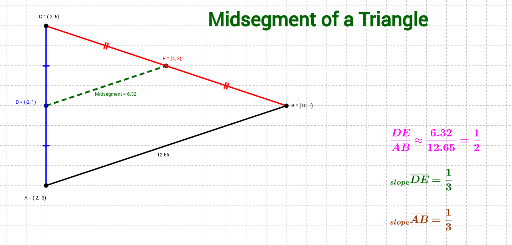
This example illustrates the concept of the midsegment of a triangle, which is a line segment connecting the midpoints of two sides of a triangle. Key mathematical concepts include the midpoints and midsegments of triangles. Using GeoGebra commands such as Segment, Midpoint, and Slope, the properties of the midsegment can be visually demonstrated. Suitable for middle school and above students learning geometric construction.
GeoGebra Commands & Parameters
Segment(A, B) → aSegment(B, C) → bSegment(C, A) → cMidpoint(c) → DMidpoint(b) → ESegment(A, D) → dSegment(D, C) → eSegment(C, E) → fSegment(E, B) → gSegment(D, E) → MidsegmentSlope(Midsegment) → hSlope(a) → iLength(Midsegment) → jLength(a) → kFractionText(h) → text4Segment(A_1, B_1) → a_1Segment(B_1, C_1) → b_1Segment(C_1, A_1) → c_1Midpoint(c_1) → D_1Midpoint(b_1) → E_1Segment(A_1, D_1) → d_1Segment(D_1, C_1) → e_1Segment(C_1, E_1) → f_1Segment(E_1, B_1) → g_1Segment(D_1, E_1) → Midsegment_1Slope(Midsegment_1) → h_1Length(Midsegment_1) → j_1FractionText(h_1) → text4_1Slope(a) → lFractionText(Slope[Midsegment]) → text5FractionText(Slope[a]) → text6
AI Drawing Prompt Reference
Draw a triangle ABC and connect the midpoints D and E of sides AB and BC, forming the midsegment DE. Then, draw another triangle A1B1C1 and connect the midpoints D1 and E1 of sides A1B1 and B1C1, forming the midsegment D1E1. Observe and compare the slopes and lengths of DE and D1E1.
The prompt above was compiled from the original drawing commands and is for reference only.