
Midpoints of a Quadrilateral Form a Parallelogram by Tim Brzezinski
Loading the math board and drawing, please wait…
In collections
Congruence (CO) Cluster
Congruence (Vol 2)
CCSS High School: Geometry (Congruence) Volume 2
CCSS High School: Geometry (Congruence) Volume 2
CCSS High School: Geometry (Congruence) Volume 2
Geometry (Congruence) Volume 2
CCSS High School: Geometry (Congruence) Volume 2
CCSS High School: Geometry (Congruence) Volume 2
CCSS High School: Geometry (Congruence) Volume 2
CCSS High School: Geometry (Congruence) Volume 2
CCSS High School: Geometry (Congruence) Volume 2
CCSS High School: Geometry (Congruence) Volume 2
CCSS High School: Geometry (Congruence) Volume 2
Gail LeBlancCCSS High School: Geometry (Congruence) Volume 2
CCSS High School: Geometry (Congruence) Volume 2
Quadrilaterals
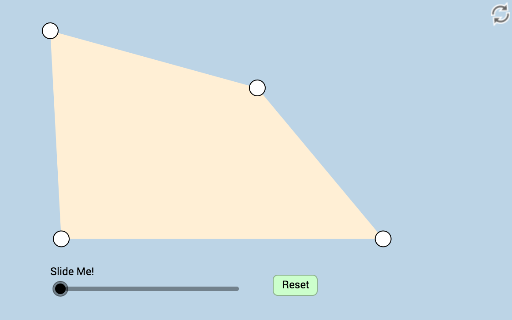
This example dynamically illustrates that the midpoints of any quadrilateral always form a parallelogram. Key mathematical concepts include quadrilaterals, parallelograms, and midpoints. GeoGebra commands used include Polygon, Midpoint, Dilate, etc. Suitable for middle school and above students to learn geometric construction and proofs.
GeoGebra Commands & Parameters
Polygon(A, B, C, D) → poly1, a, b, c, dMidpoint(A, B) → EMidpoint(B, C) → FMidpoint(C, D) → GMidpoint(D, A) → HPolygon(E, F, G, H) → poly2, e, f, g, hDilate(A, If[0 < i ≤ 1, 1 - i, 0], E) → A'Dilate(B, If[0 < i ≤ 1, 1 - i, 0], F) → B'Dilate(C, If[0 < i ≤ 1, 1 - i, 0], G) → C'Dilate(D, If[0 < i ≤ 1, 1 - i, 0], H) → D'Segment(A, A') → jSegment(B, B') → kSegment(C, C') → lSegment(D, D') → mDilate(E, If[1 < i ≤ 2, 2 - i, 0], B) → E'Dilate(F, If[1 < i ≤ 2, 2 - i, 0], C) → F'Dilate(G, If[1 < i ≤ 2, 2 - i, 0], D) → G'Dilate(H, If[1 < i ≤ 2, 2 - i, 0], A) → H'Segment(E, E') → nSegment(F, F') → pSegment(G, G') → qSegment(H, H') → rRotate(A, If[2 < i ≤ 3, ((-(i - 2)) * π), (-π)], E) → A'_1Rotate(A', If[2 < i ≤ 3, ((-(i - 2)) * π), (-π)], E) → A''Segment(A'_1, A'') → j'Rotate(B, If[2 < i ≤ 3, ((-(i - 2)) * π), (-π)], F) → B'_1Rotate(B', If[2 < i ≤ 3, ((-(i - 2)) * π), (-π)], F) → B''Segment(B'_1, B'') → k'Rotate(C, If[2 < i ≤ 3, ((-(i - 2)) * π), (-π)], G) → C'_1Rotate(C', If[2 < i ≤ 3, ((-(i - 2)) * π), (-π)], G) → C''Segment(C'_1, C'') → l'Rotate(D, If[2 < i ≤ 3, ((-(i - 2)) * π), (-π)], H) → D'_1Rotate(D', If[2 < i ≤ 3, ((-(i - 2)) * π), (-π)], H) → D''Segment(D'_1, D'') → m'Dilate(E, If[3 < i ≤ 4, 4 - i, 0], F) → E'_1Segment(E, E'_1) → sDilate(F, If[4 < i ≤ 5, 5 - i, 0], G) → F'_1Segment(F, F'_1) → tDilate(E, If[5 < i ≤ 6, 6 - i, 0], H) → E'_2Vector(E, E'_2) → uTranslate(E, u) → E'_3Translate(E'_1, u) → ISegment(E'_3, I) → s'Dilate(G, If[6 < i ≤ 7, 7 - i, 0], H) → G'_1Vector(G, G'_1) → vTranslate(F, v) → F'_2Translate(F'_1, v) → JSegment(F'_2, J) → t'Polygon(E, F, G, H) → poly3, e_1, f_1, g_1, h_1