
Midpoint Theorem: Dynamic Geometric Construction
Loading the math board and drawing, please wait…
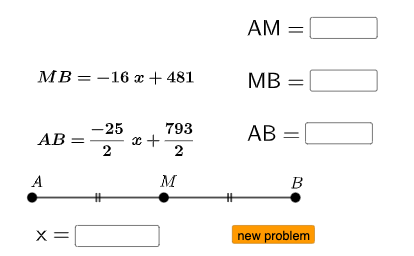
This example demonstrates the Midpoint Theorem using GeoGebra, showing that the line connecting midpoints of a triangle is parallel to the base and half its length. Key mathematical concepts include similarity, proportionality, and geometric construction. The construction involves commands like Midpoint, Segment, and RandomElement to create and verify the theorem. Suitable for middle school students learning geometric proofs and dynamic geometry applications.
GeoGebra Commands & Parameters
Random(1, 3) → nSequence(i, i, -30, 30, 1) → solsetRandomElement(solset) → solRandom(5, 50) → halfLSequence(i, i, -30, 30, 0.5) → coefflistRandomElement(coefflist) → aSimplify(f) → gRandomElement(coefflist) → cSimplify(h) → pExpand(f) → qExpand(h) → rRandomElement(coefflist) → AExpand(s) → tSegment(C, D) → iMidpoint(i) → ESegment(C, E) → jSegment(E, D) → kTextfield(a_1) → InputBox1Textfield(b_1) → InputBox2Textfield(c_1) → InputBox3Textfield(d_1) → InputBox4If(d_1 ≟ sol, "√", "X") → text5If(a_1 ≟ halfL, "√", "X") → text6If(b_1 ≟ halfL, "√", "X") → text7If(c_1 ≟ (2 * halfL), "√", "X") → text8
AI Drawing Prompt Reference
Create a dynamic triangle in the plane using two chosen vertices for the base endpoints and a third vertex so the triangle is non-degenerate. Draw the base segment between the base endpoints, then find the midpoint on each of the two sides (excluding the base). Connect the two midpoints with a new segment. Keep the base segment and the midpoint-connecting segment visible, and add small text indicators to reflect whether selected input values match the expected relationships, including the idea that the midpoint-connection length corresponds to half the base length. Make the construction adjustable so the triangle can change.
The prompt above was compiled from the original drawing commands and is for reference only.