
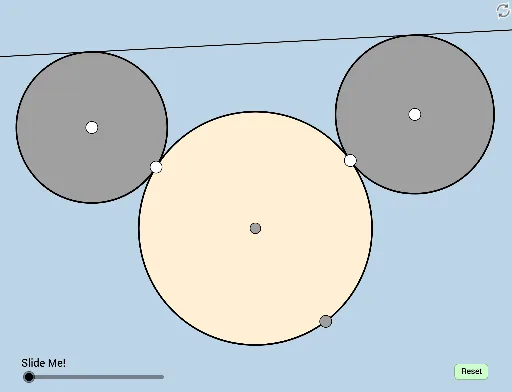
Mickey Mouse Theorem Dynamic Illustration
Loading the math board and drawing, please wait…
This is a dynamic and modifiable illustration of the 'Mickey Mouse Theorem'. The theorem involves properties of circles and angles. Through the construction of basic geometric objects such as points, lines, circles, and tangents, the geometric meaning of the theorem is demonstrated. Suitable for middle school and above students to learn geometric construction and properties of circles.
GeoGebra Commands & Parameters
Circle(A, B) → cPoint(c) → CPoint(c) → DLine(A, D) → fLine(A, C) → gCircle(D, 2) → dCircle(C, 2) → eIntersect(e, g, 2) → EIntersect(d, f, 2) → FRay(D, F) → hRay(C, E) → iPoint(i) → GPoint(h) → ICircle(G, C) → kCircle(I, D) → pTangent(k, p) → j, l, m, nIntersect(-15.601407171722501x² - 1.3443720015595133x y + 0.9727833902891139y² + 24.520011764711146x - 10.706007966687965y = -25.15643549470964, k) → , , ,Intersect(k, l) → HIntersect(p, l) → JOrthogonalLine(H, l) → qOrthogonalLine(J, l) → rLine(J, D) → sLine(H, C) → tIntersect(s, t) → KLine(A, K) → aOrthogonalLine(K, a) → bIntersect(l, a) → LIntersect(q, b) → MIntersect(b, r) → NAngle(G, H, L) → αAngle(L, J, I) → βAngle(A, L, J) → γAngle(A, K, M) → δDilate(I, If[0 < o ≤ 1, 1 - o, 0], J) → I'Dilate(G, If[0 < o ≤ 1, 1 - o, 0], H) → G'Segment(G, G') → f_1Segment(I, I') → g_1Dilate(H, If[1 < o ≤ 2, 2 - o, 0], C) → H'Dilate(J, If[1 < o ≤ 2, 2 - o, 0], D) → J'Segment(H, H') → h_1Segment(J, J') → i_1Dilate(D, If[2 < o ≤ 3, 3 - o, 0], K) → D'Dilate(C, If[2 < o ≤ 3, 3 - o, 0], K) → C'Segment(D, D') → j_1Segment(C, C') → k_1Dilate(A, If[3 < o ≤ 4, 4 - o, 0], K) → A'Segment(A, A') → l_1Dilate(A, If[4 < o ≤ 5, 5 - o, 0], L) → A'_1Segment(A, A'_1) → m_1Segment(G, C) → n_1Segment(I, D) → p_1Segment(A, B) → q_1