
Matrix Linear Transformations 2: Visualizing Polygon and Vector Mappings
Loading the math board and drawing, please wait…
In collections
AMSP PD Videos - Teaching Further Pure
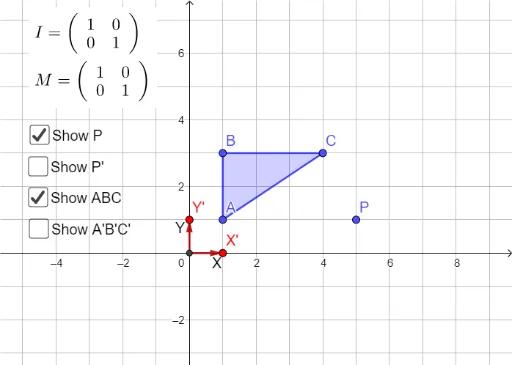
①This example demonstrates how a matrix linear transformation maps polygons and vectors in the 2D plane, showing the geometric changes in position, shape, and orientation before and after the transformation. ②Core mathematical concepts include matrix multiplication, linear transformations, vector mapping, coordinate transformation of polygon vertices, and the effects of the transformation matrix on area, direction, and location. ③Construction highlights: Based on the construction summary, GeoGebra commands such as Intersect, Point, Vector, and Polygon are used to create the original polygon (A,B,C,D,E) and vectors u, v, as well as the transformed polygon (A',B',C',D',E') and vectors w, H. Dependent points P and P' illustrate the correspondence of an arbitrary point under the transformation, and text1 provides explanatory labels. ④This is suitable for high school or early college students learning linear algebra and analytic geometry, and for teachers to demonstrate the intuitive effects of matrix transformations in class, helping to understand concepts like eigenvectors, determinants, and area scaling.
GeoGebra Commands & Parameters
Intersect(xAxis, yAxis) → DPoint(xAxis) → EVector(D, E) → uPoint(yAxis) → FVector(D, F) → vPolygon(A, B, C) → t1, c, a, bVector(D, G) → wVector(D, H) → dPolygon(A', B', C') → t2, c', a', b'