
Matrices - Invariant Lines
Loading the math board and drawing, please wait…
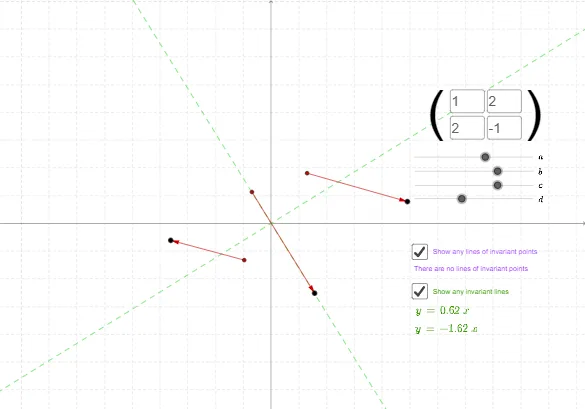
This example demonstrates how matrices affect invariant lines in plane geometry. Key mathematical concepts include matrix transformations and invariant lines. Using GeoGebra commands such as If, Determinant, Vector, Point, etc., the effect of matrix transformations can be constructed. Suitable for high school mathematics education and students learning matrix transformations.
GeoGebra Commands & Parameters
If(r ≠ 0, (t - q - sqrt((q - t)^(2) + ((4 * r) * s))) / ((2 * r)), s / (q - t)) → m_{-}Determinant(M) → determIf(abs(determ) ≤ 0.01, true, false) → detcheckTextfield(q) → inputBox2Textfield(r) → inputBox1Textfield(s) → inputBox3Textfield(t) → inputBox4Vector(O, S) → uVector(Q, U) → vVector(P, T) → aIf(abs(((q - 1) * (t - 1)) - (r * s)) ≤ 0.01, 0, ((q - 1) * (t - 1)) - (r * s)) → detIf(q ≟ 1 ∧ r ≟ 0, (s * x) + ((t - 1) * y) = 0, ((q - 1) * x) + (r * y) = 0) → eq1If(r ≠ 0, (t - q + sqrt((q - t)^(2) + ((4 * r) * s))) / ((2 * r)), s / (q - t)) → m_{+}If(abs(t - (r * m_{+}) - 1) ≤ 0.001, true, false) → kcheck_{+}If(abs(t - (r * m_{-}) - 1) ≤ 0.001, true, false) → kcheck_{-}Point(g) → AOrthogonalLine(A, g) → hPoint(h) → BVector(A, B) → bTranslate(A, c) → A'Line(A', g) → iMirror(g, i) → g'Mirror(i, g') → i'Mirror(g', i') → g''Mirror(i', g'') → i''Mirror(i, g) → i'_{1}Mirror(g, i'_{1}) → g'_{1}Mirror(i'_{1}, g'_{1}) → jMirror(g'_{1}, j) → kMirror(j, k) → j'OrthogonalLine(A, f) → lPoint(l) → CVector(A, C) → dTranslate(A, e) → A'_{1}Translate(f, e) → f'Mirror(f, f') → f'_{1}Mirror(f', f'_{1}) → f''Mirror(f'_{1}, f'') → mMirror(f'', m) → f'''Mirror(f', f) → f''_{1}Mirror(f, f''_{1}) → f'_{2}Mirror(f''_{1}, f'_{2}) → nMirror(f'_{2}, n) → pMirror(n, p) → n'If(r ≟ 0 ∧ q ≟ 1, true, false) → vertcheckMirror(f'_{1}, f') → f_1Translate(eq2, (2, 0)) → eq2'Mirror(eq2, eq2') → eq2'_{1}Mirror(eq2', eq2'_{1}) → eq2''Mirror(eq2'_{1}, eq2'') → g_1Mirror(eq2'', g_1) → eq2'''Mirror(eq2', eq2) → eq2''_{1}Mirror(eq2, eq2''_{1}) → eq2'_{2}Mirror(eq2''_{1}, eq2'_{2}) → h_1Mirror(eq2'_{2}, h_1) → i_1Mirror(h_1, i_1) → j_1Rotate(p_1, π / 6) → k_1Rotate(p_1, π / 3) → l_1Rotate(p_1, π / 2) → m_1Rotate(p_1, ((2 * π)) / 3) → n_1Rotate(p_1, ((5 * π)) / 6) → q_1If(q ≟ t ∧ r ≟ 0 ∧ s ≟ 0, true, false) → encheckDefined(f) → fcheckDefined(g) → gcheckIf(q ≟ 1 ∧ r ≟ 0, (s * x) + ((t - 1) * y) = 0, ((q - 1) * x) + (r * y) = 0) → eq3
AI Drawing Prompt Reference
On a coordinate plane, introduce adjustable parameters q, r, s, and t and use them to define two cases of lines via conditional formulas: depending on a computed determinant-like check, choose one of two equations to determine the relevant line(s). Construct orthogonal directions by drawing perpendicular lines through the key reference point(s), and build vectors from the given reference point to establish the base line used for symmetry. Then perform a sequence of reflections successively across the chosen base line and the generated perpendicular/related lines, producing multiple mirrored lines and corresponding points, so that two families of invariant lines under the parameter-driven transformation appear in symmetric pairs. Use the same scheme again with the second branch to show the counterpart invariant structure.
The prompt above was compiled from the original drawing commands and is for reference only.