
Mapping Diagrams for Complex Quadratic Functions & Equations
Loading the math board and drawing, please wait…
In collections
Mapping Diagrams to Visualize Complex Analysis
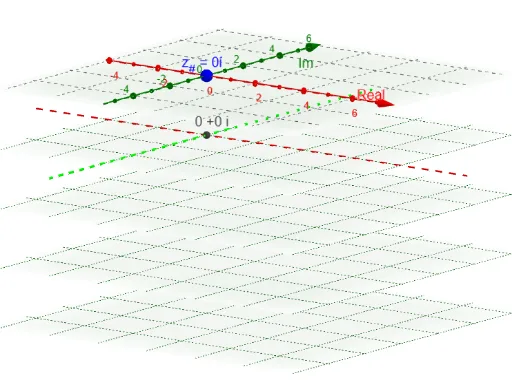
This example demonstrates mapping diagrams for complex quadratic functions and equations, visually illustrating the function's graph and mapping relationships. Key math concepts include complex numbers, function mapping, coordinate geometry, and analytical geometry. Construction highlights involve GeoGebra commands like Sequence, Zip, Line, Circle, Point, If, Vector, Textfield, and Locus. Suitable for high school and above students to understand the geometric meaning and properties of complex functions.
GeoGebra Commands & Parameters
Sequence(0, n) → M_1Zip(((2 * pi) * k / n), k, M_1) → t_*Zip((δ * ℯ^((t * ί))) + z_#, t, t_*) → z_cZip(z_# + ((t - pi) * (P_l - z_#)), t, t_*) → z_lLine(z_#, P_l) → lCircle(z_#, δ) → cPoint(c) → PcIf(m ≟ 1, z_c, z_l) → z_*Zip(s1(z), z, z_*) → fz_*Line(O, ZY1) → Im_{axis}Line(O, ZX1) → Real_{axis}Vector(z_#, fz1_#) → vecf_#Textfield(F) → InputBox1Zip((x(z), y(z), ht), z, fz_*) → fpt_*Zip(Vector[z, w], z, z_*, w, fpt_*) → fvec_*Locus(Pts1Pc, Pc) → loc_cPoint(l) → PlLocus(Pts1Pl, Pl) → loc_lLine((x(O2), y(O2), z(O2)), Vector[(1, 0, 0)]) → Real_{axis2}Line((x(O2), y(O2), z(O2)), Vector[(0, 1, 0)]) → Im_{axis2}Zip(g(s1(z)), z, z_*) → gfz_*Zip((x(z), y(z), (2 * ht)), z, gfz_*) → gfpt_*Zip(Vector[z, w], z, fpt_*, w, gfpt_*) → gfvec_*Locus(Ptgs1Pc, Pc) → loc2_cTextfield(G) → InputBox2Sequence(n_p) → NpZip(z = (ht * k), k, Np) → PlanesZip(mf(g(s1(z))), z, z_*) → Agfz_*Zip((x(z), y(z), (3 * ht)), z, Agfz_*) → Agfpt_*Zip(Vector[z, w], z, gfpt_*, w, Agfpt_*) → Agfvec_*Zip(s2(mf(SQ(s1(z)))), z, z_*) → kAgfz_*Zip((x(z), y(z), (4 * ht)), z, kAgfz_*) → kAgfpt_*Zip(Vector[z, w], z, Agfpt_*, w, kAgfpt_*) → kAgfvec_*Locus(PtAgs1Pc, Pc) → Loc3_cLocus(Pts2Ags1Pc, Pc) → Loc4_cLocus(Ptgs1Pl, Pl) → loc2_lLocus(PtAgs1Pl, Pl) → Loc3_lLocus(Pts2Ags1Pl, Pl) → Loc4_lVector(B3, Is2B3) → uVector(Is2B3, IAIs2B3) → vVector(IAIs2B3, SQRPIAIs2B3) → wVector(IAIs2B3, SQRNIAIs2B3) → bVector(SQRPIAIs2B3, Is1SQRPIAIs2B) → eVector(SQRNIAIs2B3, Is1SQRNIAIs2B) → d