
Malfatti Points Intersection Demo by Steve Phelps
Loading the math board and drawing, please wait…
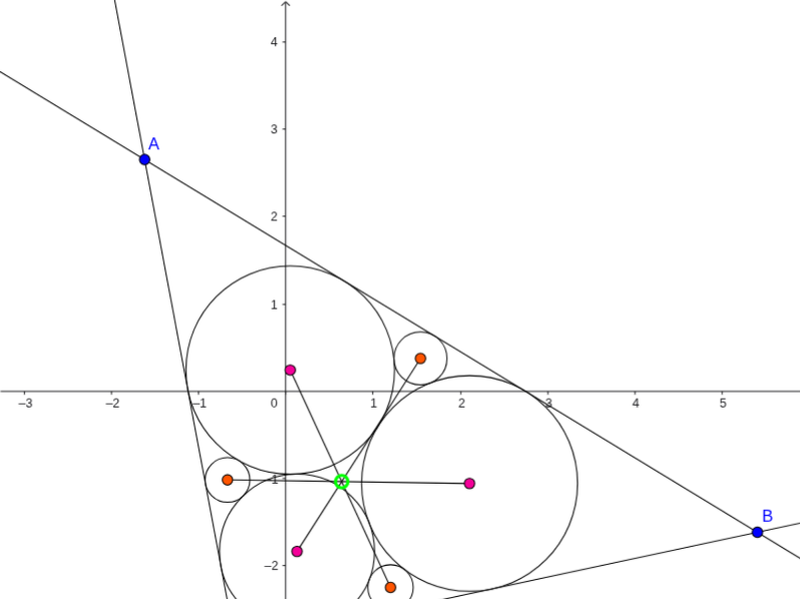
This example demonstrates the intersection points of Malfatti circles within a triangle, highlighting key geometric concepts such as intersections, angle bisectors, orthogonal lines, circles, segments, and transformations. It utilizes GeoGebra commands like Line, AngularBisector, Intersect, OrthogonalLine, Circle, Segment, Mirror, Dilate, Midpoint, and Center to construct the figure. Suitable for high school and advanced learners exploring geometric constructions and complex shapes.
GeoGebra Commands & Parameters
Line(A, B) → aLine(B, C) → bLine(C, A) → cAngularBisector(C, A, B) → dAngularBisector(A, B, C) → eAngularBisector(B, C, A) → fIntersect(d, e) → DAngularBisector(C, A, D) → gAngularBisector(D, C, A) → hIntersect(g, h) → EOrthogonalLine(E, c) → iIntersect(c, i) → FCircle(E, F) → kAngularBisector(D, A, B) → jAngularBisector(D, B, A) → lIntersect(j, l) → GOrthogonalLine(G, a) → mIntersect(a, m) → HCircle(G, H) → pAngularBisector(B, C, D) → nAngularBisector(D, B, C) → qIntersect(n, q) → IOrthogonalLine(I, b) → rIntersect(b, r) → JCircle(I, J) → sIntersect(k, d) → K, NIntersect(p, d) → L, MSegment(E, G) → tMirror(d, t) → d'Segment(E, I) → a_1Segment(I, G) → b_1Mirror(e, b_1) → e'Mirror(f, a_1) → f'Intersect(d', e') → OAngularBisector(O, F, A) → c_1AngularBisector(A, H, O) → d_1Intersect(d, c_1) → POrthogonalLine(P, a) → e_1Intersect(a, e_1) → QCircle(P, Q) → f_1AngularBisector(O, J, B) → g_1Intersect(e, g_1) → ROrthogonalLine(R, a) → h_1Intersect(a, h_1) → SCircle(R, S) → k_1AngularBisector(O, J, C) → i_1Intersect(i_1, f) → TOrthogonalLine(T, b) → j_1Intersect(b, j_1) → UCircle(T, U) → p_1Intersect(p_1, k_1) → V, , ,OrthogonalLine(V, b) → l_1Intersect(b, l_1) → WCircle(V, W) → q_1Dilate(q_1, 0.5, W) → r_1Intersect(k_1, q_1) → Z, A_1, ,Line(A_1, Z) → m_1Midpoint(V, W) → B_1Line(B_1, m_1) → n_1Intersect(r_1, n_1) → C_1, D_1Mirror(r_1, D_1) → s_1Mirror(s_1, q_1) → t_1Intersect(f_1, p_1, 1) → E_1OrthogonalLine(E_1, c) → a_2Intersect(c, a_2) → F_1Midpoint(F_1, E_1) → G_1Circle(G_1, F_1) → c_2Circle(E_1, F_1) → d_2Intersect(f_1, d_2) → H_1, I_1, ,Line(I_1, H_1) → b_2Line(G_1, b_2) → e_2Intersect(c_2, e_2) → J_1, K_1Mirror(c_2, J_1) → f_2Mirror(f_2, d_2) → g_2Intersect(f_1, k_1, 1) → L_1OrthogonalLine(L_1, a) → h_2Intersect(a, h_2) → M_1Midpoint(M_1, L_1) → N_1Circle(L_1, M_1) → k_2Circle(N_1, M_1) → p_2Intersect(k_2, f_1) → O_1, P_1, ,Line(P_1, O_1) → i_2Line(N_1, i_2) → j_2Intersect(p_2, j_2) → Q_1, R_1Mirror(p_2, Q_1) → q_2Mirror(q_2, k_2) → r_2Center(f_1) → S_1Center(p_1) → T_1Center(k_1) → U_1Center(r_2) → V_1Center(g_2) → W_1Center(t_1) → Z_1Segment(S_1, Z_1) → l_2Segment(T_1, V_1) → m_2Segment(W_1, U_1) → n_2Intersect(l_2, m_2) → A_2