
Logarithmic to Exponential Equation Conversion Demo
Loading the math board and drawing, please wait…
In collections
CCGPS AA Unit 4 Lesson 2
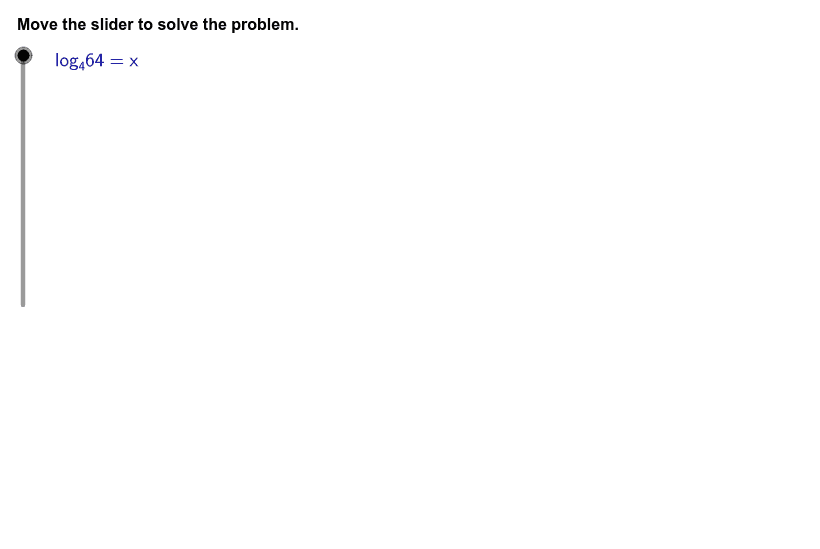
① This example demonstrates converting the logarithmic equation $\log_4 64 = x$ into its equivalent exponential form $4^x = 64$. ② Core mathematical concepts include the definition of logarithms, the inverse relationship between logarithms and exponents, and the notation of base, exponent, and power. ③ Construction highlights: GeoGebra's LaTeX command renders the equations; Line, button1, button2 and other UI objects provide interactive step‑by‑step display; stepper, steps, counter control animation progression; layout parameters such as screenwidth, screenheight, indent, align* ensure a clean interface. ④ Suitable for high‑school mathematics (logarithmic and exponential functions) as a classroom demonstration, student exploration tool, or teacher resource for lesson preparation.
GeoGebra Commands & Parameters
Line((x(Corner[1]) + (indent * screenwidth), 0), yAxis) → align1Line((0, y(Corner[4]) - (indent * screenheight)), xAxis) → alignTopLine((x(Corner[1]) + ((2 * indent) * screenwidth), 0), yAxis) → align2Line((x(Corner[1]) + ((3 * indent) * screenwidth), 0), yAxis) → align3Line((x(Corner[1]) + ((4 * indent) * screenwidth), 0), yAxis) → align4Line((x(Corner[1]) + ((5 * indent) * screenwidth), 0), yAxis) → align5LaTeX((((((("\text{log}_{" * base) * "}{ ") * power) * "}={") * exponent) * "}")) → logeqnLaTeX("\text{Define each part of the given equation in terms of the base, the} \cr \text{exponent, and the quantity that results when the base is raised to} \cr \text{the exponent.}") → text1LaTeX("y = b^x") → eqnLaTeX((((((("{" * base) * "}^{") * exponent) * "}={") * power) * "}")) → anseqnLaTeX((((("\text{Thus, }\textcolor{#000099}{" * logeqn) * "}\text{ written as an exponential equation is }\textcolor{#000099}{") * anseqn) * "}\text{.}")) → text5LaTeX((((((((("\text{In the equation }\textcolor{#000099}{" * logeqn) * "}\text{, the base is }\textcolor{#000099}{") * base) * "}\text{, the exponent is }\textcolor{#000099}{") * exponent) * "}\text{, and the} \cr \text{number is }\textcolor{#000099}{") * power) * "}\text{.}")) → text2LaTeX((("\text{Rewrite the logarithmic equation in the form }\textcolor{#000099}{" * eqn) * "}\text{.}")) → text3LaTeX((("\textcolor{#000099}{" * logeqn) * "}")) → ProblemLaTeX((("\text{The general form of an exponential equation is }\textcolor{#000099}{" * eqn) * "}\text{, where }\textcolor{#000099}\text{x}\text{ is the}\cr \text{exponent,}\textcolor{#000099}\text{ b}\text{ is the base, and}\textcolor{#000099}\text{ y}\text{ is the result of }\textcolor{#000099}\text{b}\text{ raised to the power of }\textcolor{#000099}\text{x}\text{.}\cr \text{Substitute each of the identified terms into the general form.}")) → text4
AI Drawing Prompt Reference
Create a screen layout with a horizontal line at the top and five vertical lines dividing the space into six columns. On the left side, display the logarithmic equation log_4 64 = x. In the following columns, show the general exponential form y = b^x, then the specific exponential equation 4^x = 64, along with descriptive text that labels the base, exponent, and result. Include sliders for the base, exponent, and power to allow interactive exploration of the conversion.
The prompt above was compiled from the original drawing commands and is for reference only.