
Reflection at Fixed and Free Ends of a Linear Wave Carrier
Loading the math board and drawing, please wait…
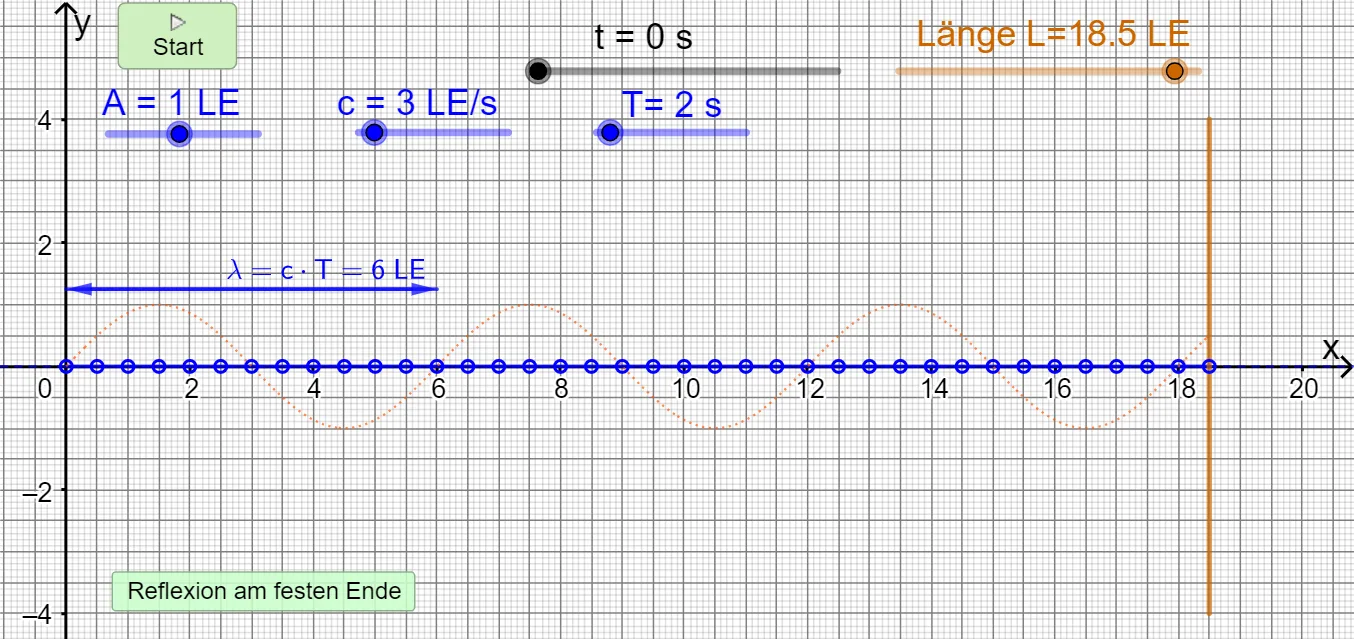
① This GeoGebra example dynamically simulates the reflection of a one-dimensional linear wave at a fixed end (phase inversion) and a free end (no phase inversion), clearly showing how incident and reflected waves superpose to form standing waves. ② Core mathematical concepts include wave superposition, boundary conditions for reflection, standing waves with nodes and antinodes, and trigonometric functions (sine/cosine) for wave representation. ③ Construction highlights: using GeoGebra commands such as Min, Max, Vector, If, Sequence, Element, and Segment to build the incident wave, reflected wave, and resultant wave; sliders (t, L, delta) control time and wave parameters; multiple objects (A_1, T_1, c_1, f, etc.) are used for dynamic updates, and conditional logic (If) distinguishes the phase change at fixed vs. free ends. ④ Suitable for high school physics (wave unit) or introductory university physics, as well as mathematics classes demonstrating trigonometric graphs and transformations, helping students understand how boundary conditions affect wave behavior.
GeoGebra Commands & Parameters
Min((2 * L) - (t * c_2), L) → t2_lMax(t2_l, 0) → t2_lLMin((t * c_1), 16) → t1_rMax(0, (t * c_1) - (c_1 * T_1 / 2)) → t1_lMin(16, 16 - (t * c_2) + (c_2 * T_2 / 2)) → t2_rVector(LambdaEP, LambdaAP) → v2Vector(LambdaAP, LambdaEP) → λMax(0, t1_0) → t1_0MaxIf((t * c_1) < 16, 32, 31) → t1_eIf((t * c_1) > (c_1 * T_1 / 2), 0, 1) → t1_aSequence((k / 2, 0), k, t1_a, Min[t1_0Max, 32]) → l0Sequence((k / 2, f_0(k / 2)), k, 1, 32) → l1Element(LiFunktionen, n) → uVector((16, (-A_2) - 0.25), (16 - (T_2 * c_2), (-A_2) - 0.25)) → v_2Vector((16 - (T_2 * c_2), (-A_2) - 0.25), (16, (-A_2) - 0.25)) → v_2rSegment(RO, RU) → MauerIf(n_d ≟ 1 ∨ n_d ≟ 13, Element[LiDelta, n_d], "") → TxDeltaSchiebe_211If(1 < n_d < 13, Element[LiDelta, n_d], "") → TxDeltaSchiebe_112Max(x(MinKnoten), 0) → minx_KnotenSequence((L - ((k * c_1) * T_1 / 2), 0), k, 0, floor((2 * (L - Min[L, minx_Knoten]) / ((T_1 * c_1))))) → KnotenSequence((L + (c_1 * T_1 / 4) - ((k * c_1) * T_1 / 2), 0), k, 1, floor((2 * (L - Min[L, minx_Knoten - (T_1 * c_1 / 4)]) / ((T_1 * c_1))))) → KnotenloseSequence((k / 2, u(k / 2)), k, 0, (L * 2)) → l2
AI Drawing Prompt Reference
Draw a one-dimensional linear wave undergoing reflection at a fixed end (phase inversion) and a free end (no phase inversion). Show the incident wave, the reflected wave, and their superposition as a resultant waveform, using time control via a slider so the shapes evolve over time. Include sliders for key parameters such as length and wave speed/period, and apply conditional behavior at the boundaries to switch the phase sign only at the fixed end. Represent propagation directions and boundary relationships with vectors, and depict how nodes and antinodes arise in the resultant standing-wave pattern as time progresses.
The prompt above was compiled from the original drawing commands and is for reference only.