
Determine a Triangle-to-Rectangle Area Share with Construction and Algebra Link
Loading the math board and drawing, please wait…
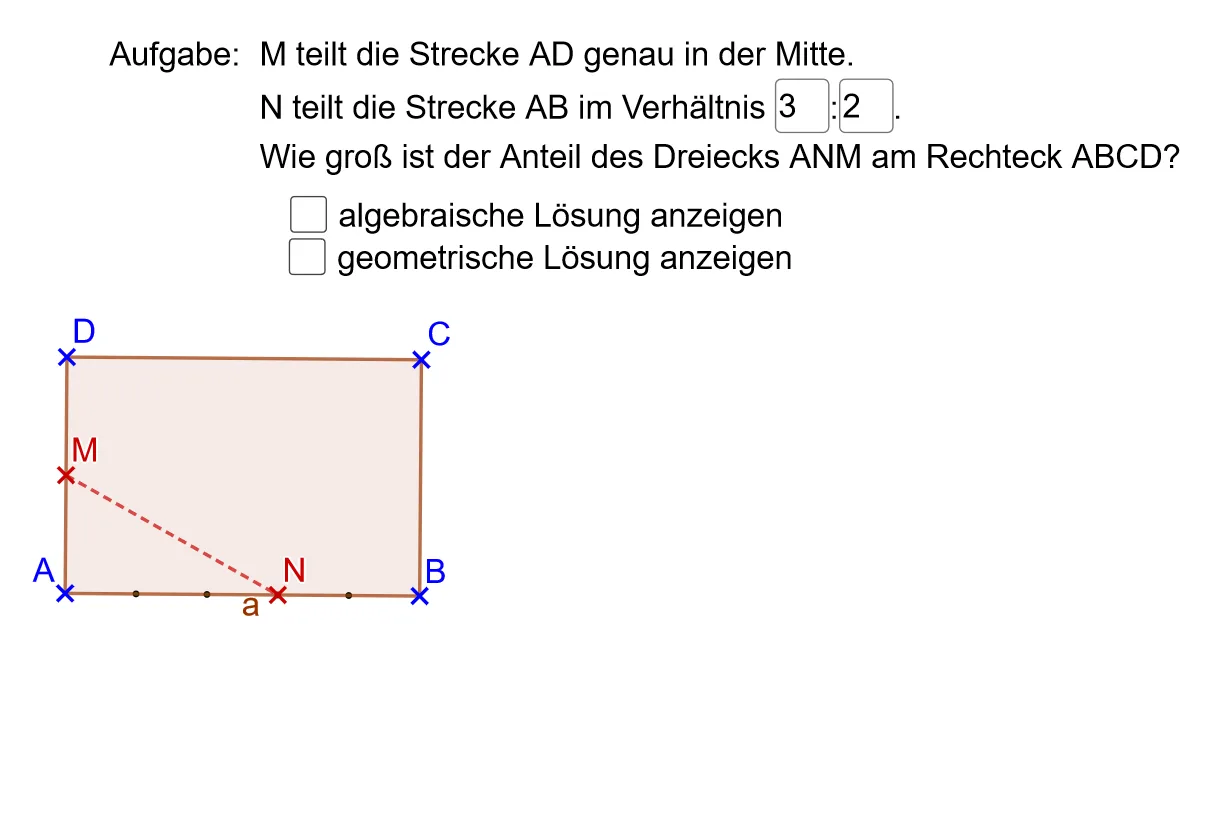
This GeoGebra example animates how to find the fraction of a rectangle’s area occupied by a triangle by connecting a geometric area-decomposition strategy with an algebraic solution. The construction first builds auxiliary points, segments, and partitions inside a rectangle, then expresses the sought area share through core algebraic relationships such as ratios and equation-based quantities. Key concepts include area ratios, relationships between triangle and rectangle areas, and how linear algebraic structures can model the geometric problem. Construction highlights: Point, Segment, and Polygon create the main triangle/rectangle boundaries; Midpoint and OrthogonalLine provide perpendicular and midpoint-based helpers for clean partitioning; Circle and Intersect determine intersection points used in the decomposition; Translate and Sequence generate repeated/preserved configurations to realize the “same-share by shifting” idea; Textfield and text objects display linked algebraic variables; object sets such as lists/Element help organize multiple constructed steps and computed values (including parameters like k, l and coordinate/ratio variables). It is well-suited for middle school through early university learners studying geometry-algebra connections, area reasoning, and modeling with construction geometry.
GeoGebra Commands & Parameters
GCD(xa, (4 * (xa + xb))) → k_zLCM(xa, xb + xa) → kgVPoint(Circle[A, 6]) → BSegment(A, B) → fOrthogonalLine(B, f) → gCircle(B, 4) → cIntersect(c, g, 2) → COrthogonalLine(A, f) → hOrthogonalLine(C, g) → iIntersect(h, i) → DTextfield(xa) → x1Polygon(A, B, C, D) → v1, a, b, c_1, dMidpoint(d) → MTextfield(xb) → x2Circle(A, (xa / (xa + xb) * a)) → eIntersect(e, a, 1) → NSegment(M, N) → jSequence(i, i, 1, xa + xb) → ListeSequence(Polygon[Translate[A, (k * (B - A))], Translate[B, (k * (B - A))], Translate[C, (k * (B - A))], Translate[D, (k * (B - A))]], k, 1, kgV / (xa + xb) - 1) → VVerschiebungSequence(Translate[N, ((N - A) * i)], i, 1, kgV / xa - 1) → NfolgeSequence(Translate[M, ((N - A) * i)], i, 1, kgV / xa - 1) → MFolgeSequence((x(A) + (Element[Liste, k] * (x(B) - x(A)) / (xa + xb)), y(A) + (Element[Liste, k] * (y(B) - y(A)) / (xa + xb))), k, 1, xa + xb - 1) → PunktfolgeSequence(Translate[Punktfolge, (z * (B - A))], z, 1, kgV / (xa + xb) - 1) → PFVerschiebungElement(lTxList, n) → lTxSegment(A, N) → pSegment(A, M) → qSequence(Polygon[Translate[A, ((N - A) * i)], Translate[N, ((N - A) * i)], Translate[M, ((N - A) * i)]], i, 0, kgV / xa - 1) → DFolgeTranslate(DFolge, M - A) → DFolgeoben
AI Drawing Prompt Reference
Draw a rectangle with a triangle inside, where the triangle is formed by connecting a point on one side to the midpoint of the opposite side. Start with the rectangle, mark the midpoint of one side, choose a point on another side, and connect them to create the triangle. Then replicate and translate this triangle and auxiliary segments across the rectangle to show the area ratio between the triangle and the rectangle. Include text labels for two variables representing side length ratios, and add helper circles and perpendicular lines for construction. The final image illustrates the geometric decomposition and algebraic relationship of area shares.
The prompt above was compiled from the original drawing commands and is for reference only.