
Loci of Equal Distance on an Argand Diagram
Loading the math board and drawing, please wait…
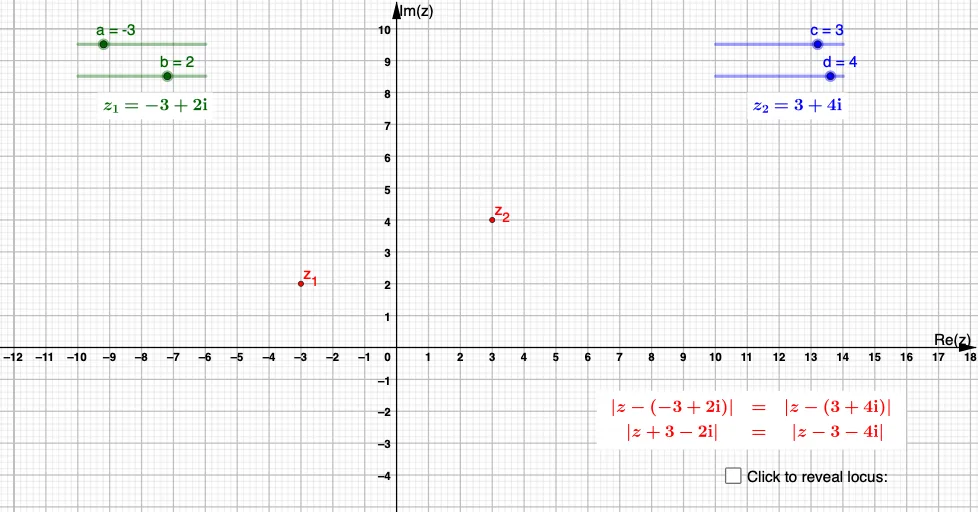
This example demonstrates the geometric construction of equal distance loci on an Argand diagram. Key mathematical concepts include complex numbers, coordinate geometry, and loci. Using GeoGebra commands such as LineBisector, Segment, and Intersect, the equal distance locus can be constructed. Suitable for high school mathematics education and learning.
GeoGebra Commands & Parameters
LineBisector(z_1, z_2) → fSegment(z_1, z_2) → gAngle(f, g) → αIntersect(f, g) → ASegment(z_1, A) → hSegment(A, z_2) → iIf(b < 0, "-", "+") → text4If(a < 0, "+", "-") → text5If(b < 0, "+", "-") → text6If(d < 0, "-", "+") → text7If(c < 0, "+", "-") → text8If(d < 0, "+", "-") → text9
AI Drawing Prompt Reference
Draw two points A and B on the complex plane, then construct the perpendicular bisector f of AB and the line segment g. Find the intersection point A of f and g, and draw line segments h and i from A to A and B, respectively. Finally, based on the signs of b and d, mark the appropriate plus or minus signs in the appropriate positions.
The prompt above was compiled from the original drawing commands and is for reference only.