
Locus of Complex Roots of a Quadratic
Loading the math board and drawing, please wait…
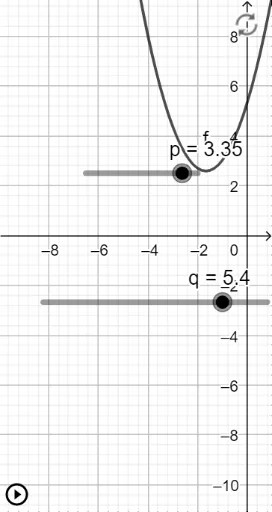
This example demonstrates the locus of complex roots of a quadratic equation. Key mathematical concepts include complex numbers and roots. By using the GeoGebra commands listed in the construction summary, one can observe the trajectory of the roots in the complex plane. Suitable for high school mathematics education, particularly in coordinate geometry and complex numbers.
GeoGebra Commands & Parameters
Numeric p(3.3524199845510996)Numeric q(5.4)y = x^(2) + (p * x) + q(((-p)) / 2 - (p^(2) - (4 * q))^(0.5) / 2, 0)(((-p)) / 2, ((4 * q) - p^(2))^(0.5) / 2)(((-p)) / 2, ((-((4 * q) - p^(2))^(0.5))) / 2)x(R_1) + (y(R_1) * ί)x(R_2) + (y(R_2) * ί)
AI Drawing Prompt Reference
Draw a locus plot of complex roots for a quadratic equation. In the complex plane, use the horizontal axis as the real axis and the vertical axis as the imaginary axis. First, sketch a parabola defined by parameters p (approximately 3.35) and q (5.4). Then mark three root points: one on the real axis, one in the upper half-plane, and one in the lower half-plane, symmetric about the real axis. Finally, indicate the trajectory of these roots as the parameters vary, using arrows or a path. The figure should clearly show the parabola, the three root points, and their symmetry.
The prompt above was compiled from the original drawing commands and is for reference only.