
Linear Patterns Exploration
Loading the math board and drawing, please wait…
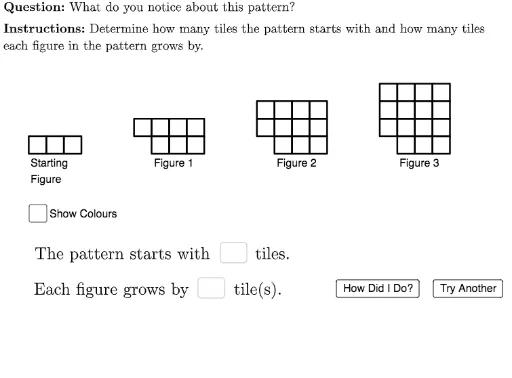
This example demonstrates graphical patterns generated by linear equations. It involves core math concepts like linear equations, algebra, sine, derivatives, pyramids, and secant lines. Constructed using commands like Random, UnicodeToLetter, Textfield, Sequence, Join, and LaTeX, along with objects such as sliders and text fields. Ideal for high school mathematics teaching and function graph exploration.
GeoGebra Commands & Parameters
Random(2, 6) → bRandom(1, 6) → mUnicodeToLetter(10007) → xmarkUnicodeToLetter(10003) → cmarkTextfield(textM) → ansMboxTextfield(textB) → ansBboxSequence(Polygon[(i, 0), (i + 1, 0), 4], i, 1, b) → startFigPurpleSquaresSequence(Polygon[(i + 7, 0), (i + 8, 0), 4], i, 1, b) → fig1purpleSquaresSequence(Polygon[(i + 14, 0), (i + 15, 0), 4], i, 1, b) → fig2purpleSquaresSequence(Polygon[(i, 0), (i + 1, 0), 4], i, 1, b) → startFigBordersSequence(Polygon[(i + 21, 0), (i + 22, 0), 4], i, 1, b) → fig3purpleSquaresSequence(Sequence[Polygon[(8 + b - i, j), (8 + b - i + 1, j), 4], i, 1, m], j, 1, 1) → fig1orangeSquaresSequence(Sequence[Polygon[(15 + b - i, j), (15 + b - i + 1, j), 4], i, 1, m], j, 1, 2) → fig2orangeSquaresSequence(Sequence[Polygon[(22 + b - i, j), (22 + b - i + 1, j), 4], i, 1, m], j, 1, 3) → fig3orangeSquaresJoin({Sequence[Polygon[(i + 7, 0), (i + 8, 0), 4], i, 1, b], Sequence[Sequence[Polygon[(8 + b - i, j), (8 + b - i + 1, j), 4], i, 1, m], j, 1, 1]}) → fig1bordersJoin({Sequence[Polygon[(i + 14, 0), (i + 15, 0), 4], i, 1, b], Sequence[Sequence[Polygon[(15 + b - i, j), (15 + b - i + 1, j), 4], i, 1, m], j, 1, 2]}) → fig2bordersJoin({Sequence[Polygon[(i + 21, 0), (i + 22, 0), 4], i, 1, b], Sequence[Sequence[Polygon[(22 + b - i, j), (22 + b - i + 1, j), 4], i, 1, m], j, 1, 3]}) → fig3bordersLaTeX("\text{\textbf{Question: }What do you notice about this pattern?}") → MainInstrucLaTeX("\text{\textbf{Instructions: }Determine how many tiles the pattern starts with and how many tiles\\each figure in the pattern grows by.}") → SpecInstrucLaTeX("\text{The starting figure has " + b + " tiles and each figure is " + m + " tile(s) larger\\than the previous one.}") → feedback
AI Drawing Prompt Reference
Draw a linear pattern of squares where the initial figure has b squares and each subsequent figure adds m squares. The pattern is divided into three sections, each with different colored squares and varying counts. Borders separate the sections. Include text boxes at the top with instructions to observe the pattern's growth.
The prompt above was compiled from the original drawing commands and is for reference only.