
Linear Growth
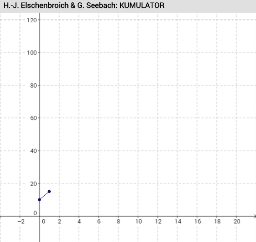
Loading the math board and drawing, please wait…
In collections
ICME 13, TSG 46: Growth and Modelling with KUMULATOR
This example demonstrates the concept of linear growth within geometric constructions using GeoGebra. It involves core mathematical ideas such as sequences, geometric constructions, and coordinate geometry. Key GeoGebra commands and objects used include Sequence, Textfield, LaTeX, First, PolyLine, Element, Polygon, Segment, and If. Suitable for high school mathematics education, illustrating the application of dynamic geometry and sequences.
GeoGebra Commands & Parameters
Sequence((Element[L_T, i + 1], Element[L_{vC}, i + 1]), i, 0, n - 1) → L_{TvCG}Sequence((Element[L_T, i + 1], Element[L_C, i + 1]), i, 0, n) → L_{TCG}Textfield(ST) → TxtSTTextfield(ET) → TxtETTextfield(SA) → TxtSATextfield(SB) → TxtSBTextfield(SC) → TxtSCTextfield(vA) → TxtvATextfield(vB) → TxtvBTextfield(vC) → TxtvCLaTeX(vA, false, false) → TextvALaTeX(vB, false, false) → TextvBLaTeX(vC, false, false) → TextvCFirst(Sequence[(Element[L_T, i + 1], Element[L_A, i + 1]), i, 0, n + 1], Iteration + 1) → L_{TAE}PolyLine(L_{TAE}) → Str_{AE}PolyLine(L_{TBE}) → Str_{BE}First(L_{TCG}, Iteration + 1) → L_{TCE}PolyLine(L_{TCE}) → Str_{CE}Element(L_A, Iteration + 1) → Bestand_AElement(L_B, Iteration + 1) → Bestand_BElement(L_C, Iteration + 1) → Bestand_CElement(L_{vA}, Iteration) → Aenderung_AElement(L_{vB}, Iteration) → Aenderung_BElement(L_{vC}, Iteration) → Aenderung_CFirst(Sequence[(Element[L_T, i + 1], Element[L_{vA}, i + 1]), i, 0, n], Iteration) → L_{TvAE}PolyLine(L_{TvAE}) → Str_{vAE}PolyLine(L_{TvBE}) → Str_{vBE}First(L_{TvCG}, Iteration) → L_{TvCE}PolyLine(L_{TvCE}) → Str_{vCE}Element(L_{TCE}, Iteration) → DrAElement(L_{TCE}, Iteration + 1) → DrCPolygon(DrA, DrB, DrC) → Dreieck_C, dr3, dr2, dr1Element(L_{TvCE}, Iteration) → vCESegment(TX, vCE) → Strecke_{vC}Sequence((Element[L_T, i + 1], Element[L_A, i + 1]), i, 0, n) → L_{TAG}Sequence((Element[L_T, i + 1], Element[L_{vA}, i + 1]), i, 0, n - 1) → L_{TvAG}If(b, 1, 5) → dPolyLine(L_{TAG}) → Str_{AG}PolyLine(L_{TvAG}) → Str_{vAG}PolyLine(L_{TBG}) → Str_{BG}PolyLine(L_{TvBG}) → Str_{vBG}PolyLine(L_{TCG}) → Str_{CG}PolyLine(L_{TvCG}) → Str_{vCG}
AI Drawing Prompt Reference
Draw a linear growth geometric figure with points A, B, and C, and their changes vA, vB, vC. First, generate a series of points based on the coordinates of A, B, and C, then connect these points to form segments and polygons to illustrate the linear growth process. Finally, draw the changes vA, vB, vC of points A, B, and C, and form new segments and polygons with the original points A, B, and C to show the trend of change.
The prompt above was compiled from the original drawing commands and is for reference only.