
Linear Equations & Inequalities Example
Loading the math board and drawing, please wait…
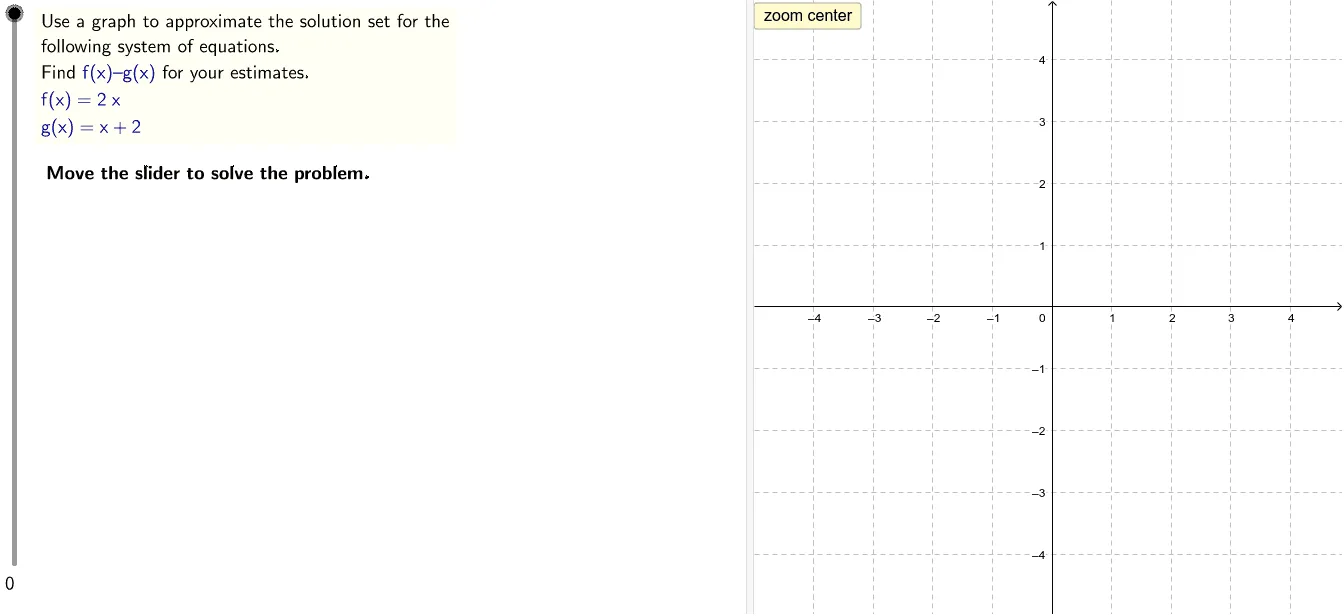
This example demonstrates the representation and solution of linear equations and inequalities in the coordinate system. Key math concepts include linear equations, inequalities, unit circle, rational numbers, circumcircle, etc. GeoGebra commands and objects like LaTeX, Corner, Simplify, If, gb, ga, fa, solx, soly are utilized in the construction. Suitable for high school mathematics teaching to help students understand the geometric meaning and solution methods of linear equations and inequalities.
GeoGebra Commands & Parameters
LaTeX(steps) → counterLaTeX("\text{Move the slider to solve the problem.}") → text0LaTeX("\text{Use the buttons below to return to the original}\cr\text{problem or randomly generate a similar practice}\cr\text{problem.}") → RandomizationTextCorner(2, 3) → toprightCorner(2, 1) → bottomleftSimplify((ga * x) + gb) → gLaTeX((((("\text{Graph }\textcolor{#000099}{f(x) = " * f) * "}\text{ and }\textcolor{#000099}{g(x) = ") * g) * "}\text{ on the same}\cr\text{coordinate axes.}")) → text1LaTeX((((("\text{Use a graph to approximate the solution set for the}\cr\text{following system of equations.}\cr\text{Find }\textcolor{#000099}{f(x) – g(x)}\text{ for your estimates.}\cr\textcolor{#000099}{f(x)=" * f) * "}\cr\textcolor{#000099}{g(x)=") * g) * "}")) → ProblemLaTeX("\text{Approximate the values for }\textcolor{#000099}{x}\text{ where }\textcolor{#000099}{f(x) = g(x)}\text{.}") → text2LaTeX((("\text{The graphs intersect in one point. From the graph, }\cr\textcolor{#000099}{x = " * solx) * "}\text{ appears to be a good estimate.}")) → text3LaTeX((((((("\text{Evaluate }\textcolor{#000099}{f(x)=" * f) * "}\text{ and }\textcolor{#000099}{g(x)=") * g) * "}\text{ for }\textcolor{#000099}{x=") * solx) * "}.")) → text4LaTeX((("\text{Change ``}\textcolor{#000099}{f(x) =}\text{'' and ``}\textcolor{#000099}{g(x) =}\text{'' to ``}\textcolor{#000099}{y =}\text{'' and}\cr\text{substitute }\textcolor{#000099}{" * solx) * "}\text{ for }\textcolor{#000099}{x}.")) → text5LaTeX((((((((("\textcolor{#000099}{y=" * f) * "=") * fa) * "(") * solx) * ")=") * soly) * "}")) → text6If(gb > 0, LaTeX[("+" * gb)], LaTeX[gb]) → gaddLaTeX("\text{Find the difference in the y-values for the equations.}") → text8LaTeX((((((((((("\textcolor{#000099}{y=" * g) * "=") * ga) * "(") * solx) * ")") * gadd) * "=") * solyg) * "}")) → text7If(ydiff ≟ 0, LaTeX["satisfies"], LaTeX["approximately satisfies"]) → satIf(ydiff ≟ 0, LaTeX["x-coordinate"], LaTeX["approximate x-coordinate"]) → coordIf(ydiff ≟ 0, LaTeX["solution"], LaTeX["approximate solution"]) → solnLaTeX((((((("\text{The point whose ordered pair is }\textcolor{#000099}{(" * solx) * ", ") * soly) * ")}\text{ is the}\cr\text{") * soln) * " of this system.}")) → text10LaTeX((((((((((((("\text{Because }\textcolor{#000099}{" * soly) * "-(") * solyg) * ")=") * ydiff) * "}\text{, }\textcolor{#000099}{x=") * solx) * "}\cr\text{") * sat) * " }\textcolor{#000099}{f(x)=g(x)}\text{ and is the}\cr\text{") * coord) * " of a solution to the}\cr\text{system.}")) → text9