
Lens Image Distance Example
Loading the math board and drawing, please wait…
In collections
CCGPS AA Unit 6 Lesson 5
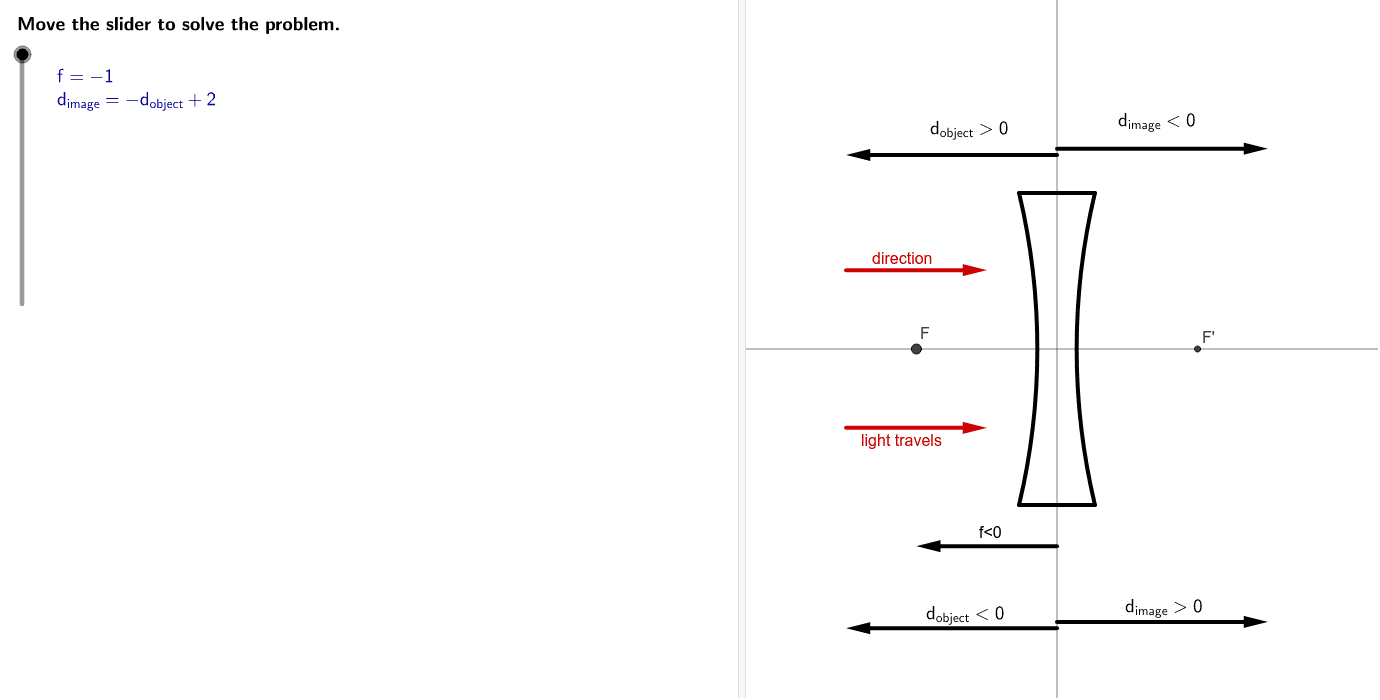
This example demonstrates the relationship between object distance (d₁) and image distance (d₂) in lens imaging, highlighting geometric mean properties. Core concepts include object/image distances, geometric mean, and lens imaging formulas. GeoGebra commands like LaTeX, points, circumcircle arcs, vectors, and midpoints are used in construction. Suitable for high school physics and mathematics education on optics and geometric modeling.
GeoGebra Commands & Parameters
LaTeX(steps) → counterLaTeX("\text{Move the slider to solve the problem.}") → text0Corner(1) → ACorner(3) → BPoint(xAxis) → DCircumcircleArc(C, D, F_1) → cCircumcircleArc(I, J, H) → dCircumcircleArc(G, D, E) → eCircumcircleArc(E, J, G) → fSegment(C, H) → bSegment(F_1, I) → gIf(sgn(focal) < 0, "f<0", "f>0") → focaltextVector((0, -1.25), (x(F), (-1.25))) → uMidpoint((0, -1.25), (sgn(focal), (-1.25))) → MLaTeX("d_{image}<0") → imagetextnegVector((0, -1.77), (-1.5, -1.77)) → vMidpoint((0, -1.77), (-1.5, -1.77)) → NVector((0, -1.73), (1.5, -1.73)) → wMidpoint((0, -1.73), (1.5, -1.73)) → OLaTeX("d_{image}>0") → imagetextposVector((0, 1.23), (-1.5, 1.23)) → hMidpoint((0, 1.23), (-1.5, 1.23)) → PVector((0, 1.27), (1.5, 1.27)) → iMidpoint((0, 1.27), (1.5, 1.27)) → QLaTeX("d_{object}>0") → objecttextposLaTeX("d_{object}<0") → objtextnegLine((-1, 0), (1, 0)) → jLine((0, -1), (0, 1)) → kLaTeX("\textcolor{#000099}{f=\frac{d_{object}d_{image}}{d_{object}+d_{image}}}") → text3If(focal < 0, LaTeX[("-d_{object}+" * diff)], LaTeX[("d_{object}+" * diff)]) → drelationLaTeX((((("\textcolor{#000099}{f=" * focal) * "}\cr\textcolor{#000099}{d_{image}= ") * drelation) * "}")) → ProblemIf(focal < 0, LaTeX[diff], LaTeX[("2d_{object}+" * diff)]) → denominatorIf(focal < 0, LaTeX[(("-d_{object}^2+" * diff) * "d_{object}")], LaTeX[(("d_{object}^2+" * diff) * "d_{object}")]) → numeratorLaTeX((("\text{Multiply both sides by }\textcolor{#000099}{" * denominator) * "}.")) → text8If(focal < 0, LaTeX[(focal * diff)], LaTeX[(((focal * 2) * "d_{object}+") * focaldiff)]) → leftsideLaTeX((((((("\textcolor{#000099}{" * focal) * "=\frac{") * numerator) * "}{") * denominator) * "}}")) → text7LaTeX((((("\textcolor{#000099}{" * leftside) * "=") * numerator) * "}")) → text9If(focal < 0, LaTeX[(("\text{Subtract }\textcolor{#000099}{" * numerator) * "}\text{ from both sides.}")], LaTeX[(("\text{Subtract }\textcolor{#000099}{" * leftside) * "}\text{ from both sides.}")]) → text10If(focal < 0, LaTeX[(((("\textcolor{#000099}{d_{object}^2-" * diff) * "d_{object}") * leftside) * "=0}")], LaTeX[(((("\textcolor{#000099}{d_{object}^2 +(" * linterm) * ")d_{object}-") * focaldiff) * "=0}")]) → text11LaTeX("\text{}") → text14If(focal < 0, Polynomial[x^(2) - (diff * x) + (focal * diff)], Polynomial[x^(2) + ((diff - (2 * focal)) * x) - (focal * diff)]) → pUnique(Zip[x(a), a, zeropts]) → zerosLength(zeros) → numzerosIf(Element[zeros, Length[zeros]] ≟ 0 ∨ Element[zeros, 1] ≟ 0, LaTeX["\text{A zero value for }\textcolor{#000099}{d_{object}}\text{ makes no}\cr\text{sense because the object will be in the}\cr\text{middle of the lens.}"], "") → zerorootIf(Element[zeros, 1] < 0, LaTeX["\text{A negative value for }\textcolor{#000099}{d_{object}}\text{ means the object is on}\cr\text{the right side of the lens. This is a virtual object}\cr\text{which typically occurs only in multi-lens systems.}\cr"], "") → negrootIf(Element[zeros, Length[zeros]] > 0, LaTeX["\text{A positive value for }\textcolor{#000099}{d_{object}}\text{ means the object is on}\cr\text{the left side of the lens.}\cr"], "") → posrootLaTeX(((negroot * posroot) * zeroroot)) → text17LaTeX("\textcolor{#000099}{x=\frac{-b\pm\sqrt{b^2-4ac}}{2a}}") → text20If(focal < 0, (focal * diff), ((-focal) * diff)) → quadcIf(focal < 0, (-diff), diff - (2 * focal)) → quadbLaTeX((((((("\textcolor{#000099}{d_{object}=\frac{-(" * quadb) * ")\pm\sqrt{(") * quadb) * ")^2-4(1)(") * quadc) * ")}}{2(1)}}")) → text22LaTeX("\text{Simplify.}") → text23LaTeX((("\textcolor{#000099}{d_{object}=" * zeros) * "}")) → text24If(focal > 0, Zip[a + diff, a, zeros], Zip[(-a) + diff, a, zeros]) → imagesLaTeX("\text{Find }\textcolor{#000099}{d_{image}}\text{ and interpret the result in terms of the}\cr\text{image location relative to the lens.}") → text25LaTeX((("\textcolor{#000099}{d_{image}=" * images) * "}")) → text26If(Min[images] < 0, LaTeX["\text{A negative value for }\textcolor{#000099}{d_{image}}\text{ means the image is on}\cr\text{the left side of the lens.}\cr"], "") → negimageIf(Max[images] > 0, LaTeX["\text{A positive value for }\textcolor{#000099}{d_{image}}\text{ means the image is on}\cr\text{the right side of the lens.}\cr"], "") → posimageIf(Element[images, Length[images]] ≟ 0 ∨ Element[images, 1] ≟ 0, LaTeX["\text{A zero value for }\textcolor{#000099}{d_{image}}\text{ makes no sense because}\cr\text{the image will be in the middle of the lens.}"], "") → zeroimageLaTeX(((negimage * posimage) * zeroimage)) → text27Vector(((-Element[zeros, chooseSolution]), 0), ((-Element[zeros, chooseSolution]), 1)) → lVector((Element[images, chooseSolution], 0), (Element[images, chooseSolution], ((-Element[images, chooseSolution])) / Element[zeros, chooseSolution])) → mLaTeX((((("\textcolor{#000099}{d_{object}=" * Element[zeros, chooseSolution]) * "}\cr \textcolor{#006633}{d_{image}=") * Element[images, chooseSolution]) * "}")) → text28Vector((((-1.5) * abs(focal)), 0.5), (((-0.5) * abs(focal)), 0.5)) → nVector((((-1.5) * abs(focal)), (-0.5)), (((-0.5) * abs(focal)), (-0.5))) → qLaTeX("\text{Use the buttons below to return to the original problem or}\cr\text{randomly generate a similar practice problem.}") → RandomizationTextLaTeX("\text{Substitute the defined variables into the thin lens equation and simplify.}") → text1LaTeX("\text{Given function}") → text2LaTeX((((((("\textcolor{#000099}{(" * focal) * ")=\frac{d_{object}(") * drelation) * ")}{d_{object}+(") * drelation) * ")}}")) → text5If(focal < 0, LaTeX[(((("\text{Graph the simplified equation }\cr\textcolor{#000099}{d_{object}^2-" * diff) * "d_{object}") * leftside) * "=0}.")], LaTeX[(((("\text{Graph the simplified equation }\textcolor{#000099}{d_{object}^2 +(" * linterm) * ")d_{object}-") * focaldiff) * "=0}.")]) → text13LaTeX("\text{Describe the zeros of the function and what that implies for the number of }\cr\text{possible solutions for }\textcolor{#000099}{d_{object}}\text{ and }\textcolor{#000099}{d_{image}.}") → text15LaTeX((((((("\text{There are " * numzeros) * " possible positions for the object so that}\cr\textcolor{#000099}{d_{image}=") * drelation) * "}\text{ is true for a focal length of }\textcolor{#000099}{f=") * focal) * "}.")) → text16LaTeX("\text{Quadratic formula}") → text19LaTeX((((("\text{Substitute }\textcolor{#000099}{d_{object}}\text{ for }\textcolor{#000099}{x}\text{, }\cr\textcolor{#000099}{1}\text{ for }\textcolor{#000099}{a}\text{, }\textcolor{#000099}{" * quadb) * "}\text{ for }\textcolor{#000099}{b}\text{,}\cr\text{and }\textcolor{#000099}{") * quadc) * "}\text{ for }\textcolor{#000099}{c}.")) → text21LaTeX("\text{Solve the simplified formula for }\textcolor{#000099}{d_{object}.}") → text18LaTeX((((("\text{Substitute the given focal length, }\textcolor{#000099}{f=" * focal) * "}\text{,}\cr\text{and the relationship between the image and}\cr\text{object distances, }\textcolor{#000099}{d_{image}=") * drelation) * "}.")) → text4LaTeX("\text{Simplify the numerator and denominator.}") → text6If(focal < 0, LaTeX[(((("\text{The simplified function can be written as }\cr\textcolor{#000099}{d_{object}^2-" * diff) * "d_{object}") * leftside) * "=0}\text{.}")], LaTeX[(((("\text{The simplified function can be written as }\cr\textcolor{#000099}{d_{object}^2 +(" * linterm) * ")d_{object}-") * focaldiff) * "=0}\text{.}")]) → text12LaTeX("\text{Move the slider to change the object's location.}") → text29
AI Drawing Prompt Reference
Draw a geometric model of lens imaging to show the relationship between object distance and image distance, using arcs to represent light paths and highlighting geometric mean properties. Include coordinate axes, focal points, object and image points, vectors for light paths, different colors for positive and negative values, and the formula derivation process to finally obtain the mathematical relationship between object and image distances.
The prompt above was compiled from the original drawing commands and is for reference only.