
Law of Cosines Proof by Sook Campanelli
Loading the math board and drawing, please wait…
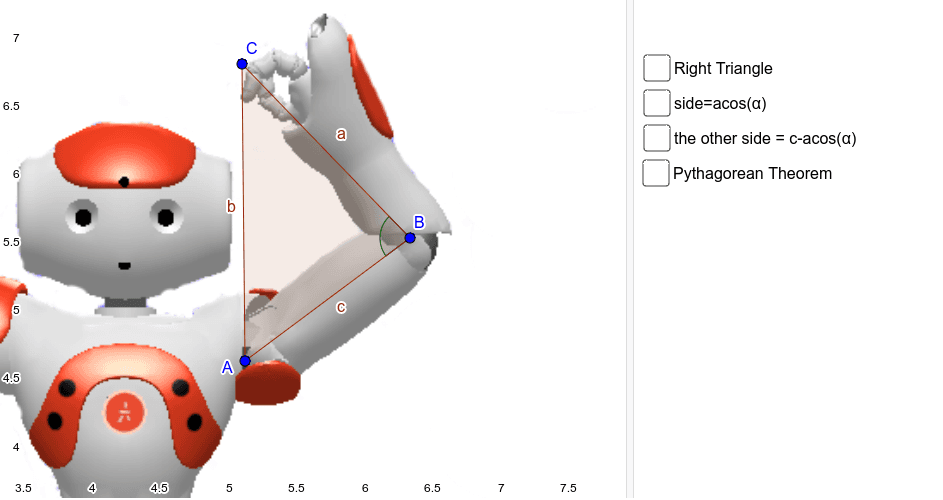
This example dynamically demonstrates the proof of the Law of Cosines, showing that the square of any side of a triangle equals the sum of the squares of the other two sides minus twice their product times the cosine of the included angle. It involves core concepts like the Law of Cosines, triangle geometry, vectors, and coordinate geometry. Construction highlights include using GeoGebra commands such as Polygon, Angle, OrthogonalLine, Intersect, Segment, Slider, and Locus to build the triangle and auxiliary lines, and to visualize dynamic changes. Suitable for high school students and teachers to understand the proof process and geometric significance.
GeoGebra Commands & Parameters
Polygon(E, C, D) → poly1, d, e, cAngle(E, D, C) → αOrthogonalLine(E, e) → fIntersect(f, e) → FSegment(E, F) → heightSegment(D, F) → side1Segment(F, C) → side2Polygon(E, C, F) → poly2, f_1, e_1, c_1
AI Drawing Prompt Reference
Draw a triangle ABC with point A at the origin, point B on the x-axis, and point C in the first quadrant. Use vector and coordinate geometry to construct a perpendicular line from D to BC, intersecting at point D. Then, connect AD and construct a new triangle ACD, labeling the angle at A. Adjust the positions of points B or C to observe the relationship between the sides of triangle ABC and angle A, and verify the Law of Cosines.
The prompt above was compiled from the original drawing commands and is for reference only.