
Lagrange Multipliers
Loading the math board and drawing, please wait…
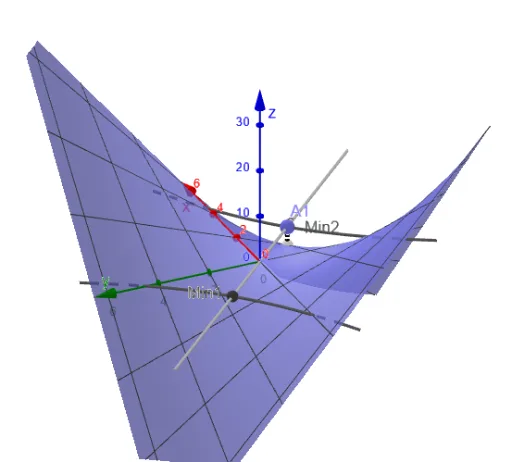
This example demonstrates the Lagrange multiplier method for finding the minima of a function of two variables. It involves core mathematical concepts such as derivatives, function extrema, and optimization. The construction uses GeoGebra commands like 'Function', 'Point', 'Segment', and 'Intersect' to plot the function, constraint, and key points (c, a, A1, Min1, Min2). Suitable for high school students and learners needing to understand optimization techniques.
GeoGebra Commands & Parameters
Function((x * y), -10, 10, -10, 10) → aPoint(c) → A1Segment(A, A1) → HightIntersect(c, symmetry1, 1) → Min1Intersect(c, symmetry1, 2) → Min2
AI Drawing Prompt Reference
Draw a 2D function plot and mark the extrema under a specific constraint. First, plot the function surface, then identify and label two key points on the surface: one is the minimum point and the other is a related point. Next, draw a perpendicular line from the minimum point to the boundary line of the surface, marking the foot of the perpendicular. Finally, find another minimum point on the surface and connect the foot of the perpendicular to this point to complete the illustration.
The prompt above was compiled from the original drawing commands and is for reference only.