
Isosceles Trapezoid Diagonals Proof
Loading the math board and drawing, please wait…
In collections
Expressing Geometric Properties with Equations (GPE) Cluster
Unit 7: Polygons and Quadrilaterals
Quadrilaterals
Coordinate Geometry Proof Prompts
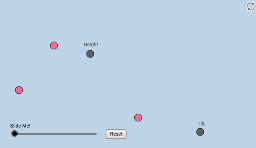
This example uses coordinate geometry to prove that the diagonals of an isosceles trapezoid are congruent. Key mathematical concepts include the properties of isosceles trapezoids and coordinate geometry. Using GeoGebra commands such as line, ray, point, midpoint, slope, mirror, and rotate, the construction demonstrates how to prove the congruence of the diagonals of an isosceles trapezoid. Suitable for students in middle school and above who are learning geometric proofs.
GeoGebra Commands & Parameters
Line(A, B) → aRay(A, B) → bPoint(b) → CMidpoint(A, C) → DLine(A, C) → cSlope(c) → dOrthogonalLine(D, c) → gPoint(g) → ERay(D, E) → hPoint(h) → FSlope(h) → iLine(F, c) → lPoint(l) → GPoint(l) → HRay(F, G) → mRay(F, H) → nPoint(m) → IMirror(I, h) → I'Dilate(A, If[0 < o ≤ 1, 1 - o, 0], C) → A'Segment(A, A') → pDilate(A, If[1 < o ≤ 2, 2 - o, 0], I) → A'_1Segment(A, A'_1) → qSegment(A, C) → rSegment(C, I') → sSegment(I', I) → tSegment(I, A) → a_1Circle(A, (0.2 * Min[a_1, r])) → c_1Circle(I, (0.2 * Min[a_1, r])) → d_1Intersect(d_1, a_1, 1) → JIntersect(d_1, t, 1) → KIntersect(c_1, r, 1) → LIntersect(c_1, a_1, 1) → MDilate(I, If[2 < o ≤ 3, 3 - o, 0], I') → I'_1Segment(I, I'_1) → b_1Dilate(A, If[3 < o ≤ 4, 4 - o, 0], C) → A'_2Vector(A, A'_2) → uTranslate(A, u) → A'_3Translate(A'_1, u) → NSegment(A'_3, N) → q'OrthogonalLine(A, r) → g_1Point(g_1) → OAngle(I, A, O) → αAngle(I', C, A) → βRotate(A'_3, If[4 < o ≤ 5, (((o - 4) * 2) * α), (2 * α)], C) → PRotate(N, If[4 < o ≤ 5, (((o - 4) * 2) * α), (2 * α)], C) → N'Segment(P, N') → q''Dilate(A, If[5 < o ≤ 6, 6 - o, 0], C) → A'_4Vector(A, A'_4) → vDilate(I, If[7 < o ≤ 8, 8 - o, 0], I') → I'_2Vector(I, I'_2) → wDilate(A, If[5 < o ≤ 6, 6 - o, 0], I') → A'_5Segment(A, A'_5) → i_1Dilate(A, If[6 < o ≤ 7, 7 - o, 0], I) → A'_6Vector(A, A'_6) → u_1Translate(A, u_1) → A'_7Translate(A'_5, u_1) → QSegment(A'_7, Q) → j_1Segment(I, C) → l_1Angle(L, A, I') → γRotate(A'_7, If[11 < o ≤ 12, ((-(o - 11)) * (2 * γ)), (-2 * γ)], I) → RRotate(Q, If[7 < o ≤ 8, (((-(o - 7)) * 2) * γ), (-2 * γ)], I) → Q'Segment(R, Q') → m_1Polygon(A, C, I', I) → poly1, a_2, c_2, i', i_2
AI Drawing Prompt Reference
Draw an isosceles trapezoid and prove that its diagonals are equal. First, create two parallel lines a and c, then take points A and B on a and C on c, making AC the base of the trapezoid. Next, find the midpoint D of AC, construct a line g perpendicular to AC through D, intersecting g at point E, then construct a line h through D, intersecting h at point F. Then, construct a line l parallel to AC through F, intersecting l at point G, and construct a line m perpendicular to AC through F, intersecting m at point I, and mirror I to get I'. Next, construct a circle c_1 and d_1 with C as the center and 0.2 times the length of AC as the radius, find their intersections with AC and I', construct line segments p and q. Then, construct line segments r and s, find their intersections with circles c_1 and d_1, construct line segments t and a_1. Next, construct line segments b_1 with circles c_1 and d_1 and line segments a_1 and t, construct line segment b_1. Then, construct vector u, translate point A to get A'_3 and N, construct line segment q'. Next, construct a line g_1 perpendicular to r through A, intersecting g_1 at point O, construct angles α and β, rotate A'_3 and N' by 2α, construct line segment q''. Finally, construct vector v, translate point A to get A'_4.
The prompt above was compiled from the original drawing commands and is for reference only.