
Isosceles Trapezoid Construction
Loading the math board and drawing, please wait…
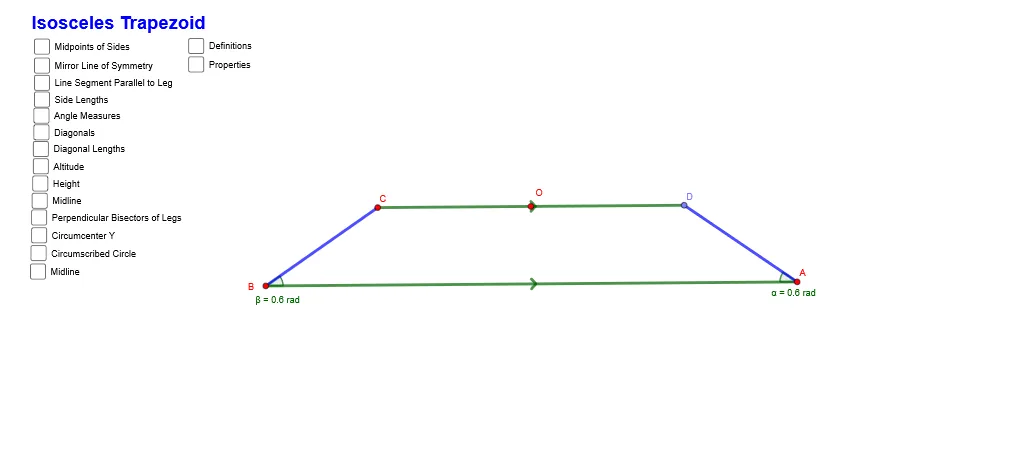
This example demonstrates the construction of an isosceles trapezoid. Key mathematical concepts include the properties of trapezoids, midpoints, orthogonal lines, segments, reflections, angles, and distances. Using GeoGebra commands such as Segment, Midpoint, OrthogonalLine, and Point, the example dynamically illustrates the geometric properties of the isosceles trapezoid. Suitable for students at the middle school level and above for learning geometric constructions and related concepts.
GeoGebra Commands & Parameters
Segment(B, A) → fMidpoint(B, A) → MOrthogonalLine(M, f) → hPoint(h) → OLine(O, f) → gOrthogonalLine(B, f) → iIntersect(g, i) → FSegment(O, F) → jPoint(j) → CSegment(B, C) → kMirror(C, h) → DSegment(C, D) → lSegment(D, A) → mLine(D, k) → nIntersect(n, f) → ESegment(D, E) → pAngle(A, B, C) → βAngle(D, A, B) → αMidpoint(B, C) → NMidpoint(A, D) → PAngle(B, C, D) → γAngle(C, D, A) → δDistance(A, D) → distanceADDistance(B, C) → distanceBCDistance(C, D) → distanceCDDistance(A, B) → distanceABSegment(B, D) → qSegment(A, C) → rIntersect(q, r) → XDistance(A, C) → distanceACDistance(B, D) → distanceBDPoint(l) → GOrthogonalLine(G, l) → f_1Intersect(f_1, f) → HAngle(A, H, G) → εSegment(G, H) → g_1Segment(N, P) → h_1Distance(G, H) → distanceGHOrthogonalLine(N, k) → i_1OrthogonalLine(P, m) → j_1Intersect(h, i_1) → YCircle(Y, B) → c_1Segment(N, P) → k_1
AI Drawing Prompt Reference
Draw an isosceles trapezoid ABCD with AB and CD parallel, and AD equal to BC. First, draw segment AB, then find the midpoint M of AB and draw a perpendicular line h through M. On line h, take point O and draw a line g through O, perpendicular to AB. Next, draw a perpendicular line i from B to AB, and let the intersection of i and g be point F. Connect OF. Then, draw segment OC, with C being the intersection of OF and a perpendicular line to AB. Draw segment BC, and let D be the reflection of C over line h, then connect CD. Draw segment AD, and let E be the intersection of D's perpendicular line to BC and AB, then connect DE. Finally, measure the lengths and angles of each side and angle to ensure the trapezoid is isosceles.
The prompt above was compiled from the original drawing commands and is for reference only.