
Isosceles & Right Triangles 3D Vector Animation
Loading the math board and drawing, please wait…
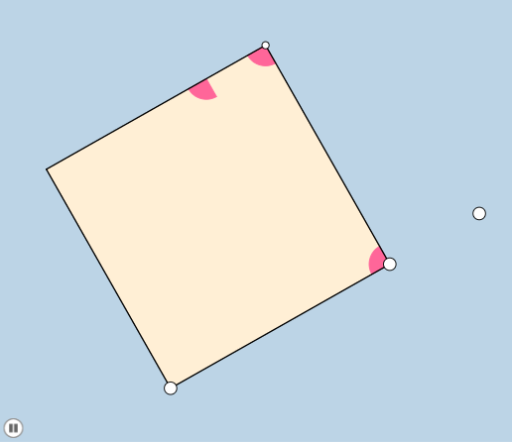
This example demonstrates isosceles and right triangles in 3D space with vector representations and linear equation transformations through animation. Key math concepts include properties of isosceles/right triangles, 3D vector operations, linear equations and functions, geometric transformations (rotation, dilation), and definite integrals. GeoGebra commands like Ray, Segment, Circle, Intersect, Point, OrthogonalLine, Line, Polygon, Rotate, Dilate, Midpoint, CircleArc, CircleSector, Vector, Translate, Angle, Mirror are used in construction. Suitable for high school students and math enthusiasts learning spatial geometry and vectors.
GeoGebra Commands & Parameters
Ray(A, B_2) → m_2Segment(A, B_2) → gCircle(B_2, g) → q_2Intersect(q_2, m_2, 2) → J_1Segment(B_2, J_1) → n_2Point(n_2) → K_1Segment(B_2, K_1) → r_2OrthogonalLine(K_1, r_2) → s_2Circle(K_1, r_2) → t_2Intersect(t_2, s_2, 2) → L_1Line(K_1, L_1) → h_3Polygon(A, B_2, 4) → poly1, a, b, c, d, C, DSegment(B_2, C) → hOrthogonalLine(L_1, h) → f_3Intersect(f_3, h) → M_1Line(K_1, M_1) → i_2Rotate(A, If[1 < e ≤ 2, ((-(e - 1)) * π / 2), -1.5707963267948966], B_2) → A'_1Rotate(A'_1, If[2 < e ≤ 3, ((-(e - 2)) * π / 2), -1.5707963267948966], C) → RDilate(A, If[0 < e ≤ 1, 1 - e, 0], B_2) → A'Rotate(A', If[1 < e ≤ 2, ((-(e - 1)) * π / 2), -1.5707963267948966], B_2) → A''Rotate(A'', If[2 < e ≤ 3, ((-(e - 2)) * π / 2), -1.5707963267948966], C) → A'''Segment(R, A''') → f''Intersect(i_2, f'') → V_1Dilate(M_1, If[16 < e ≤ 17, 17 - e, 0], V_1) → Z_1Segment(M_1, Z_1) → e_2Line(C, e_2) → f_4Dilate(A, If[17 < e ≤ 18, 18 - e, 0], M_1) → A'_4Midpoint(A, C) → VCircleArc(V, C, D) → g_2Point(g_2) → BSegment(C, B) → j_1Segment(A, B) → nIntersect(n, f'') → ZSegment(B, Z) → l_1Segment(A, A') → fSegment(A'_1, A'') → f'Segment(C, D) → iCircle(B_2, (0.2 * r_2)) → pSegment(D, A) → jCircle(C, Radius[p]) → kCircle(A, (0.1 * j)) → qCircle(D, (0.1 * j)) → rSegment(A, C) → lSegment(D, B_2) → mIntersect(r, j, 1) → FIntersect(r, m, 1) → GIntersect(r, i, 1) → HIntersect(k, i, 1) → IIntersect(k, l, 1) → JIntersect(k, h, 1) → KIntersect(p, h, 1) → LIntersect(p, m, 1) → MIntersect(p, g, 1) → NIntersect(q, g, 1) → OIntersect(q, l, 1) → PIntersect(q, j, 1) → QCircleSector(B_2, L, N) → sRotate(R, If[3 < e ≤ 4, ((-(e - 3)) * π / 2), -1.5707963267948966], D) → R'Rotate(A''', If[3 < e ≤ 4, ((-(e - 3)) * π / 2), -1.5707963267948966], D) → SSegment(R', S) → f'''Dilate(B_2, If[4 < e ≤ 5, 5 - e, 0], C) → B'Vector(B_2, B') → uTranslate(s, u) → s'Rotate(s', If[5 < e ≤ 6, ((e - 5) * π / 2), 1.5707963267948966], C) → s''Dilate(C, If[6 < e ≤ 7, 7 - e, 0], D) → C'Vector(C, C') → vTranslate(s'', v) → s'''Rotate(s''', If[7 < e ≤ 8, ((e - 7) * π / 2), 1.5707963267948966], D) → tDilate(D, If[8 < e ≤ 9, 9 - e, 0], A) → D'Vector(D, D') → wTranslate(t, w) → t'Rotate(t', If[9 < e ≤ 10, ((e - 9) * π / 2), 1.5707963267948966], A) → t''Dilate(B_2, If[18 < e ≤ 19, 19 - e, 0], C) → B'_1Dilate(B_2, If[18 < e ≤ 19, 19 - e, 0], A) → B'_2Dilate(B_2, If[18 < e ≤ 19, 19 - e, 0], D) → B'_3Vector(B_2, B'_1) → v_1Vector(B_2, B'_3) → w_1Vector(B_2, B'_2) → i_1Circle(A, n - j_1) → h_2Dilate(B, If[10 < e ≤ 11, 11 - e, 0], C) → W'Dilate(B_2, If[13 < e ≤ 14, 14 - e, 0], B) → B'_4Vector(B_2, B'_4) → u_1Translate(s, u_1) → s'_1Line(B, f') → a_1Point(a_1) → UAngle(U, B, C) → αRotate(B, If[14 < e ≤ 15, ((-(e - 14)) * π / 2), ((-π)) / 2], B) → W'_2Rotate(W', If[14 < e ≤ 15, ((-(e - 14)) * π / 2), ((-π)) / 2], B) → W''Line(A, B_2) → h_1Angle(B, A, D) → βDilate(D, If[19 < e ≤ 20, 20 - e, 0], B) → D'_1Mirror(C, D) → C'_1Rotate(C, ((-π)) / 3, B_2) → C'_2Segment(B_2, C'_2) → f_1Segment(C, C'_2) → g_1Intersect(k, g_1, 1) → EIntersect(k, h) → T,CircleSector(C, T, E) → d_1Rotate(D, 15°, C) → D'_2Angle(D, C, D'_2) → γRay(C, D'_2) → k_1Rotate(C, (-(15°)), D) → C'_3Angle(C'_3, D, C) → δRay(D, C'_3) → m_1Rotate(B_2, If[10 < e ≤ 11, (((-π)) / 3 * (e - 10)), ((-π)) / 3], B_2) → A_1Rotate(C, If[10 < e ≤ 11, (((-π)) / 3 * (e - 10)), ((-π)) / 3], B_2) → C'_4Rotate(B_2, If[11 < e ≤ 12, (π / 3 * (e - 11)), π / 3], C) → B_1Rotate(C, If[11 < e ≤ 12, (π / 3 * (e - 11)), π / 3], C) → C'_5Rotate(E, If[12 < e ≤ 13, (((-π)) / 6 * (e - 12)), ((-π)) / 6], C) → E'Rotate(T, 15°, C) → T'Angle(T, C, T') → εRay(C, T') → q_1Dilate(C, If[21 < e ≤ 22, 22 - e, 0], D) → C'_8Vector(C, C'_8) → u_2Rotate(B_2, If[26.75 < e ≤ 27.75, (π / 2 * (e - 26.75)), π / 2], B_2) → H_1Rotate(C'_2, If[26.75 < e ≤ 27.75, (π / 2 * (e - 26.75)), π / 2], B_2) → I_1Rotate(C, If[26.75 < e ≤ 27.75, (π / 2 * (e - 26.75)), π / 2], B_2) → C'_{10}Dilate(B_2, If[10 < e ≤ 11, 11 - e, 0], K_1) → C_1Segment(B_2, C_1) → n_1Rotate(B_2, If[11 < e ≤ 12, ((-(e - 11)) * π / 2), ((-π)) / 2], K_1) → D_1Rotate(C_1, If[11 < e ≤ 12, ((-(e - 11)) * π / 2), ((-π)) / 2], K_1) → E_1Segment(D_1, E_1) → p_1Rotate(D_1, If[12 < e ≤ 13, ((-(e - 12)) * π / 2), ((-π)) / 2], L_1) → F_1Rotate(E_1, If[12 < e ≤ 13, ((-(e - 12)) * π / 2), ((-π)) / 2], L_1) → N_1Segment(F_1, N_1) → r_1Rotate(F_1, If[13 < e ≤ 14, ((-(e - 13)) * π / 2), ((-π)) / 2], M_1) → O_1Rotate(N_1, If[13 < e ≤ 14, ((-(e - 13)) * π / 2), ((-π)) / 2], M_1) → P_1Segment(O_1, P_1) → s_1Polygon(B_2, K_1, L_1, M_1) → poly6, b_3, k_2, l_3, m_3Dilate(B_2, If[14 < e ≤ 15, 15 - e, 0], K_1) → Q_1Vector(B_2, Q_1) → c_1Translate(s, c_1) → s'_2Segment(C, K_1) → e_1Line(A, M_1) → t_1Intersect(t_1, e_1) → R_1Segment(A, R_1) → f_2Dilate(C, If[15 < e ≤ 16, 16 - e, 0], K_1) → C'_6Dilate(A, If[16 < e ≤ 17, 17 - e, 0], M_1) → A'_3Dilate(M_1, If[17 < e ≤ 18, 18 - e, 0], R_1) → S_1Line(R_1, p_1) → g_3Point(g_3) → U_1Angle(U_1, R_1, K_1) → ζPolygon(A, B_2, C, D) → poly7, a_4, b_4, c_4, d_4Dilate(K_1, If[15 < e ≤ 16, 16 - e, 0], M_1) → W_1Segment(K_1, W_1) → p_2Line(A, K_1) → k_3Dilate(A, If[20 < e ≤ 21, 21 - e, 0], V_1) → A'_5Segment(A, A'_5) → s_3Ray(M_1, V_1) → j_3Circle(V_1, 1) → e_3Intersect(e_3, j_3, 2) → T_1Ray(V_1, T_1) → n_3Circle(V_1, (0.2 * r_2)) → p_3Intersect(p_3, n_3, 1) → A_2Intersect(p_3, f'', 2) → C_2Intersect(f_4, h_3) → H_2Dilate(C, If[17 < e ≤ 18, 18 - e, 0], H_2) → C'_7Segment(C, C'_7) → q_3Angle(A_2, V_1, C_2) → ηRotate(C_2, If[17 < e ≤ 18, ((-(e - 17)) * π / 4), ((-π)) / 4], V_1) → D_2CircleSector(V_1, D_2, C_2) → r_3Dilate(V_1, If[18 < e ≤ 19, 19 - e, 0], C) → E_2Vector(V_1, E_2) → v_2Translate(r_3, v_2) → t_3Rotate(t_3, If[19 < e ≤ 20, (((-(e - 19)) * 5) * π / 4), (-5 * π / 4)], C) → e_4Dilate(V_1, If[21 < e ≤ 22, 22 - e, 0], H_2) → F_2Segment(V_1, F_2) → g_4Rotate(A, If[22 < e ≤ 23, ((e - 22) * π / 2), π / 2], V_1) → A'_2Rotate(A'_5, If[22 < e ≤ 23, ((e - 22) * π / 2), π / 2], V_1) → WSegment(A'_2, W) → b_1Line(V_1, s_1) → j_2Dilate(B_2, If[23 < e ≤ 24, 24 - e, 0], V_1) → G_1Vector(B_2, G_1) → w_2Translate(s, w_2) → s'_3Intersect(t, f'', 1) → G_2Angle(G_2, V_1, H_2) → θRotate(s'_3, If[23 < e ≤ 24, ((e - 23) * θ), θ], G_1) → c_2Dilate(A, If[24 < e ≤ 25, 25 - e, 0], H_2) → A'_6Segment(A, A'_6) → l_2Dilate(V_1, If[25 < e ≤ 26, 26 - e, 0], A) → I_2Vector(V_1, I_2) → a_2Translate(r_3, a_2) → d_2Line(A, V_1) → b_2Line(V_1, l_2) → a_3Point(n_3) → J_2Point(a_3) → K_2Angle(K_2, V_1, J_2) → κRotate(d_2, If[26 < e ≤ 27, ((-(e - 26)) * κ), (-κ)], A) → d_3Dilate(L_1, If[17 < e ≤ 18, 18 - e, 0], H_2) → L_2Segment(L_1, L_2) → i_3Segment(K_1, H_2) → c_3
AI Drawing Prompt Reference
Visualize isosceles and right triangles in 3D space with vector representations and linear equation transformations through animation. Show key points, lines, and circles, and demonstrate geometric transformations like rotation and dilation to present a dynamic geometric figure.
The prompt above was compiled from the original drawing commands and is for reference only.