
Isometries Quick Reference (Coordinate Plane)
Loading the math board and drawing, please wait…
In collections
Congruence (Vol 1)
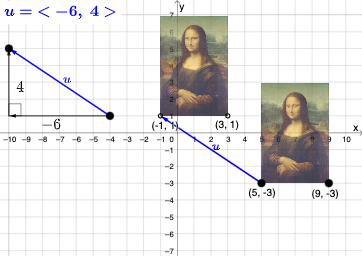
This example visually demonstrates isometries like reflection, rotation, and translation in the coordinate plane, highlighting their properties and algebraic representations. Core concepts include transformations, vectors, coordinate geometry, angles, and the unit circle. GeoGebra commands like Vector, Translate, Rotate, Circle, Line, Mirror, Dilate, Textfield, Intersect, and Angle are used to construct the figures, making it ideal for high school mathematics education.
GeoGebra Commands & Parameters
Vector(D, E) → uTranslate(pic1, u) → pic1'Translate(B, u) → B'Translate(C, u) → C'Vector(B, B') → vRotate(C, δ, A) → C'_1CircleArc(A, C'_1, C) → cCircleArc(A, C, C'_1) → dCircle(A, C) → eLine(F, G) → fMirror(pic1, f) → pic1'_2Mirror(B, f) → B'_2Mirror(C, f) → C'_2Dilate(pic1, k, A) → pic1'_3Dilate(B, k, A) → B'_3Dilate(C, k, A) → C'_3Rotate(B, δ, A) → B'_1Rotate(pic1, δ, A) → pic1'_1Circle(A, C) → pCircleArc(A, C'_1, C) → rTextfield(δ) → InputBox1Textfield(k) → InputBox2Intersect(q, eq1) → HVector(D, H) → wVector(H, E) → lAngle(D, H, E) → ε
AI Drawing Prompt Reference
Draw a coordinate-plane diagram involving isometries. Place points A, C, D, E, B, and C on the plane, then construct a circle centered at A with radius equal to the distance from A to C, and create two circle arcs using A and the rotated position of C (one arc passing through the rotation image C'_1 and the other between C and C'_1). Add an input box for the rotation angle δ and another for the dilation factor k. Construct the translation vector u from D toward E, translate the base figure and specifically points B and C by u to get their translated images, and form a second displacement vector from B to its translated image. Use rotation about A by δ to obtain the rotated point C'_1 and also rotate B about A by δ to obtain B'_1. Draw a line determined by points F and G and mirror the figure across this line, marking the mirrored images of B and C. Finally, dilate the figure about A by factor k, including the dilated images of B and C, and display angle ε defined by points D, H, and E.
The prompt above was compiled from the original drawing commands and is for reference only.