
Isometries Case 3: Combining Translation, Rotation, and Reflection
Loading the math board and drawing, please wait…
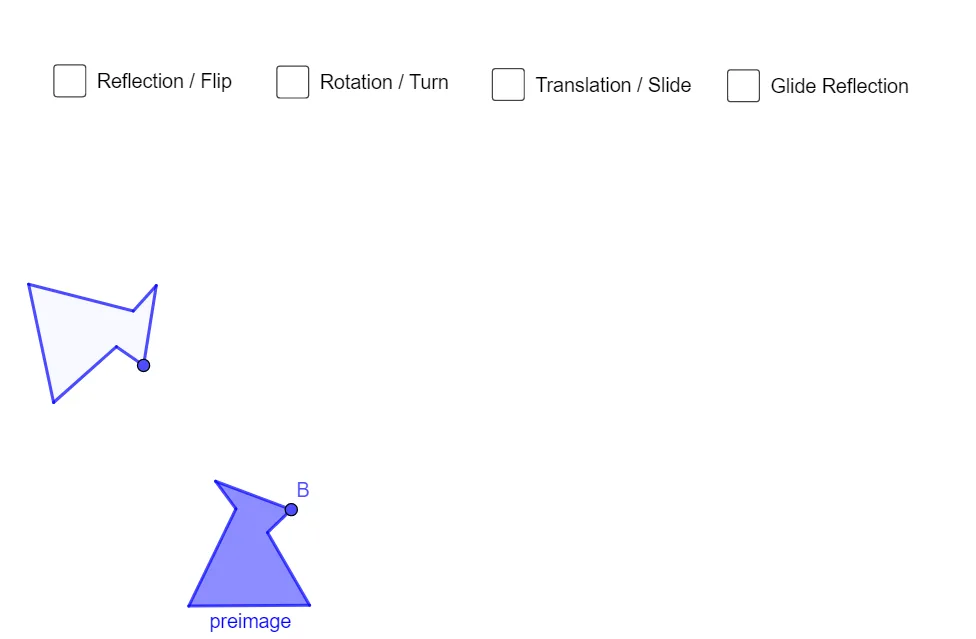
① This example demonstrates the effects of three basic isometries (translation, rotation, reflection) and their composition (glide reflection) on a polygon, allowing visual comparison of preimage and image positions. ② Core mathematical concepts include isometries (distance-preserving transformations), translation vectors, rotation centers and angles, reflection axes, glide reflection (composition of translation and reflection), and composition/inverse of transformations. ③ Construction highlights: using GeoGebra commands Point, Polygon, Vector, Line to construct the original polygon and transformation axes/vectors; Translate, Mirror, Rotate to generate translated, reflected, and rotated images; then combining operations to produce a glide reflection, with labeled points A', B', etc., to show correspondences. ④ Suitable for middle/high school geometry lessons on transformations and symmetry, or introductory college geometry for understanding isometry groups, and for dynamic demonstrations of transformation composition.
GeoGebra Commands & Parameters
Point(Circle[A, 1.2851459061133876]) → BPolygon(A, B, C, D, E, F) → preimage, a, b, c, d, e, fVector(G, H) → VectorLine(I, J) → lineOfReflectionTranslate(A, Vector) → A'Translate(B, Vector) → B'Translate(C, Vector) → C'Translate(D, Vector) → D'Translate(E, Vector) → E'Translate(F, Vector) → F'Polygon(A', B', C', D', E', F') → translated, a', b', c', d', e', f'Mirror(A, lineOfReflection) → A'_{1}Mirror(B, lineOfReflection) → B'_{1}Mirror(C, lineOfReflection) → C'_{1}Mirror(D, lineOfReflection) → D'_{1}Mirror(E, lineOfReflection) → E'_{1}Mirror(F, lineOfReflection) → F'_{1}Polygon(A'_{1}, B'_{1}, C'_{1}, D'_{1}, E'_{1}, F'_{1}) → reflected, a'_{1}, b'_{1}, c'_{1}, d'_{1}, e'_{1}, f'_{1}Rotate(A, α, Center) → A'_{2}Rotate(B, α, Center) → B'_{2}Rotate(C, α, Center) → C'_{2}Rotate(D, α, Center) → D'_{2}Rotate(E, α, Center) → E'_{2}Rotate(F, α, Center) → F'_{2}Polygon(A'_{2}, B'_{2}, C'_{2}, D'_{2}, E'_{2}, F'_{2}) → rotated, a'_{2}, b'_{2}, c'_{2}, d'_{2}, e'_{2}, f'_{2}Line(K, lineOfReflection) → hPoint(h) → LVector(K, L) → Vector2Mirror(A, lineOfReflection) → A'_{3}Mirror(B, lineOfReflection) → B'_{3}Mirror(C, lineOfReflection) → C'_{3}Mirror(D, lineOfReflection) → D'_{3}Mirror(E, lineOfReflection) → E'_{3}Mirror(F, lineOfReflection) → F'_{3}Polygon(A'_{3}, B'_{3}, C'_{3}, D'_{3}, E'_{3}, F'_{3}) → intermediary, a'_{3}, b'_{3}, c'_{3}, d'_{3}, e'_{3}, f'_{3}Translate(A'_{3}, Vector2) → MTranslate(B'_{3}, Vector2) → NTranslate(C'_{3}, Vector2) → OTranslate(D'_{3}, Vector2) → PTranslate(E'_{3}, Vector2) → QTranslate(F'_{3}, Vector2) → RPolygon(M, N, O, P, Q, R) → image_{1}, m, n, o, p, q, rPoint(Circle[A_{3}, 1.2851459061133876]) → B_{1}Polygon(A_{3}, B_{1}, C_{1}, D_{1}, E_{1}, F_{1}) → directImage, a_{1}, b_{1}, c_{1}, d_{1}, e_{1}, f_{1}Point(Circle[U, 1.2935928228236204]) → B_2Polygon(U, B_2, W, Z, G_1, H_1) → poly1, u, v, w, z_1, g_1, h_1
AI Drawing Prompt Reference
Draw a hexagon, then translate it along a vector to get a translated image; reflect the original hexagon over a line to obtain a reflected image; rotate the original hexagon around a point by a certain angle to get a rotated image; finally, translate the reflected image along another vector to create a combined transformation image, labeling corresponding vertices to show the transformation relationships.
The prompt above was compiled from the original drawing commands and is for reference only.