
Is SSA a Valid Congruence Criterion?
Loading the math board and drawing, please wait…
In collections
Congruence (CO) Cluster
Congruence (Vol 1)
Congruence (Vol 1) Over 80 Resources
Geometry (Congruence) Volume 1
CCSS High School: Geometry (Congruence) Volume 1 S N ATTAR
CCSS High School: Geometry (Congruence) Volume 1
CCSS High School: Geometry (Congruence) Volume 1
CCSS High School: Geometry (Congruence) Volume 1
CCSS High School: Geometry (Congruence) Volume 1
CCSS High School: Geometry (Congruence) Volume 1
CCSS High School: Geometry (Congruence) Volume 1
CCSS High School: Geometry (Congruence) Volume 1
CCSS High School: Geometry (Congruence) Volume 1
CCSS High School: Geometry (Congruence) Volume 1
CCSS High School: Geometry (Congruence) Volume 1
CCSS High School: Geometry (Congruence) Volume 1
CCSS High School: Geometry (Congruence) Volume 1
Unit 5: Triangle Congruence
Triangle Congruence Theorems 1
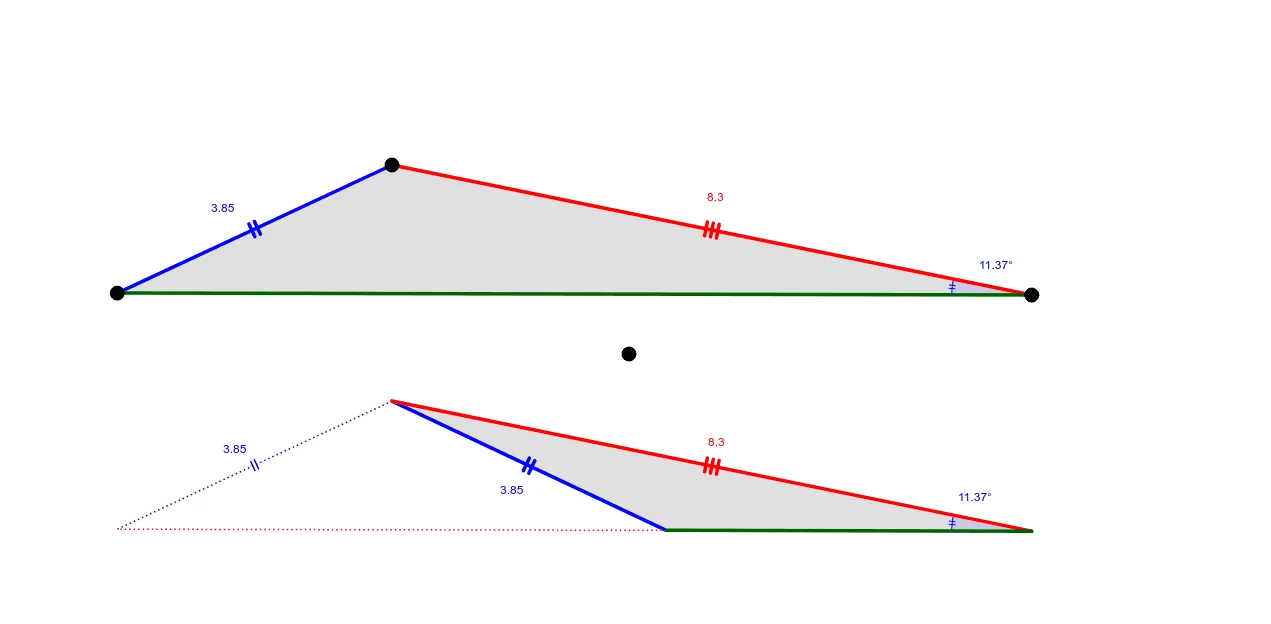
① This example demonstrates whether a triangle is uniquely determined by two sides and a non‑included angle (SSA), showing the ambiguous case and the possible two solutions. ② Core math concepts: triangle congruence criteria, the SSA ambiguous case, relationships between angles and side lengths, and geometric construction verification. ③ Construction highlights: Circle creates the locus of a fixed side length; Point, Segment, Ray, Vector define vertices and vectors; Translate copies elements; Angle measures the given angle; Polygon forms the triangle region. ④ Suitable for high‑school geometry lessons on congruence, teacher demonstrations, and student inquiry.
GeoGebra Commands & Parameters
Circle(B, B_1) → cPoint(c) → APoint(c) → DSegment(B, A) → aSegment(B, D) → bSegment(D, A) → dRay(A, D) → ePoint(e) → E_1Ray(D, E_1) → fPoint(f) → CSegment(B, C) → gSegment(D, C) → hVector((0, 0), (0, -3)) → uTranslate(B, u) → FTranslate(A, u) → ESegment(F, E) → a'Translate(B, u) → A'_1Translate(D, u) → HSegment(A'_1, H) → b'Translate(D, u) → D'_1Translate(A, u) → C'_1Segment(D'_1, C'_1) → d'Translate(B, u) → A'_2Translate(C, u) → GSegment(A'_2, G) → g'Translate(D, u) → H_1Translate(C, u) → F'_1Segment(H_1, F'_1) → h'Segment(E, G) → iSegment(A, C) → jAngle(B, C, A) → αAngle(F, G, H) → βPolygon(A, B, C) → poly1, c_1, a_1, b_1Polygon(F, G, H) → poly2, h_1, f_1, g_1