
Is 'Side-Side' Similarity Enough to Prove Similar Triangles?
Loading the math board and drawing, please wait…
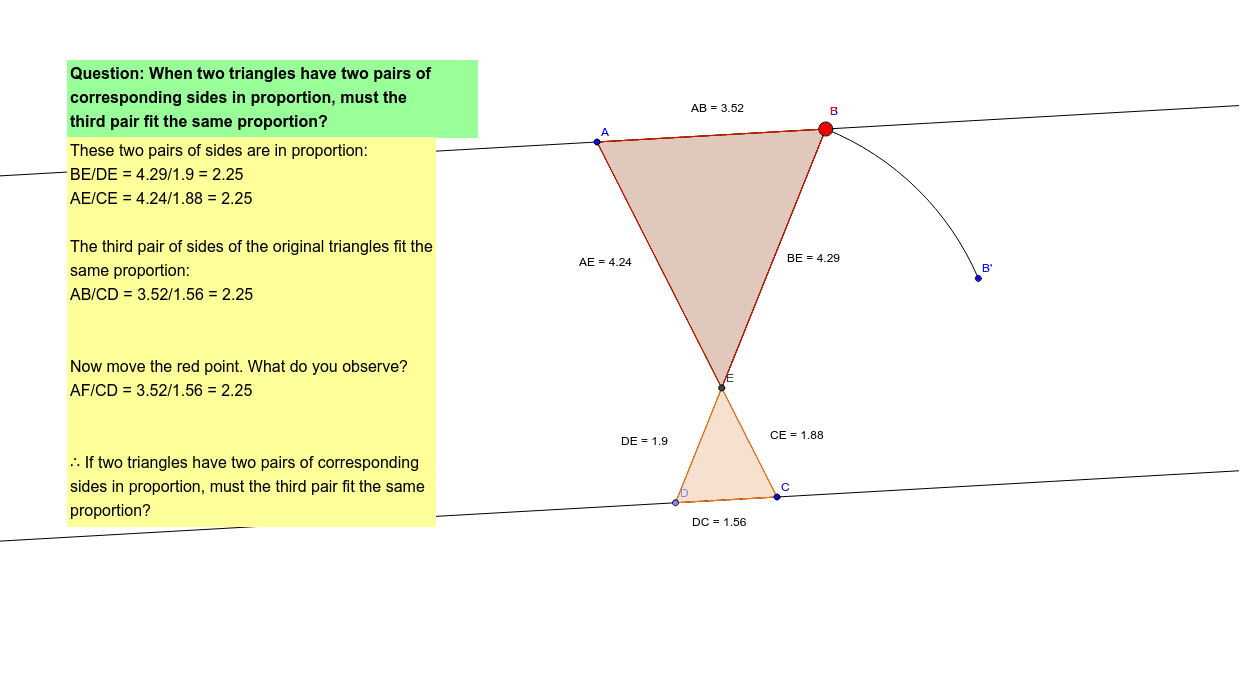
This example allows manipulation of triangle vertices to explore if two pairs of corresponding sides being in proportion are sufficient to prove triangle similarity. It covers core concepts like similarity criteria, proportionality, and geometric transformations. Constructed using commands such as Line, Point, Polygon, Intersect, Distance, Rotate, CircleArc, Segment. Ideal for high school geometry instruction to visually understand similarity criteria.
GeoGebra Commands & Parameters
Line(A, B) → aLine(C, a) → bPoint(b) → DPolygon(A, C, D, B) → poly1, a_1, c, d, b_1Intersect(a_1, d) → EDistance(A, E) → γDistance(B, E) → αDistance(C, E) → δDistance(D, E) → ζPolygon(E, B, A) → poly2, a_2, e, b_2Polygon(E, C, D) → poly3, d_1, e_1, c_1Rotate(B, -45*°, E) → B'CircleArc(E, B', B) → fPoint(f) → FSegment(E, F) → gPolygon(E, F, A) → poly4, a_3, e_2, f_1Distance(A, B) → βDistance(D, C) → εDistance(A, F) → ηDistance(A, B) → distanceAB
AI Drawing Prompt Reference
Draw two triangles and adjust their vertices to explore if corresponding sides being in proportion are sufficient to prove triangle similarity. First, construct two triangles and find the intersection point of one side of the first triangle with one side of the second triangle. Measure and label the lengths of the sides, then rotate one triangle around the intersection point, draw the rotated triangle, and connect the corresponding vertices. Observe the similarity and draw line segments connecting the rotated triangle's vertices to the intersection point, measuring relevant distances to verify the similarity criteria.
The prompt above was compiled from the original drawing commands and is for reference only.