
Investigation of Hemisphere Volume
Loading the math board and drawing, please wait…
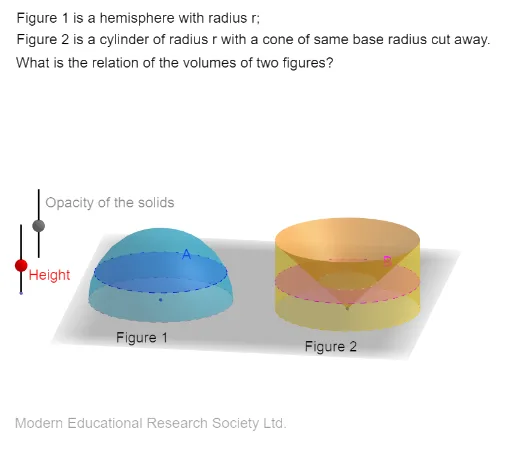
This example demonstrates how to explore the volume of a hemisphere using geometric construction methods. Key mathematical concepts include solid geometry and coordinate geometry. It utilizes commands such as CurveCartesian, Line, Surface, Point, Circle, Cylinder, Cone, Segment, Vector, Angle, Intersect, Ray. Suitable for high school mathematics education and learning.
GeoGebra Commands & Parameters
CurveCartesian(A + (r; θ), θ, 0, π) → dLine(A, A + (1, 0)) → hSurface(d, 180°, h) → aPoint(h) → BCircle(B, r, xOyPlane) → mCylinder(B, C, r) → b, e, g_1, h_1Cone(C, B, r) → i, k, jPoint(xAxis) → DSegment(D, E) → lPoint(l) → FVector(A, G) → uCircle(G, sqrt(r^(2) - z(F)^(2)), u) → cCircle(H, z(F), e) → fCircle(H, r, e) → gSegment(I, J) → nPoint(n) → KCircle(A, r, e) → pPoint(c) → LSegment(A, L) → qSegment(A, G) → sSegment(G, L) → f_1Angle(A, G, L) → αSegment(H, B) → i_1Line(H, f_1) → j_1Intersect(j_1, f, 1) → MSegment(H, M) → k_1Circle(A, r, e) → c_1Ray(B, M) → l_1Point(k) → NSegment(C, N) → m_1Point(c_1) → OSegment(A, O) → n_1Segment(N, N') → p_1Circle(Q, r) → e_1Circle(Q, z(F)) → q_1Circle(Q, z(F)) → r_1Circle(P, r) → s_1Circle(P, f_1) → d_1Segment(P, L') → t_1Segment(P, O') → a_1Segment(Q, M') → b_1Segment(Q, N_2) → f_2Point(m_1) → RSegment(R, R') → g_2
AI Drawing Prompt Reference
Draw a 3D geometric figure exploring hemisphere volume. Start with a horizontal axis and a semicircular arc, then revolve the arc around the axis to create a hemispherical surface. Place a point on the axis to define a base circle, and construct a cylinder and a cone that intersect or touch the hemisphere. Draw a vertical segment with a point on it, through which pass a horizontal circle, and connect the center to a point on the hemisphere to form an angle. Add several auxiliary circles and segments representing cross-sections at different heights, plus rays and segments from the hemisphere's top to the base edge. Finally, include points, segments, and angle marks to illustrate the volume relationships.
The prompt above was compiled from the original drawing commands and is for reference only.