
Investigation for Sum of Interior Angles of Polygons
Loading the math board and drawing, please wait…
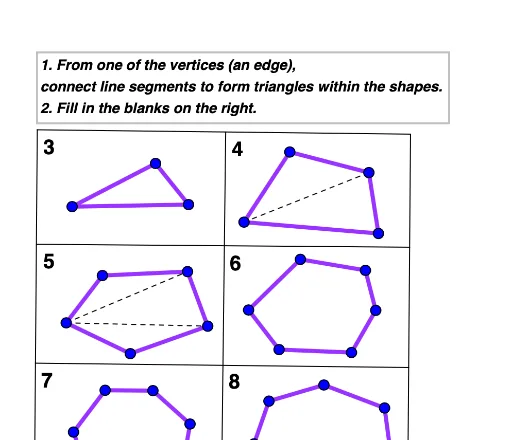
This GeoGebra example dynamically constructs multiple polygons to visually demonstrate how the sum of interior angles changes with the number of sides. The core mathematical concept is the polygon interior angle sum formula (n-2)×180°, and the method of triangulating a polygon to derive this formula. Construction highlights: using the Polygon command to create polygons, Line and Segment commands for auxiliary lines, OrthogonalLine for perpendiculars, and Point/Intersect to define vertices and division points, effectively splitting polygons into triangles. Suitable for middle or high school geometry classes, this interactive investigation encourages students to discover the formula through hands-on exploration and inductive reasoning.
GeoGebra Commands & Parameters
Polygon(A, B, C) → poly1, c, a, bPolygon(D, E, F, G) → poly2, d, e, f, gPolygon(H, I, J, K, L) → poly3, h, i, j, k, lPolygon(M, N, O, P, Q, R) → poly4, m, n, o, p, q, rPolygon(S, T, U, V, W, Z, A_1) → poly5, s, t, u, v, w, z_1, a_1Polygon(B_1, C_1, D_1, E_1, F_1, G_1, H_1, I_1) → poly6, b_1, c_1, d_1, e_1, f_1, g_1, h_1, i_1Line(J_1, K_1) → j_1Line(L_1, M_1) → k_1OrthogonalLine(L_1, k_1) → l_1OrthogonalLine(K_1, j_1) → n_1OrthogonalLine(M_1, k_1) → p_1Point(j_1) → O_1Line(O_1, n_1) → q_1Line(J_1, q_1) → m_1Intersect(j_1, k_1) → N_1Intersect(p_1, m_1) → P_1Intersect(l_1, m_1) → Q_1Intersect(l_1, n_1) → R_1Intersect(p_1, n_1) → S_1Intersect(m_1, p_1) → T_1Intersect(l_1, m_1) → U_1Segment(Q_1, P_1) → r_1Segment(P_1, S_1) → s_1Segment(S_1, R_1) → t_1Segment(R_1, Q_1) → f_2Segment(J_1, K_1) → g_2Segment(L_1, M_1) → h_2Intersect(l_1, f_2) → V_1Intersect(q_1, l_1) → W_1Intersect(p_1, s_1) → Z_1Intersect(q_1, p_1) → A_2Segment(W_1, A_2) → i_2Segment(F, D) → j_2Segment(H, J) → k_2Segment(H, K) → l_2
AI Drawing Prompt Reference
Draw multiple polygons to show how the sum of interior angles changes as the number of sides increases, using auxiliary lines to divide the polygons into triangles, and explain the formula for the sum of interior angles of a polygon (n-2)×180° with the sum of angles in triangles. Start by drawing polygons with different numbers of sides, connect vertices with auxiliary lines to form triangles, and connect division points with line segments, finally showing the relationship between polygons and triangles.
The prompt above was compiled from the original drawing commands and is for reference only.