
Investigating the Interior Angle Sum vs. Number of Sides
Loading the math board and drawing, please wait…
In collections
Some terms & definitions. Angles, angle pairs, angle measure
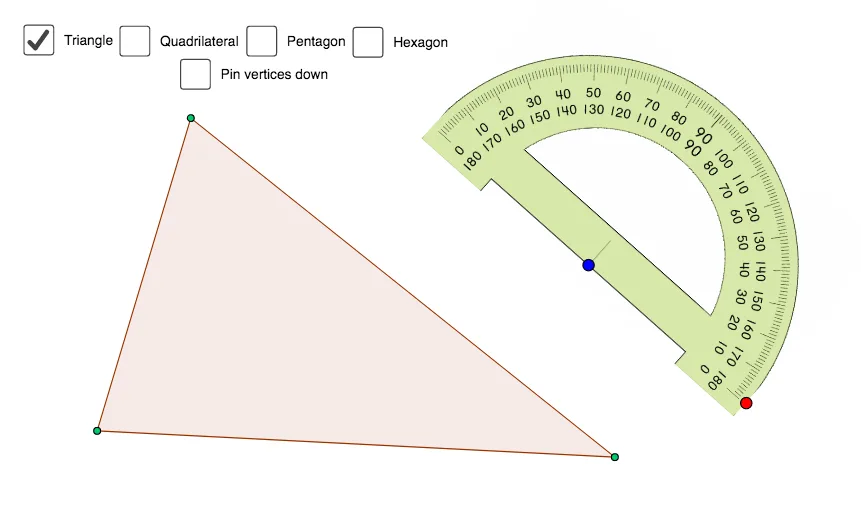
This example demonstrates how to construct regular or general polygons of different side counts in GeoGebra and directly measure their interior angles to observe the relationship between the number of angles n and the total interior angle sum S. It centers on key geometry ideas: the definition of interior angles, the dependence of S on the number of sides, and the well-known formula S=(n-2)·180° as a linear pattern in n. The construction uses Circle and Line together with Intersect to determine points, Rotate to generate polygon vertices by rotational placement, then Point and Polygon to form the polygon itself. Interior angles are created and labeled with Angle, while Segment and a protractor-style measurement tool are used to read angle values. Finally, text objects (e.g., text1–text5) summarize the measured results and guide students to test additional n values (via a new problem prompt). Suitable for middle-school geometry classes, math exploration activities, and anytime students need an interactive way to verify angle-sum reasoning.
GeoGebra Commands & Parameters
Circle(B, a) → cLine(B, xAxis) → bIntersect(c, b, 2) → C_1Rotate(C_1, α, B) → CAngle(C_1, B, C) → βSegment(B, C) → dRotate(C, γ, B) → AAngle(C, B, A) → δSegment(B, A) → eCircle(D, f) → gPoint(g) → ERotate(E, (-ε), D) → E'Angle(E', D, E) → ζRotate(E, 184°, D) → E'_1Angle(E, D, E'_1) → ηCircle(F, protrac2) → hPoint(h) → GRotate(G, (-adjust), F) → G'Angle(G', F, G) → θRotate(G, adjust + 180°, F) → G'_1Angle(G, F, G'_1) → ιPolygon(H, I, J) → poly1, j_1, h_1, i_1Polygon(K, L, M, N) → poly2, k_1, l_1, m_1, n_1Polygon(O, P, Q, R, S) → poly3, o, p, q, r, sPolygon(T, U, V, W, Z, A_1) → poly4, t, u, v, w, z, a_1
AI Drawing Prompt Reference
Draw a polygon graph to demonstrate the relationship between the interior angle sum and the number of sides. Use circles and lines to determine key points, then rotate to generate polygon vertices. Form the polygon using points and polygons, and create and label interior angles. Use line segments and a measurement tool to read angle values. Finally, add text objects to summarize the results. Suitable for middle school geometry classes and math exploration activities.
The prompt above was compiled from the original drawing commands and is for reference only.