
Investigating Quadrilaterals
Loading the math board and drawing, please wait…
In collections
Investigating Quadrilaterals
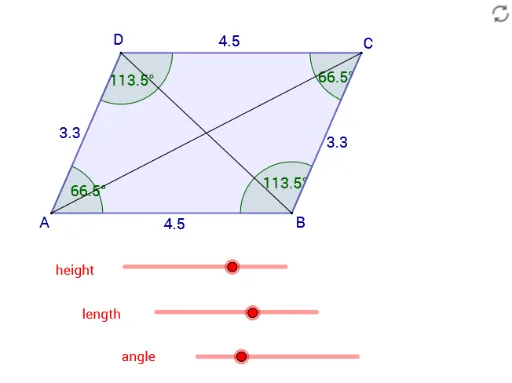
This example demonstrates the geometric properties and relationships of various quadrilaterals (kites, parallelograms, rectangles, squares, trapezoids). It involves core concepts like quadrilateral classification, side-angle relationships, area calculations, equations, and conditional probability. GeoGebra commands and objects such as Line, Point, Segment, Intersect, Angle, Polygon, Corner are used to construct and measure the figures. Suitable for middle school and above mathematics education for geometric exploration and concept deepening.
GeoGebra Commands & Parameters
Line(B, a) → cPoint(a) → ASegment(B, A) → dIntersect(b, a) → DIntersect(c, b) → CSegment(D, A) → eSegment(D, C) → fSegment(B, C) → gAngle(B, A, D) → αAngle(A, D, C) → βAngle(D, C, B) → γAngle(C, B, A) → δPolygon(A, B, C, D) → poly1, a_1, b_1, c_1, d_1Segment(A, C) → hSegment(D, B) → iCorner(5) → E
AI Drawing Prompt Reference
Draw a quadrilateral with four vertices A, B, C, and D. First, draw a line c through points A and B, then draw segments AD and BC, followed by segments AC and BD. Finally, use these four points to form a quadrilateral. Measure the degree of angles α, β, γ, and δ.
The prompt above was compiled from the original drawing commands and is for reference only.