
Investigate Alternate Exterior Angles
Loading the math board and drawing, please wait…
In collections
Congruence (CO) Cluster
Congruence (Vol 2)
CCSS High School: Geometry (Congruence) Volume 2
CCSS High School: Geometry (Congruence) Volume 2
CCSS High School: Geometry (Congruence) Volume 2
Geometry (Congruence) Volume 2
CCSS High School: Geometry (Congruence) Volume 2
CCSS High School: Geometry (Congruence) Volume 2
CCSS High School: Geometry (Congruence) Volume 2
CCSS High School: Geometry (Congruence) Volume 2
CCSS High School: Geometry (Congruence) Volume 2
CCSS High School: Geometry (Congruence) Volume 2
CCSS High School: Geometry (Congruence) Volume 2
Gail LeBlancCCSS High School: Geometry (Congruence) Volume 2
CCSS High School: Geometry (Congruence) Volume 2
Parallel Lines & Related Angles
Parallel Lines & Related Angles
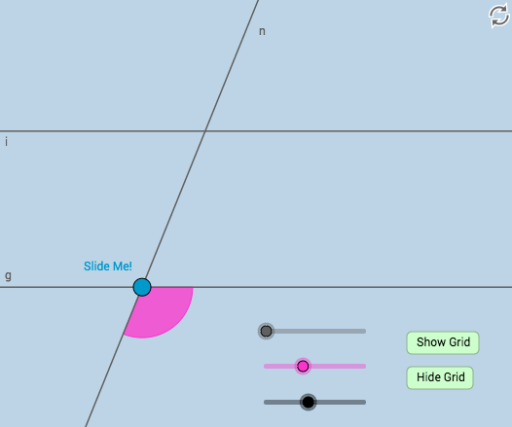
When a transversal intersects two parallel lines, the alternate exterior angles are equal. This example uses GeoGebra to demonstrate the properties of alternate exterior angles. Key mathematical concepts include angle properties and geometric construction. Commands used include Point, Line, Rotate, Angle, Circle, Intersect, Segment, Vector, Ray, CircleArc, CircleSector, Translate. Suitable for middle school and above students learning geometry.
GeoGebra Commands & Parameters
Point(y = 0) → ALine(A, B) → fRotate(B, α, A) → B'Angle(B, A, B') → γLine(A, B') → gRotate(B', β, A) → B''Angle(B', A, B'') → δLine(A, B'') → hCircle(A, a) → cIntersect(c, h, 2) → CLine(C, g) → iCircle(C, A) → dCircle(A, C) → eIntersect(e, h, 2) → JSegment(A, C) → jCircle(A, (0.3 * j)) → kCircle(C, (0.3 * j)) → pIntersect(p, h) → N, OIntersect(k, h) → P, QIntersect(k, g) → T, UIntersect(p, i, 2) → VIntersect(p, i, 1) → WCircle(C, j / 2) → g_1Circle(A, j / 2) → h_1Intersect(g_1, i, 2) → DIntersect(g_1, i, 1) → EIntersect(g_1, h, 2) → HIntersect(g_1, h) → I, ZIntersect(h_1, h) → A_1, B_1Intersect(h_1, g) → E_1, F_1Point(j) → G_1Vector(A, G_1) → uSegment(A, G_1) → lRay(A, A_1) → mRay(C, H) → nVector(A, G_1) → vSegment(G_1, C) → sCircleArc(C, N, O) → rPoint(r) → FRotate(F, (-δ), C) → F'Angle(F', C, F) → εSegment(A, C) → bCircleSector(A, P, U) → d_1Translate(d_1, v) → e_1CircleArc(C, W, V) → f_1Point(f_1) → GRotate(G, (-(π - ε)), C) → G'Angle(G', C, G) → ζCircleSector(C, G', G) → k_1CircleArc(A, P, U) → qSegment(A, C) → t
AI Drawing Prompt Reference
Draw two parallel lines intersected by a transversal to form alternate exterior angles. Use circles and intersection points to mark the angles, demonstrating their equality. Add rotations, auxiliary line segments, arcs, and sectors to emphasize geometric properties.
The prompt above was compiled from the original drawing commands and is for reference only.