
Inverse of an Absolute Value Function and Domain/Range Analysis
Loading the math board and drawing, please wait…
In collections
UCSS Secondary Math III Unit 4A Lesson 1
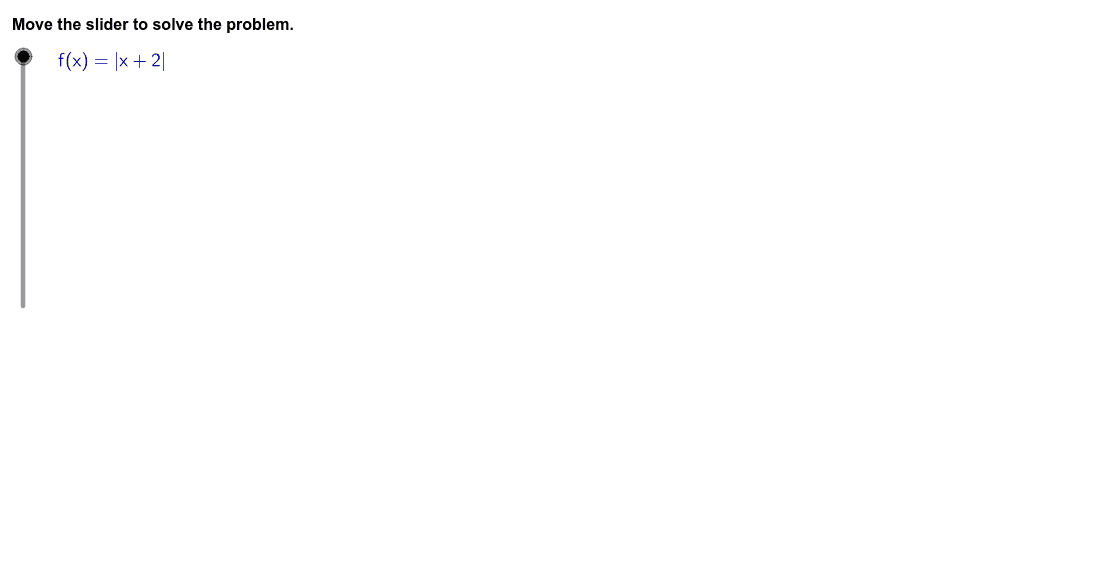
This example demonstrates how to find the inverse of the absolute value function f(x) = |x + 2| and analyze its domain and range. Key math concepts include absolute value functions, inverse functions, domain, and range. GeoGebra commands and objects used are LaTeX for mathematical expressions, If for conditional statements, TableText for creating text tables, stepMax, stepper, steps, counter for step-by-step demonstration, and objects like f, g_1, g_2 for function graphs, mirror for reflection transformation. Suitable for high school students learning function properties and inverse function concepts.
GeoGebra Commands & Parameters
LaTeX(steps) → counterLaTeX((("\textcolor{#000099}{f(x)=" * f) * "}")) → ProblemLaTeX("\text{Write the inverse of the function and simplify it.}") → text4If(a ≟ 1, LaTeX["f(x)"], If[a ≟ -1, LaTeX["-f(x)"], LaTeX[(a * "f(x)")]]) → firstIf(b ≟ 0, "", If[b < 0, LaTeX[("-" * abs(b))], LaTeX[("+" * b)]]) → secondIf(a ≟ 1, LaTeX["f^{-1}(x)"], If[a ≟ -1, LaTeX["-f^{-1}(x)"], LaTeX[(a * "f^{-1}(x)")]]) → firstbLaTeX("\text{Solve for }\textcolor{#006633}{f^{-1}(x)}.") → text6LaTeX("\text{Handle the absolute value by working with two cases.}") → text7LaTeX("\text{Determine the domains and ranges of }\textcolor{#000099}{f(x)}\text{ and }\textcolor{#006633}{f^{-1}(x)}.") → text1LaTeX("\text{State the final results.}") → text9LaTeX("\text{Graph both functions and their inverses together.}") → text14LaTeX("\text{Use the buttons below to return to the original problem or}\cr\text{randomly generate a similar practice problem.}") → text13TableText({{LaTeX[(("\textcolor{#000099}{f(x)=" * f) * "}")], LaTeX["\text{Original function}"]}, {LaTeX[((("\textcolor{#006633}{x=\left|" * first) * second) * "\right|}")], LaTeX["\text{Switch the variables.}"]}, {LaTeX[((("\textcolor{#006633}{x=\left|" * firstb) * second) * "\right|}")], LaTeX["\text{Since this defines the inverse function, change to }\textcolor{#006633}{f^{-1}(x)}."]}}) → text5LaTeX("\text{In order for a function to have an inverse, the function must be one-to-one.}\cr \text{Since absolute value functions are V-shaped, the domain of }\textcolor{#000099}{f(x)}\text{ needs to be restricted.}\cr \text{The range(s) of }\textcolor{#006633}{f^{-1}(x)}\text{ will be the restricted domain(s) of }\textcolor{#000099}{f(x)}.\cr \text{The domain of }\textcolor{#006633}{f^{-1}(x)}\text{ will be the range of }\textcolor{#000099}{f(x)}.") → text2TableText({{LaTeX[""], LaTeX["\textcolor{#000099}{f(x)}"], LaTeX["\textcolor{#006633}{f^{-1}(x)}"]}, {LaTeX["\text{Domain:}"], LaTeX["\text{all real numbers;}"], LaTeX["\textcolor{#006633}{[0,+\infty)}"]}, {LaTeX[""], LaTeX[(("\text{split domain where }\textcolor{#000099}{" * Simplify[(a * x) + b]) * "=0}")], LaTeX["\textcolor{#006633}{}"]}, {LaTeX[""], LaTeX["\text{ to get restricted domains where }"], LaTeX["\textcolor{#006633}{}"]}, {LaTeX[""], LaTeX["\text{ }\textcolor{#000099}{f(x)}\text{ is one-to-one}"], LaTeX["\textcolor{#006633}{}"]}, {LaTeX[""], LaTeX[(((("\textcolor{#000099}{(-\infty," * Simplify[((-b)) / a]) * "]}\text{ and }\textcolor{#000099}{[") * Simplify[((-b)) / a]) * ",+\infty)}")], LaTeX["\textcolor{#006633}{}"]}, {LaTeX["\text{Range:}"], LaTeX["\text{The vertex of the function is at}"], LaTeX[(((("\textcolor{#006633}{(-\infty," * Simplify[((-b)) / a]) * "]}\text{ and }\textcolor{#006633}{[") * Simplify[((-b)) / a]) * ",+\infty)}")]}, {LaTeX[""], LaTeX["\text{ }\textcolor{#000099}{x=0}\text{ and the function opens up.}"], LaTeX[""]}, {LaTeX[""], LaTeX["\textcolor{#000099}{[0,+\infty)}"], LaTeX[""]}}) → text3TableText({{LaTeX[((("\textcolor{#006633}{x=" * firstb) * second) * "}")], LaTeX["\text{Set up two cases.}"], LaTeX[((("\textcolor{#006633}{-x=" * firstb) * second) * "}")]}, {LaTeX[(((("\textcolor{#006633}{" * Simplify[x - b]) * "=") * firstb) * "}")], LaTeX[(("\text{Subtract }\textcolor{#006633}{" * b) * "}\text{ from both sides.}")], LaTeX[(((("\textcolor{#006633}{" * Simplify[(-x) - b]) * "=") * firstb) * "}")]}, {LaTeX[(((("\textcolor{#006633}{\frac{" * Simplify[x - b]) * "}{") * a) * "}=f^{-1}(x)}")], LaTeX[(("\text{Divide both sides by }\textcolor{#006633}{" * a) * "}.")], LaTeX[(((("\textcolor{#006633}{\frac{" * Simplify[(-x) - b]) * "}{") * a) * "}=f^{-1}(x)}")]}, {LaTeX[(("\textcolor{#006633}{f^{-1}(x)=" * g_1) * "}")], LaTeX["\text{Simplify and use the Symmetric Property of Equality.}"], LaTeX[(("\textcolor{#006633}{f^{-1}(x)=" * g_2) * "}")]}}) → text8LaTeX((((((((((((("\text{On the restricted domain }\textcolor{#000099}{[" * Simplify[((-b)) / a]) * ",+\infty)}\text{, the inverse of }\textcolor{#000099}{f(x)=") * f) * "}\text{ is }\textcolor{#006633}{f^{-1}(x)=") * g_1) * "}\text{ where }\textcolor{#006633}{[0,+\infty)}\text{.}\cr \text{On the restricted domain }\textcolor{#000099}{(-\infty,") * Simplify[((-b)) / a]) * "]}\text{, the inverse of }\textcolor{#000099}{f(x)=") * f) * "}\text{ is }\textcolor{#006633}{f^{-1}(x)=") * g_2) * "}\text{ where }\textcolor{#006633}{[0,+\infty)}. ")) → text10LaTeX((("\text{Graph the function on the restricted domain }\cr\textcolor{#000099}{[" * Simplify[((-b)) / a]) * ",+\infty)}\text{ and graph its inverse.}")) → text11LaTeX((("\text{Graph the function on the restricted domain }\cr\textcolor{#000099}{(-\infty," * Simplify[((-b)) / a]) * "]}\text{ and graph its inverse.}")) → text12
AI Drawing Prompt Reference
Draw the graph of the absolute value function f(x) = |x+2| and its inverse, analyzing their domains and ranges. First, plot the V-shaped graph of the absolute value function and determine its domain and range. Then, find the inverse function and plot its graph on two intervals. Finally, draw both the original function and its inverse on the same coordinate system, labeling their domains and ranges.
The prompt above was compiled from the original drawing commands and is for reference only.