
Introduction to Special Angles in Standard Position
Loading the math board and drawing, please wait…
In collections
Similarity & Right Triangle Trigonometry
Similarity, Right Triangles, and Trigonometry (SRT) Cluster
Trigonometric Functions of Angles
Special Right Triangles
Special Right Triangles
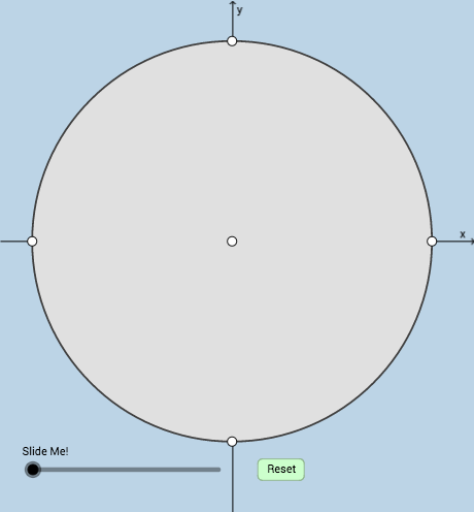
This example demonstrates special angles in standard position, involving angle concepts and transformations. Using commands like Mirror, Intersect, Dilate, Segment, and Polygon, it dynamically illustrates the properties and changes of angles. Suitable for high school math education and learning.
GeoGebra Commands & Parameters
Mirror(G, f) → G'Mirror(F, f) → F'Mirror(E, g) → E'Mirror(F, g) → F'_1Mirror(G, g) → G'_1Mirror(F', g) → F''Mirror(G', g) → G''Mirror(E, f) → E'_1Mirror(E'_1, g) → HIntersect(g, j) → IIntersect(g, i) → JIntersect(g, h) → KDilate(L, If[0 < a ≤ 1, 1 - a, 0], K) → L'Segment(L, L') → kDilate(K, If[1 < a ≤ 2, 2 - a, 0], E) → K'Segment(K, K') → lPolygon(L, K, E) → poly1, e, l_1, k_1Midpoint(L, E) → MDilate(E, If[2 < a ≤ 3, 3 - a, 0], M) → E'_2Segment(E, E'_2) → mDilate(M, If[3 < a ≤ 4, 4 - a, 0], L) → M'Segment(M, M') → nRotate(K, If[4 < a < 5, ((-(a - 4)) * π / 3), ((-π)) / 3], E) → K'_1Rotate(K', If[4 < a < 5, ((-(a - 4)) * π / 3), ((-π)) / 3], E) → K''Segment(K'_1, K'') → l'Rotate(K'_1, If[5 < a < 6, ((-(a - 5)) * π), (-π)], M) → NRotate(K'', If[5 < a < 6, ((-(a - 5)) * π), (-π)], M) → K'''Segment(N, K''') → l''Rotate(L, If[6 < a < 7, ((a - 6) * π / 2), π / 2], L) → L'_1Rotate(K, If[6 < a < 7, ((a - 6) * π / 2), π / 2], L) → K'_2Rotate(E, If[6 < a < 7, ((a - 6) * π / 2), π / 2], L) → E'_3Polygon(L'_1, K'_2, E'_3) → poly1', e'_3, l'_1, k'_2Rotate(K, If[6 < a < 7, ((a - 6) * π / 2), π / 2], L) → K'_3Rotate(K', If[6 < a < 7, ((a - 6) * π / 2), π / 2], L) → K''_1Segment(K'_3, K''_1) → l'_2Rotate(L, If[6 < a < 7, ((a - 6) * π / 2), π / 2], L) → L'_2Rotate(L', If[6 < a < 7, ((a - 6) * π / 2), π / 2], L) → L''Segment(L'_2, L'') → k'Rotate(K'_1, If[6 < a < 7, ((a - 6) * π / 2), π / 2], L) → ORotate(K'', If[6 < a < 7, ((a - 6) * π / 2), π / 2], L) → K'''_1Segment(O, K'''_1) → l''_1Rotate(N, If[6 < a < 7, ((a - 6) * π / 2), π / 2], L) → N'Rotate(K''', If[6 < a < 7, ((a - 6) * π / 2), π / 2], L) → PSegment(N', P) → l'''Rotate(L'_1, If[7 < a < 8, ((a - 7) * π / 2), π / 2], L) → QRotate(K'_2, If[7 < a < 8, ((a - 7) * π / 2), π / 2], L) → RRotate(E'_3, If[7 < a < 8, ((a - 7) * π / 2), π / 2], L) → SPolygon(Q, R, S) → poly1'', s, q, rRotate(K'_3, If[7 < a < 8, ((a - 7) * π / 2), π / 2], L) → TRotate(K''_1, If[7 < a < 8, ((a - 7) * π / 2), π / 2], L) → USegment(T, U) → pRotate(L'_2, If[7 < a < 8, ((a - 7) * π / 2), π / 2], L) → VRotate(L'', If[7 < a < 8, ((a - 7) * π / 2), π / 2], L) → L'''Segment(V, L''') → k''Rotate(O, If[7 < a < 8, ((a - 7) * π / 2), π / 2], L) → O'Rotate(K'''_1, If[7 < a < 8, ((a - 7) * π / 2), π / 2], L) → WSegment(O', W) → tRotate(N', If[7 < a < 8, ((a - 7) * π / 2), π / 2], L) → N''Rotate(P, If[7 < a < 8, ((a - 7) * π / 2), π / 2], L) → P'Segment(N'', P') → bRotate(Q, If[8 < a < 9, ((a - 8) * π / 2), π / 2], L) → Q'Rotate(R, If[8 < a < 9, ((a - 8) * π / 2), π / 2], L) → R'Rotate(S, If[8 < a < 9, ((a - 8) * π / 2), π / 2], L) → S'Polygon(Q', R', S') → poly1''', s', q', r'Rotate(V, If[8 < a < 9, ((a - 8) * π / 2), π / 2], L) → V'Rotate(L''', If[8 < a < 9, ((a - 8) * π / 2), π / 2], L) → ZSegment(V', Z) → k'''Rotate(N'', If[8 < a < 9, ((a - 8) * π / 2), π / 2], L) → N'''Rotate(P', If[8 < a < 9, ((a - 8) * π / 2), π / 2], L) → P''Segment(N''', P'') → b'Rotate(O', If[8 < a < 9, ((a - 8) * π / 2), π / 2], L) → O''Rotate(W, If[8 < a < 9, ((a - 8) * π / 2), π / 2], L) → W'Segment(O'', W') → t'Rotate(T, If[8 < a < 9, ((a - 8) * π / 2), π / 2], L) → T'Rotate(U, If[8 < a < 9, ((a - 8) * π / 2), π / 2], L) → U'Segment(T', U') → p'Intersect(d, f) → A_1Dilate(A_1, If[9 < a ≤ 10, 10 - a, 0], G) → B_1Segment(A_1, B_1) → f_1Rotate(K'_3, If[10 < a < 11, ((a - 10) * π), π], A_1) → C_1Rotate(K''_1, If[10 < a < 11, ((a - 10) * π), π], A_1) → D_1Segment(C_1, D_1) → g_1Rotate(K'_1, If[11 < a < 12, ((a - 11) * π / 6), π / 6], L) → E_1Rotate(K'', If[11 < a < 12, ((a - 11) * π / 6), π / 6], L) → K'''_2Segment(E_1, K'''_2) → l''_2Rotate(M, If[11 < a < 12, ((a - 11) * π / 6), π / 6], L) → M'_1Rotate(N, If[11 < a < 12, ((a - 11) * π / 6), π / 6], L) → N'_1Rotate(K''', If[11 < a < 12, ((a - 11) * π / 6), π / 6], L) → F_1Segment(N'_1, F_1) → l'''_1Rotate(A_1, π / 2) → G_1Rotate(G_1, π / 2) → H_1Dilate(G_1, If[9 < a ≤ 10, 10 - a, 0], E'_1) → I_1Dilate(H_1, If[9 < a ≤ 10, 10 - a, 0], G'') → J_1Dilate(K, If[9 < a ≤ 10, 10 - a, 0], E') → K'_4Segment(G_1, I_1) → h_1Segment(H_1, J_1) → i_1Segment(K, K'_4) → j_1Rotate(C_1, π / 2, L) → K_1Rotate(D_1, π / 2, L) → L_1Segment(K_1, L_1) → m_1Rotate(C_1, π, L) → M_1Rotate(D_1, π, L) → N_1Segment(M_1, N_1) → n_1Rotate(C_1, (3 * π / 2), L) → O_1Rotate(D_1, (3 * π / 2), L) → P_1Segment(O_1, P_1) → p_1Polygon(L, G, A_1) → poly2, a_1, l_2, g_2Polygon(L, E'_1, G_1) → poly3, g_3, l_3, e'_1Polygon(L, G'', H_1) → poly4, h_2, l_4, g''Polygon(L, K, E') → poly5, e', l_5, k_2Rotate(M'_1, π, L) → Q_1Rotate(M'_1, π / 2, L) → R_1Rotate(M'_1, (3 * π / 2), L) → S_1Rotate(E_1, π / 2, L) → T_1Rotate(K'''_2, π / 2, L) → U_1Segment(T_1, U_1) → q_1Rotate(E_1, π, L) → V_1Rotate(K'''_2, π, L) → W_1Segment(V_1, W_1) → r_1Rotate(E_1, (3 * π / 2), L) → Z_1Rotate(K'''_2, (3 * π / 2), L) → A_2Segment(Z_1, A_2) → s_1Rotate(N'_1, π / 2, L) → B_2Rotate(F_1, π / 2, L) → C_2Segment(B_2, C_2) → t_1Rotate(N'_1, π, L) → D_2Rotate(F_1, π, L) → E_2Segment(D_2, E_2) → b_1Rotate(N'_1, (3 * π / 2), L) → F_2Rotate(F_1, (3 * π / 2), L) → G_2Segment(F_2, G_2) → c_1Circle(L, (0, 0.5)) → d_1Intersect(d_1, x = 0) → H_2, I_2Line(G, L) → e_1Intersect(d_1, e_1) → J_2, K_2CircleSector(L, J_2, H_2) → c_2Rotate(c_2, If[13.5 < a ≤ 14.5, ((-(a - 13.5)) * π / 6), ((-π)) / 6], L) → d_2Rotate(d_2, If[15.5 < a ≤ 16.5, ((-(a - 15.5)) * π / 6), ((-π)) / 6], L) → e_2Segment(L', A) → f_2Segment(L'', B) → i_2Segment(L''', C) → j_2Segment(Z, D) → m_2
AI Drawing Prompt Reference
Draw a standard-position angle and demonstrate special angles through reflections, rotations, and dilations. First, reflect several points, then form new segments by intersecting lines. Next, scale and connect these segments to create polygons. Finally, rotate and reflect these polygons to dynamically show the changes and properties of angles.
The prompt above was compiled from the original drawing commands and is for reference only.