
Introduction to Differential Calculus: Tangents, Slopes, and Geometric Insight
Loading the math board and drawing, please wait…
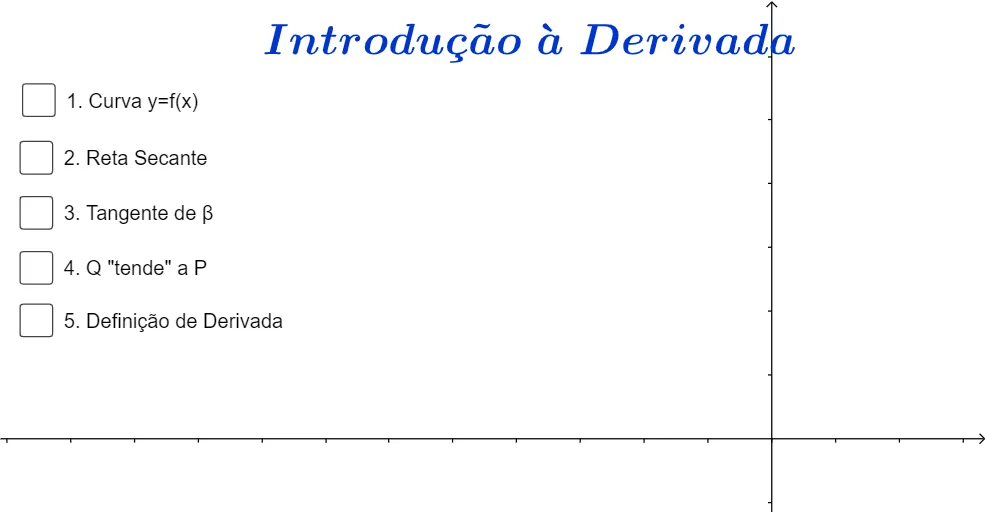
① This interactive GeoGebra example demonstrates the fundamental concepts of differential calculus by visualizing the tangent line, normal line, and related geometric elements at a point on a function's graph, helping learners intuitively grasp the derivative as the slope of the tangent. ② Core mathematical concepts include differential calculus, derivatives, tangent and normal lines, slopes, angles, intersections, and segments, with additional references to pyramids, random variables, ratios, exponents, and sine functions, but the main focus is on introductory calculus. ③ Construction details: Based on the summary, the example uses GeoGebra commands such as Line, OrthogonalLine, Intersect, Segment, Angle, Tangent, and Polygon, and defines multiple points (e.g., P, Q, X, Y), a function f, auxiliary lines (g, h, i, j, k, etc.), and text objects (texto1 through texto9), enabling an interactive exploration of tangent lines and their relationship to the function. ④ Suitable for senior high school or early university students beginning calculus, this example serves as a classroom demonstration or self-study tool to bridge geometric intuition and the derivative concept, and can help teachers explain tangent slopes and limit ideas.
GeoGebra Commands & Parameters
Line(P, Q) → gOrthogonalLine(P, xAxis) → hOrthogonalLine(Q, xAxis) → iOrthogonalLine(P, yAxis) → jOrthogonalLine(Q, yAxis) → kIntersect(j, yAxis) → Y_0Segment(P, Y_0) → lIntersect(h, xAxis) → X_0Segment(P, X_0) → mIntersect(i, xAxis) → XSegment(Q, X) → nIntersect(k, yAxis) → YSegment(Q, Y) → pIntersect(g, xAxis) → AAngle(X_0, A, P) → βTangent(P, f) → qIntersect(q, xAxis) → BAngle(X_0, B, P) → αLine(P, xAxis) → rIntersect(n, r) → Q'Segment(P, Q') → sPolygon(P, Q', Q) → t1, q_1, p_1, q'Angle(Q', P, Q) → γ
AI Drawing Prompt Reference
Draw a function graph and mark a point on it. From this point, draw a tangent line and a normal line, showing the angles between the tangent and the x-axis, and the normal and the x-axis. Also, draw horizontal and vertical lines through the point, and show their intersections with the coordinate axes. Connect the intersection of the tangent with the x-axis to the origin, and the intersection of the normal with the x-axis to the origin, forming two line segments. Use different colors for the line segments and angles, and label the angles.
The prompt above was compiled from the original drawing commands and is for reference only.