
Intro to Special Angles in Standard Position: Dynamic Templates
Loading the math board and drawing, please wait…
In collections
Similarity & Right Triangle Trigonometry
Similarity, Right Triangles, and Trigonometry (SRT) Cluster
Trigonometric Functions of Angles
Special Right Triangles
Special Right Triangles
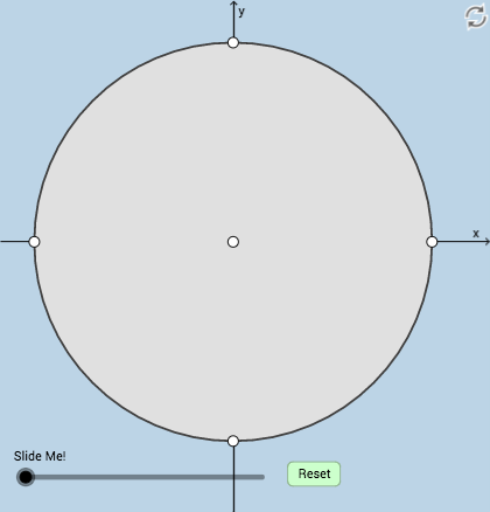
This example demonstrates the dynamic construction of special angles in standard position (e.g., 30°, 45°, 60°) using GeoGebra templates. It involves core math concepts like angles, trigonometry, and geometric transformations. Key GeoGebra commands and objects used include Mirror, Intersect, Dilate, Segment, Polygon, Midpoint, Rotate, Circle, Line, CircleSector, Vector, and Translate. Suitable for high school mathematics teaching or student exploration of geometric transformations and trigonometric relationships.
GeoGebra Commands & Parameters
Mirror(G, f) → G'Mirror(F, f) → F'Mirror(E, g) → E'Mirror(F, g) → F'_1Mirror(G, g) → G'_1Mirror(F', g) → F''Mirror(G', g) → G''Mirror(E, f) → E'_1Mirror(E'_1, g) → HIntersect(g, j) → IIntersect(g, i) → JIntersect(g, h) → KDilate(L, If[0 < a ≤ 1, 1 - a, 0], K) → L'Segment(L, L') → kDilate(K, If[1 < a ≤ 2, 2 - a, 0], E) → K'Segment(K, K') → lPolygon(L, K, E) → poly1, e, l_1, k_1Midpoint(L, E) → MDilate(E, If[2 < a ≤ 3, 3 - a, 0], M) → E'_2Segment(E, E'_2) → mDilate(M, If[3 < a ≤ 4, 4 - a, 0], L) → M'Segment(M, M') → nRotate(K, If[4 < a < 5, ((-(a - 4)) * π / 3), ((-π)) / 3], E) → K'_1Rotate(K', If[4 < a < 5, ((-(a - 4)) * π / 3), ((-π)) / 3], E) → K''Segment(K'_1, K'') → l'Rotate(K'_1, If[5 < a < 6, ((-(a - 5)) * π), (-π)], M) → NRotate(K'', If[5 < a < 6, ((-(a - 5)) * π), (-π)], M) → K'''Segment(N, K''') → l''Rotate(L, If[6 < a < 7, ((a - 6) * π / 2), π / 2], L) → L'_1Rotate(K, If[6 < a < 7, ((a - 6) * π / 2), π / 2], L) → K'_2Rotate(E, If[6 < a < 7, ((a - 6) * π / 2), π / 2], L) → E'_3Polygon(L'_1, K'_2, E'_3) → poly1', e'_3, l'_1, k'_2Rotate(K, If[6 < a < 7, ((a - 6) * π / 2), π / 2], L) → K'_3Rotate(K', If[6 < a < 7, ((a - 6) * π / 2), π / 2], L) → K''_1Segment(K'_3, K''_1) → l'_2Rotate(L, If[6 < a < 7, ((a - 6) * π / 2), π / 2], L) → L'_2Rotate(L', If[6 < a < 7, ((a - 6) * π / 2), π / 2], L) → L''Segment(L'_2, L'') → k'Rotate(K'_1, If[6 < a < 7, ((a - 6) * π / 2), π / 2], L) → ORotate(K'', If[6 < a < 7, ((a - 6) * π / 2), π / 2], L) → K'''_1Segment(O, K'''_1) → l''_1Rotate(N, If[6 < a < 7, ((a - 6) * π / 2), π / 2], L) → N'Rotate(K''', If[6 < a < 7, ((a - 6) * π / 2), π / 2], L) → PSegment(N', P) → l'''Rotate(L'_1, If[7 < a < 8, ((a - 7) * π / 2), π / 2], L) → QRotate(K'_2, If[7 < a < 8, ((a - 7) * π / 2), π / 2], L) → RRotate(E'_3, If[7 < a < 8, ((a - 7) * π / 2), π / 2], L) → SPolygon(Q, R, S) → poly1'', s, q, rRotate(K'_3, If[7 < a < 8, ((a - 7) * π / 2), π / 2], L) → TRotate(K''_1, If[7 < a < 8, ((a - 7) * π / 2), π / 2], L) → USegment(T, U) → pRotate(L'_2, If[7 < a < 8, ((a - 7) * π / 2), π / 2], L) → VRotate(L'', If[7 < a < 8, ((a - 7) * π / 2), π / 2], L) → L'''Segment(V, L''') → k''Rotate(O, If[7 < a < 8, ((a - 7) * π / 2), π / 2], L) → O'Rotate(K'''_1, If[7 < a < 8, ((a - 7) * π / 2), π / 2], L) → WSegment(O', W) → tRotate(N', If[7 < a < 8, ((a - 7) * π / 2), π / 2], L) → N''Rotate(P, If[7 < a < 8, ((a - 7) * π / 2), π / 2], L) → P'Segment(N'', P') → bRotate(Q, If[8 < a < 9, ((a - 8) * π / 2), π / 2], L) → Q'Rotate(R, If[8 < a < 9, ((a - 8) * π / 2), π / 2], L) → R'Rotate(S, If[8 < a < 9, ((a - 8) * π / 2), π / 2], L) → S'Polygon(Q', R', S') → poly1''', s', q', r'Rotate(V, If[8 < a < 9, ((a - 8) * π / 2), π / 2], L) → V'Rotate(L''', If[8 < a < 9, ((a - 8) * π / 2), π / 2], L) → ZSegment(V', Z) → k'''Rotate(N'', If[8 < a < 9, ((a - 8) * π / 2), π / 2], L) → N'''Rotate(P', If[8 < a < 9, ((a - 8) * π / 2), π / 2], L) → P''Segment(N''', P'') → b'Rotate(O', If[8 < a < 9, ((a - 8) * π / 2), π / 2], L) → O''Rotate(W, If[8 < a < 9, ((a - 8) * π / 2), π / 2], L) → W'Segment(O'', W') → t'Rotate(T, If[8 < a < 9, ((a - 8) * π / 2), π / 2], L) → T'Rotate(U, If[8 < a < 9, ((a - 8) * π / 2), π / 2], L) → U'Segment(T', U') → p'Intersect(d, f) → A_1Dilate(A_1, If[9 < a ≤ 10, 10 - a, 0], G) → B_1Segment(A_1, B_1) → f_1Rotate(K'_3, If[10 < a < 11, ((a - 10) * π), π], A_1) → C_1Rotate(K''_1, If[10 < a < 11, ((a - 10) * π), π], A_1) → D_1Segment(C_1, D_1) → g_1Rotate(K'_1, If[11 < a < 12, ((a - 11) * π / 6), π / 6], L) → E_1Rotate(K'', If[11 < a < 12, ((a - 11) * π / 6), π / 6], L) → K'''_2Segment(E_1, K'''_2) → l''_2Rotate(M, If[11 < a < 12, ((a - 11) * π / 6), π / 6], L) → M'_1Rotate(N, If[11 < a < 12, ((a - 11) * π / 6), π / 6], L) → N'_1Rotate(K''', If[11 < a < 12, ((a - 11) * π / 6), π / 6], L) → F_1Segment(N'_1, F_1) → l'''_1Rotate(A_1, π / 2) → G_1Rotate(G_1, π / 2) → H_1Dilate(G_1, If[9 < a ≤ 10, 10 - a, 0], E'_1) → I_1Dilate(H_1, If[9 < a ≤ 10, 10 - a, 0], G'') → J_1Dilate(K, If[9 < a ≤ 10, 10 - a, 0], E') → K'_4Segment(G_1, I_1) → h_1Segment(H_1, J_1) → i_1Segment(K, K'_4) → j_1Rotate(C_1, π / 2, L) → K_1Rotate(D_1, π / 2, L) → L_1Segment(K_1, L_1) → m_1Rotate(C_1, π, L) → M_1Rotate(D_1, π, L) → N_1Segment(M_1, N_1) → n_1Rotate(C_1, (3 * π / 2), L) → O_1Rotate(D_1, (3 * π / 2), L) → P_1Segment(O_1, P_1) → p_1Polygon(L, G, A_1) → poly2, a_1, l_2, g_2Polygon(L, E'_1, G_1) → poly3, g_3, l_3, e'_1Polygon(L, G'', H_1) → poly4, h_2, l_4, g''Polygon(L, K, E') → poly5, e', l_5, k_2Rotate(M'_1, π, L) → Q_1Rotate(M'_1, π / 2, L) → R_1Rotate(M'_1, (3 * π / 2), L) → S_1Rotate(E_1, π / 2, L) → T_1Rotate(K'''_2, π / 2, L) → U_1Segment(T_1, U_1) → q_1Rotate(E_1, π, L) → V_1Rotate(K'''_2, π, L) → W_1Segment(V_1, W_1) → r_1Rotate(E_1, (3 * π / 2), L) → Z_1Rotate(K'''_2, (3 * π / 2), L) → A_2Segment(Z_1, A_2) → s_1Rotate(N'_1, π / 2, L) → B_2Rotate(F_1, π / 2, L) → C_2Segment(B_2, C_2) → t_1Rotate(N'_1, π, L) → D_2Rotate(F_1, π, L) → E_2Segment(D_2, E_2) → b_1Rotate(N'_1, (3 * π / 2), L) → F_2Rotate(F_1, (3 * π / 2), L) → G_2Segment(F_2, G_2) → c_1Circle(L, (0, 0.5)) → d_1Intersect(d_1, x = 0) → H_2, I_2Line(G, L) → e_1Intersect(d_1, e_1) → J_2, K_2CircleSector(L, J_2, H_2) → c_2Rotate(c_2, If[13.5 < a ≤ 14.5, ((-(a - 13.5)) * π / 6), ((-π)) / 6], L) → d_2Rotate(d_2, If[15.5 < a ≤ 16.5, ((-(a - 15.5)) * π / 6), ((-π)) / 6], L) → e_2Segment(L', A) → f_2Segment(L'', B) → i_2Segment(L''', C) → j_2Segment(Z, D) → m_2Dilate(A_1, If[17 < a ≤ 18, 18 - a, 0], L) → L_2Vector(A_1, L_2) → uTranslate(C_1, u) → M_2Translate(D_1, u) → N_2Segment(M_2, N_2) → n_2Mirror(u, A_1) → u'Translate(K'_3, u) → O_2Translate(M_1, u') → P_2Translate(N_1, u') → Q_2Segment(P_2, Q_2) → p_2Dilate(A_1, If[18 < a ≤ 19, 19 - a, 0], G) → R_2Vector(A_1, R_2) → vMirror(R_2, L) → S_2Mirror(A_1, L) → T_2Vector(T_2, S_2) → wTranslate(L'_2, v) → U_2Translate(L'', v) → L'''_1Segment(U_2, L'''_1) → k''_1Translate(T', u') → T''Translate(U', u') → U''Segment(T'', U'') → p''Translate(K'_3, u) → V_2Translate(K''_1, u) → W_2Segment(V_2, W_2) → q_2Translate(L'_2, w) → Z_2Translate(L'', w) → L'''_2Segment(Z_2, L'''_2) → k''_2Translate(V', w) → V''Translate(Z, w) → Z'Segment(V'', Z') → r_2Translate(V', v) → V''_1Translate(Z, v) → Z'_1Segment(V''_1, Z'_1) → s_2Intersect(t_2, y = 0) → A_3Intersect(a_2, y = 0) → B_3Polygon(L, B_3, G) → poly6, g_4, l_6, b_3Polygon(L, G', A_3) → poly7, a_3, l_7, g'Polygon(L, A_3, G'') → poly8, g''_1, l_8, a_4Polygon(L, G'_1, B_3) → poly9, b_2, l_9, g'_1
AI Drawing Prompt Reference
Draw special angles in standard position, such as 30°, 45°, and 60°. Start by drawing angle lines and mirroring them, then generate multiple angle segments through rotation and scaling, and finally form multiple polygons. Pay attention to the relationships between angle segments and the construction order of polygons.
The prompt above was compiled from the original drawing commands and is for reference only.