
Intersection of Two Cylinders by Steve Phelps
Loading the math board and drawing, please wait…
In collections
intersection: surface-surface, curve-curve
intersection: surface-surface, curve-curve
intersection: surface-surface, curve-curve
intersection: surface-surface, curve-curve
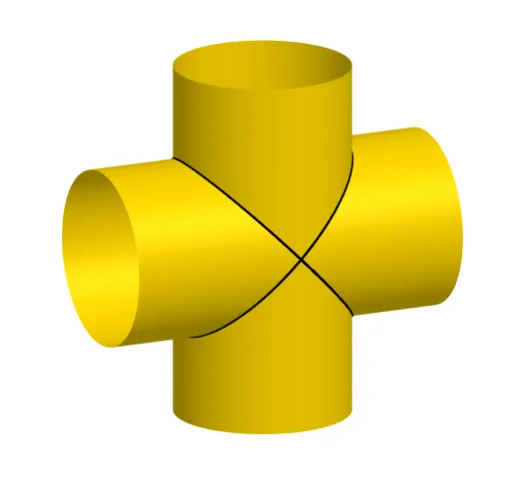
This example demonstrates the intersection of two cylinders. Key mathematical concepts include the intersection in solid geometry. Using GeoGebra commands such as Cylinder, CurveCartesian, and Surface, the intersection of two cylinders can be constructed. Suitable for high school mathematics education or students learning solid geometry.
GeoGebra Commands & Parameters
Cylinder((0, 0, -4), (0, 0, 4), 2) → e, f, g, hCylinder((0, -4, 0), (0, 4, 0), 2) → a, a_2, a_3, a_4CurveCartesian((2 * cos(t)), (2 * sin(t)), (2 * sin(t)), t, 0, π) → bCurveCartesian((2 * cos(t)), (-2 * sin(t)), (2 * sin(t)), t, 0, π) → cCurveCartesian((2 * cos(t)), (-2 * sin(t)), (-2 * sin(t)), t, 0, π) → dCurveCartesian((2 * cos(t)), (2 * sin(t)), (-2 * sin(t)), t, 0, π) → iSurface((u * x(b(t))) + ((1 - u) * x(c(t))), (u * y(b(t))) + ((1 - u) * y(c(t))), (u * z(b(t))) + ((1 - u) * z(c(t))), t, 0, π, u, 0, 1) → jSurface((u * x(d(t))) + ((1 - u) * x(c(t))), (u * y(d(t))) + ((1 - u) * y(c(t))), (u * z(d(t))) + ((1 - u) * z(c(t))), t, 0, π, u, 0, 1) → kSurface((u * x(d(t))) + ((1 - u) * x(i(t))), (u * y(d(t))) + ((1 - u) * y(i(t))), (u * z(d(t))) + ((1 - u) * z(i(t))), t, 0, π, u, 0, 1) → lSurface((u * x(b(t))) + ((1 - u) * x(i(t))), (u * y(b(t))) + ((1 - u) * y(i(t))), (u * z(b(t))) + ((1 - u) * z(i(t))), t, 0, π, u, 0, 1) → m
AI Drawing Prompt Reference
Draw two intersecting cylinders, one along the z-axis with radius 2 and height 8, and the other along the y-axis with radius 2 and height 8. Then, draw four circular curves, one in the positive and negative x-directions and one in the positive and negative y-directions, each with radius 2. Finally, use these curves as boundaries to draw four surfaces, showing the intersection lines of the two cylinders.
The prompt above was compiled from the original drawing commands and is for reference only.