
Intersection of Two Cylinders by Andreas Lindner
Loading the math board and drawing, please wait…
In collections
intersection: surface-surface, curve-curve
intersection: surface-surface, curve-curve
intersection: surface-surface, curve-curve
intersection: surface-surface, curve-curve
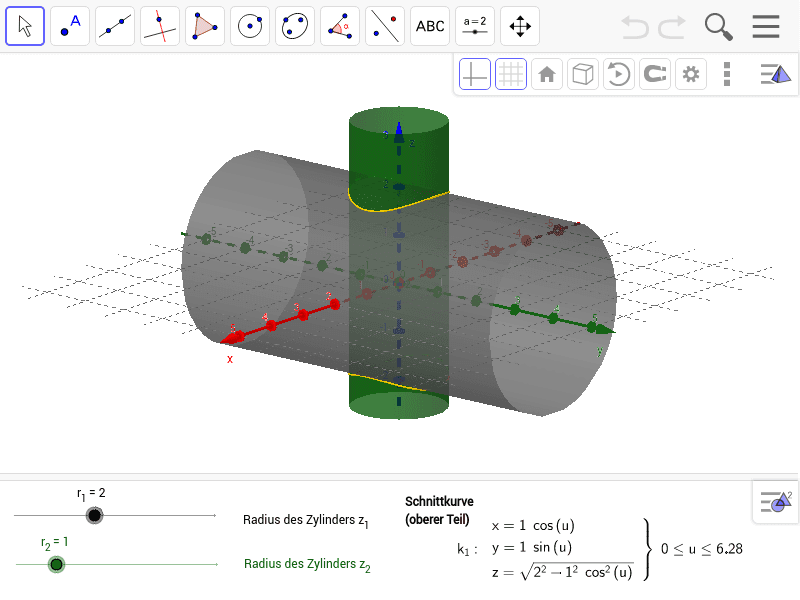
This example demonstrates the visualization of the intersection curve formed when two cylinders intersect in 3D space. It highlights the core mathematical concepts of solid geometry, parametric curves, and the hyperbolic nature of the intersection line. The construction uses GeoGebra's Surface command to create the two cylindrical surfaces, CurveCartesian to define the parametric intersection curve, and LaTeX annotations to label key parameters such as radii r_1, r_2 and heights z_1, z_2. Suitable for high school or early college students, this example serves as an intuitive introduction to spatial curve intersections and parametric surface plotting, useful in mathematics labs or as a teaching aid for 3D geometry.
GeoGebra Commands & Parameters
Surface((r_2 * cos(u)), (r_2 * sin(u)), w, u, 0, 6.283185307179586, w, -4, 4) → z_2CurveCartesian((r_2 * cos(u)), (r_2 * sin(u)), sqrt(r_1^(2) - (r_2^(2) * cos(u)^(2))), u, 0, 6.28319) → k_1LaTeX(k_1, true, true) → Text3Surface((r_1 * cos(u)), w, (r_1 * sin(u)), u, 0, 6.283185307179586, w, -4, 4) → z_1CurveCartesian((r_2 * cos(u)), (r_2 * sin(u)), (-sqrt(r_1^(2) - (r_2^(2) * cos(u)^(2)))), u, 0, 6.28319) → k_2
AI Drawing Prompt Reference
Draw the intersection curve of two cylinders, one with radius r2 and height z2, and the other with radius r1 and height z1. First, draw a cylinder with radius r2 and height ranging from -4 to 4. Then, draw two cylinders with radius r1 and height ranging from -4 to 4, where one cylinder's intersection curve is sqrt(r1^2 - (r2^2 * cos(u)^2)) and the other is -sqrt(r1^2 - (r2^2 * cos(u)^2)), with u ranging from 0 to 2π.
The prompt above was compiled from the original drawing commands and is for reference only.